Globetrotting black rat genes reveal spread of humans and diseases
February 1st, 2008 Globetrotting black rat genes reveal spread of humans and diseases

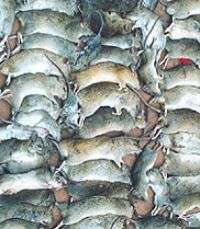
Black rats collected in a single night in a small village in northern Laos. Credit: Angela Frost, University of Queensland, Australia

DNA of the common Black Rat (Rattus rattus) has shed light on the ancient spread of rats, people and diseases around the globe.

Studying the mitochondrial DNA of 165 Black Rat specimens from 32 countries around the world, an international team of scientists has identified six distinct lineages in the Black Rat’s family tree, each originating from a different part of Asia.

“Black Rats are carriers of many different human diseases, including plague, typhus and leptospirosis,” says CSIRO mammal expert Dr Ken Aplin, lead author of the study.

“It has been unclear why certain rodent-borne diseases are more common in some places than others, but our work raises the possibility that the different lineages of Black Rats each carry a different set of diseases, which is something medical science now needs to consider.

“We need to know more about what types of Black Rats are moving around the world and what disease risks each of them might pose.”

The six different lineages originated in India, East Asia, the Himalayas, Thailand, the Mekong Delta, and Indonesia.

The Indian lineage spread to the Middle-East around 20,000 years ago, then later to Europe. It reached Africa, the Americas and Australia during the Age of Exploration.

The East Asian lineage moved from Taiwan to Japan, the Philippines, and Indonesia, arriving in Micronesia only 3,500 years ago.

The other four lineages have not become so widespread but they could be set to expand their ranges in the future.

“Our findings also show a good match between the historic spread of each lineage and ancient routes of human migration and trade, but there are a few surprises that raise new questions about human prehistory,” Dr Aplin says.

“The genetic evidence points strongly to there being more than one species of black rat, but more work is needed before we can say exactly how many species there are.”

The Black Rat is one of the most common of the world’s 56 Rattus species, and is also known as the house, roof or ship rat. It is found throughout Africa, Asia, Australia, Europe and the Americas.

Dr Aplin will present the results of his team’s research at the Archaeological Science Conference in Canberra, Australia on Monday.

Source: CSIRO Australia


print this article email this article download pdf blog this article bookmark this article     Digg this Stumble it share on Facebook share on Reddit add to delicious save to Yahoo! bookmarks
5/5 after 1 votes


February 1st, 2008 all stories
Biology /

Comments: 0
Rank: 5/5 after 1 votes

  • Stumble this up

  • Digg this

  • Share it:
  • share on Facebook
  • share on MySpace
  • share on Slashdot
  • rss-newsfeed
  • share on Google
  • share on Reddit
  • add to delicious
  • save to Yahoo! bookmarks
  • share on Windows Live
  • Add to Mixx!
Rating: 5/5 after 1 votes


Tags


  • Physicists Demonstrate Quantum Memory with Matter Qubits
    Physicists Demonstrate Quantum Memory with Matter Qubits
    Physics / General Physics
    created Jul 03, 2009 | popularity 4.4 / 5 (17) | comments 1
  • 'Holey' Nanosheets for Wastewater Dye Removal
    Nanotechnology / Nanomaterials
    created Jul 01, 2009 | popularity 5 / 5 (5) | comments 1
  • Jellyfish Robot Swims Like its Biological Counterpart
    Jellyfish Robot Swims Like its Biological Counterpart
    Electronics / Robotics
    created Jun 26, 2009 | popularity 4.4 / 5 (8) | comments 1
  • Could Maxwell's Demon Exist in Nanoscale Systems?
    Could Maxwell's Demon Exist in Nanoscale Systems?
    Physics / General Physics
    created Jun 24, 2009 | popularity 4.4 / 5 (18) | comments 29
  • Living Safely with Robots, Beyond Asimov's Laws
    Living Safely with Robots, Beyond Asimov's Laws
    Electronics / Robotics
    created Jun 22, 2009 | popularity 4.6 / 5 (52) | comments 40
  • Other News

    California water plan aims to save Puget Sound orcas

    Biology / Ecology

    created 7 hours ago | popularity not rated yet | comments 0

    A plan to restore salmon runs on California's Sacramento River also could help revive killer whale populations 700 miles to the north in Puget Sound, as federal scientists struggle to protect endangered species in a complex ...


    Scientists 'rebuild' giant moa using ancient DNA

    Biology / Plants & Animals

    created Jul 01, 2009 | popularity 5 / 5 (10) | comments 12

    (PhysOrg.com) -- Scientists have performed the first DNA-based reconstruction of the giant extinct moa bird, using prehistoric feathers recovered from caves and rock shelters in New Zealand.


    Pacific Giant Salamander (Dicamptodon tenebrosus)

    Salamanders, regenerative wonders, heal like mammals, people

    Biology / Microbiology

    created Jul 01, 2009 | popularity 5 / 5 (20) | comments 11

    The salamander is a superhero of regeneration, able to replace lost limbs, damaged lungs, sliced spinal cord -- even bits of lopped-off brain. But it turns out that remarkable ability isn't so mysterious after ...


    Genetically modified trees

    Anti-biotech groups obstruct forest biotechnology

    Biology / Biotechnology

    created Jun 30, 2009 | popularity 3.7 / 5 (7) | comments 5

    The potential of forest biotechnology to help address significant social and environmental issues is being "strangled at birth" by the rigid opposition of some groups and regulations that effectively preclude ...


    Super-sleepers could help super-sizers!

    Super-sleepers could help super-sizers!

    Biology / Plants & Animals

    created Jun 29, 2009 | popularity 5 / 5 (2) | comments 4

    Burrowing frogs can survive buried for several years without food or water. Scientists have discovered that the metabolism of their cells changes radically during the dormancy period allowing the frogs to ...