NASA Finds Glacial Sediments Adding to Louisiana Coast's Sinking
February 1st, 2008 NASA Finds Glacial Sediments Adding to Louisiana Coast's Sinking

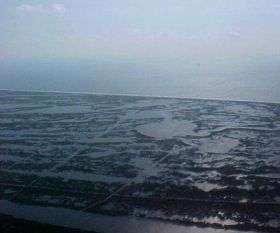
Aerial photo of the disappearing wetlands of south Louisiana. Credit: Roy Dokka, Louisiana State University

A study by NASA and Louisiana State University scientists finds that sediments deposited into the Mississippi River Delta thousands of years ago when North America's glaciers retreated are contributing to the ongoing sinking of Louisiana's coastline. The weight of these sediments is causing a large section of Earth's crust to sag at a rate of 0.1 to 0.8 centimeters (0.04 to 0.3 inches) a year.

The sediments pose a particular challenge for New Orleans, causing it to sink irreversibly at a rate of about 0.4 centimeters (0.17 inches) a year, according to data from a network of global positioning system stations and a model of sediment data collected from the northern Gulf of Mexico and the Mississippi Delta.

Hurricanes Katrina and Rita in 2005 focused national attention on the Gulf coast's vulnerability to hurricanes due to loss of wetlands and sea level rise. These new findings add another factor for scientists, government agencies and the public to consider when assessing the vulnerability of the region to hurricanes and large storms.

A science team led by Erik Ivins of NASA's Jet Propulsion Laboratory, Pasadena, Calif., hypothesized that Earth's very slow gravitational flow response to the weight of the sediments, combined with a 130-meter (427-foot) rise in sea level that took place thousands of years ago, are contributing to the sinking of a 199,000-square kilometer (77,000-square-mile) section of coastal Louisiana.

To test their theory, the team developed a physical model of sinking caused by both the weight of the sea level rise and the flow of glacial sediments into the Gulf of Mexico following the retreat of the great ice sheet that covered much of North America some 22,000 years ago. The model spanned the past 750,000 years. Results were compared with actual global positioning system measurements and other geophysical data for southern Louisiana and the Gulf, collected from multiple sources over the past 60 years.

The scientists found the model results were in good agreement with the actual geophysical data, predicting sinking of between 0.1 centimeters (0.04 inches) and 0.8 centimeters (0.3 inches) a year. The highest sinking rates were observed where coastal land loss is greatest, near the center of the Mississippi and Atchafalaya River Delta complexes.

"Our study shows that the weight of these sediments on Earth's crust can explain between 0.1 and 0.8 centimeters (0.04 and 0.3 inches) of sinking per year," said study co-author Roy Dokka of Louisiana State University, Baton Rouge. "These sediments contribute a part of the region's sinking that's inevitable and must be considered when predicting rates of sinking and future sea level change in coastal Louisiana."

The scientists say when these results are combined with sinking totaling about 0.3 centimeters (0.12 inches) per year caused by other factors such as compaction and oxidation of sediments, pumping of oil and water by humans, faulting and sea level rise, the overall outlook isn't bright. "Louisiana is slowly losing its battle with the Gulf of Mexico," said Ivins. "Our model predicts this rate of sinking will continue for hundreds of years. Continued sinking, along with the sediment starvation of the coast caused by construction of flood control levees along the Mississippi River, will ultimately lead to the drowning of the coast."

Co-author Ron Blom of JPL adds that New Orleans is particularly vulnerable. "When the effect of this sinking near New Orleans is combined with a potential 0.9 centimeter (0.35 inch) annual sea level rise that could result should ice sheet melting accelerate as projected by many climate models, it is possible New Orleans could see a relative sea level rise of roughly one meter (3.3 feet) in the next 90 years," Blom said.

The good news, the authors say, is that, with refinement, their model may help the region prepare better for future large storms and the gradual inundation of the coast. "Our model gives civil engineers and disaster preparedness managers very precise predictions of how the landscape is changing so that they can better mitigate the effects of this sinking," said Ivins. "Understanding all of the processes affecting the coast is essential for engineering effective solutions."

Louisiana's coast is far from the centers of North America's former ice sheets, which were once as large as Antarctica, but successive periods of glacier formation and retreat have affected the region through sea level rises and changes in the flow of glacial sediments into the Gulf of Mexico. This process has been ongoing in cycles caused by regular variations in Earth's orbit. When the glaciers retreated, the resulting flooding transported large volumes of sediments down today's major river systems -- three to four times more than the Mississippi River currently transports.

The authors say the relative fluidity of Earth's upper mantle beneath the Gulf coast is the primary factor that determines how Earth's crust responds to deposited sediments. Earth's crust and uppermost mantle is weaker beneath the Gulf of Mexico than it is beneath eastern Canada.

Results of the study are published in Geophysical Research Letters.

Source: NASA


print this article email this article download pdf blog this article bookmark this article     Digg this Stumble it share on Facebook share on Reddit add to delicious save to Yahoo! bookmarks
4.8/5 after 12 votes

Rank Filter

Move the slider to adjust rank threshold, so that you can hide some of the comments.


Display comments: newest first

  • CWFlink - Feb 01, 2008
    • Rank: 5 / 5 (1)
    Living on the Gulf Coast just 50 miles east of New Orleans, this article is shocking in several ways: 1) the sinking of N.O. is not just a recent phenom, but related to the last Ice Age (!); 2) that Ice Age ended only 22,000 years ago, or only 10 times further back in time than Christ (and only 2.5 times further back than the invention of writing); and 3) the oceans were 427 feet lower then!

    It is amazing how ego-centric we are! We'd come to believe our problems here were all man-made, with origins within the last century!

    We humans are supposedly going to cause the oceans to rise 3 feet in 100 years because of man-made Global Warming, yet the climate change over the last 22,000 years is vastly greater! Apparently the oceans have risen over this time more than 1 foot per 100 years, and I suspect there has been ups and downs rather than a steady state rise.

    Back then, we humans existed in only tiny numbers and were still hunter/gatherers! The land below my feet was hundreds of miles inland and 500 feet above sea level. I continue to marvel at the ability of science to remind us to be humble!
  • mikiwud - Feb 02, 2008
    • Rank: not rated yet
    We've got the UK Government bitching about the sea rise problem in the london area caused by "Global Warming".The real problem is that London,and the south of England,is sinking and Scotland is rising after the removal of the weight of ice afer the last ice age.
    By the way,the Thames barrage is use more often to keep the level high to keep the river navigable at very low tides than the opposite,but,statisticaly it is reported as used more often because of "sea level rise caused by Man-made Global Warming"!

February 1st, 2008 all stories
Space & Earth / Earth Sciences

Comments: 2
Rank: 4.8/5 after 12 votes

  • Stumble this up

  • Digg this

  • Share it:
  • share on Facebook
  • share on MySpace
  • share on Slashdot
  • rss-newsfeed
  • share on Google
  • share on Reddit
  • add to delicious
  • save to Yahoo! bookmarks
  • share on Windows Live
  • Add to Mixx!
Rating: 4.8/5 after 12 votes


Tags


  • Physicists Demonstrate Quantum Memory with Matter Qubits
    Physicists Demonstrate Quantum Memory with Matter Qubits
    Physics / General Physics
    created Jul 03, 2009 | popularity 4.4 / 5 (17) | comments 1
  • 'Holey' Nanosheets for Wastewater Dye Removal
    Nanotechnology / Nanomaterials
    created Jul 01, 2009 | popularity 5 / 5 (5) | comments 1
  • Jellyfish Robot Swims Like its Biological Counterpart
    Jellyfish Robot Swims Like its Biological Counterpart
    Electronics / Robotics
    created Jun 26, 2009 | popularity 4.4 / 5 (8) | comments 1
  • Could Maxwell's Demon Exist in Nanoscale Systems?
    Could Maxwell's Demon Exist in Nanoscale Systems?
    Physics / General Physics
    created Jun 24, 2009 | popularity 4.4 / 5 (18) | comments 29
  • Living Safely with Robots, Beyond Asimov's Laws
    Living Safely with Robots, Beyond Asimov's Laws
    Electronics / Robotics
    created Jun 22, 2009 | popularity 4.6 / 5 (52) | comments 40
  • Other News

    Steam billows from the cooling towers at a nuclear power generating station in Byron

    Tropical zone expanding due to climate change: study

    Space & Earth / Earth Sciences

    created 41 minutes ago | popularity 5 / 5 (2) | comments 0

    Climate change is rapidly expanding the size of the world's tropical zone, threatening to bring disease and drought to heavily populated areas, an Australian study has found.


    US ambitions to send astronauts back to the moon as a prelude to missions to Mars have been put in doubt

    Forty years ago man first walked on the moon

    Space & Earth / Space Exploration

    created 22 hours ago | popularity 4.3 / 5 (4) | comments 2

    Forty years ago on July 20, 1969, American astronaut Neil Armstrong realized the oldest dream of human civilizations when he became the first man to walk on the moon.


    The least sea ice in 800 years

    The least sea ice in 800 years

    Space & Earth / Earth Sciences

    created Jul 01, 2009 | popularity 4.1 / 5 (64) | comments 60

    New research, which reconstructs the extent of ice in the sea between Greenland and Svalbard from the 13th century to the present indicates that there has never been so little sea ice as there is now. The ...


    Gas around young galaxy

    Intense heat killed the Universe's would-be galaxies, researchers say

    Space & Earth / Astronomy

    created Jul 01, 2009 | popularity 3.4 / 5 (21) | comments 27

    (PhysOrg.com) -- Our Milky Way galaxy only survived because it was already immersed in a large clump of dark matter which trapped gases inside it, scientists led by Durham University's Institute for Computational ...


    Scientists' Drill Hits Magma: Only Third Time on Record

    Scientists' Drill Hits Magma: Only Third Time on Record

    Space & Earth / Earth Sciences

    created Jun 29, 2009 | popularity 4.7 / 5 (22) | comments 20

    (PhysOrg.com) -- Scientists drilling a borehole deep into Iceland’s rocky crust to explore new methods of using geothermal energy hit a major roadblock on Thursday: Their drill ran into molten rock at a depth ...