Gas 'finger' points to galaxies' future
February 4, 2008 Gas 'finger' points to galaxies' future

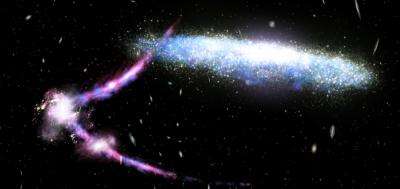
Gas streaming from the Magellanic Clouds is piercing the disk of our Milky Way Galaxy. Credit: John Rowe Animations

Like a fork piercing a fried egg, a giant finger of hydrogen gas is poking through our Milky Way Galaxy from outside, astronomers using CSIRO radio telescopes at Parkes and Narrabri have found.

The location of the intrusion may give a crucial clue to the fate of the little galaxies the gas flows from, the Large and Small Magellanic Clouds.

“We’re thrilled because we can determine exactly where this gas is ploughing into the Milky Way – it’s usually extremely hard to get distances to such gas features,” said the research team leader, Dr Naomi McClure-Griffiths of CSIRO’s Australia Telescope National Facility.

The gas finger, called HVC306-2+230, is running into the starry disk of our Galaxy about 70 thousand light-years (21kpc) away from us. On the sky, the point of contact is near the Southern Cross.

The finger is the pointy end of the so-called Leading Arm of gas that streams ahead of the Magellanic Clouds towards the Milky Way.

Until last year, astronomers generally thought that the Magellanic Clouds had orbited our Galaxy many times, and were doomed to be ripped apart and swallowed by their gravitational overlord.

But then new Hubble Space Telescope measurements showed the Clouds were moving much faster than previously thought. In turn, this implied that the Clouds are paying our Galaxy a one-time visit rather than being its long-term companions.

Knowing where the Leading Arm is crossing the Galactic Disk may help astronomers to predict where the Clouds themselves will go in future.

“We think the Leading Arm is a tidal feature, gas pulled out of the Magellanic Clouds by the Milky Way’s gravity,” said Dr McClure-Griffiths.

“Where this gas goes, we’d expect the Clouds to follow, at least approximately.”

The team’s measurement of where the Leading Arm intrudes into the Milky Way is more in line with the models that assume the Magellanic Clouds have been orbiting our Galaxy than with the models that have the Clouds just passing by.

Dr McClure-Griffiths cautions that this is not the final word on the subject, saying that the latter models were far from ruled out.

But the new result suggests that the Magellanic Clouds will eventually merge with the Milky Way, rather than zooming past.

Source: CSIRO


print this article email this article download pdf blog this article bookmark this article     Stumble it Digg this share on Facebook retweet share on Reddit add to delicious
Rate this story - 4.2 /5 (16 votes)


February 4, 2008 all stories

Comments: 0

4.2 /5 (16 votes)
  • Stumble this up

  • Digg this

  • share this

  • hide
  • Related Stories

  • Fermi Telescope Detects Gamma-Ray From 'Star Factories' in Other Galaxies
    created Nov 02, 2009 | popularity not rated yet | comments 0
  • Super Planetary Nebulae
    created Aug 14, 2009 | popularity not rated yet | comments 0
  • A curious pair of galaxies
    created Mar 16, 2009 | popularity not rated yet | comments 0
  • Drama in the heart of the Tarantula
    created Dec 11, 2008 | popularity not rated yet | comments 0
  • Supernova Remnants Dance in the LMC
    created Jan 10, 2008 | popularity not rated yet | comments 0


  • hide
  • Relevant PhysicsForums posts

  • Some help with a X-Ray astronomy question please!
    created 23 hours ago
  • Help with Images and Optical Instrument Question..
    created Nov 26, 2009
  • Redshift as a distance indicator
    created Nov 26, 2009
  • Question about 2-body gravity
    created Nov 24, 2009
  • More from Physics Forums - General Astronomy

Other News

Fermi Telescope Peers Deep into Microquasar

Fermi Telescope Peers Deep into Microquasar (w/ Video)

Space & Earth / Astronomy

created 17 hours ago | popularity 4.7 / 5 (10) | comments 0

(PhysOrg.com) -- NASA's Fermi Gamma-ray Space Telescope has made the first unambiguous detection of high-energy gamma-rays from an enigmatic binary system known as Cygnus X-3. The system pairs a hot, massive ...


The Energy Sources of Ultraluminous Galaxies

The Energy Sources of Ultraluminous Galaxies

Space & Earth / Astronomy

created 17 hours ago | popularity 4.5 / 5 (13) | comments 1

(PhysOrg.com) -- Ultraluminous infrared galaxies ((ULIRGs) are galaxies whose luminosity exceeds that of a trillion suns; for comparison, the Milky Way galaxy has a typical (and much more modest) luminosity ...


New climate targets may not change daily life much (AP)

New climate targets may not change daily life much

Space & Earth / Environment

created 21 hours ago | popularity 3.8 / 5 (13) | comments 7

(AP) -- Americans' day-to-day lives won't change noticeably if President Barack Obama achieves his newly announced goal of slashing carbon dioxide pollution by one-sixth in the next decade, experts say.


Space shuttle Atlantis, 7 astronauts back on Earth (AP)

Space shuttle Atlantis, 7 astronauts back on Earth

Space & Earth / Space Exploration

created 18 hours ago | popularity not rated yet | comments 0

(AP) -- Space shuttle Atlantis and its seven astronauts returned to Earth with a smooth touchdown Friday to end an 11-day flight that resupplied the International Space Station.


China is set to launch its second moon orbiter next October, state media have reported

China to launch second lunar probe: state media

Space & Earth / Space Exploration

created 22 hours ago | popularity 5 / 5 (5) | comments 0

China will launch its second moon orbiter next October, state media reported Friday, as it powers ahead with a space programme that has sparked concerns abroad.