Bio-crude turns cheap waste into valuable fuel
February 4, 2008 Bio-crude turns cheap waste into valuable fuel

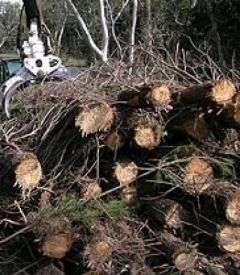
Forest waste can be converted into bio-crude oil. Credit: CSIRO

CSIRO and Monash University have developed a chemical process that turns green waste into a stable bio-crude oil.

The bio-crude oil can be used to produce high value chemicals and biofuels, including both petrol and diesel replacement fuels.

“By making changes to the chemical process, we’ve been able to create a concentrated bio-crude which is much more stable than that achieved elsewhere in the world,” says Dr Steven Loffler of CSIRO Forest Biosciences.

“This makes it practical and economical to produce bio-crude in local areas for transport to a central refinery, overcoming the high costs and greenhouse gas emissions otherwise involved in transporting bulky green wastes over long distances.”

The process uses low value waste such as forest thinnings, crop residues, waste paper and garden waste, significant amounts of which are currently dumped in landfill or burned.

“By using waste, our Furafuel technology overcomes the food versus fuel debate which surrounds biofuels generated from grains, corn and sugar,” says Dr Loffler.

“The project forms part of CSIRO’s commitment to delivering cleaner energy and reducing greenhouse gas emissions by improving technologies for converting waste biomass to transport fuels.”

The plant wastes being targeted for conversion into biofuels contain chemicals known as lignocellulose, which is increasingly favoured around the world as a raw material for the next generation of bio-ethanol.

Lignocellulose is both renewable and potentially greenhouse gas neutral. It is predominantly found in trees and is made up of cellulose; lignin, a natural plastic; and hemicellulose.

CSIRO and Monash University will apply to patent the chemical processes underpinning the conversion of green wastes to bio-crude oil once final laboratory trials are completed.

Source: CSIRO


print this article email this article download pdf blog this article bookmark this article     Stumble it Digg this share on Facebook retweet share on Reddit add to delicious
Rate this story - 4.4 /5 (30 votes)


February 4, 2008 all stories

Comments: 0

4.4 /5 (30 votes)
  • Stumble this up

  • Digg this

  • share this

  • hide
  • Related Stories

  • Germany, Mexico, US top smart energy list
    created Nov 05, 2009 | popularity not rated yet | comments 0
  • North America automobile sector bottom of 'world sustainability league'
    created Oct 30, 2009 | popularity not rated yet | comments 0
  • Simple measures can yield big greenhouse gas cuts, scientists say
    created Oct 26, 2009 | popularity not rated yet | comments 0
  • Nuclear energy becomes pivotal in climate debate
    created Oct 25, 2009 | popularity not rated yet | comments 0
  • Algae may be secret weapon in climate change war
    created Oct 22, 2009 | popularity not rated yet | comments 0


Other News

Toward home-brewed electricity with 'personalized solar energy'

Toward home-brewed electricity with 'personalized solar energy'

Chemistry / Materials Science

created Nov 04, 2009 | popularity 3.4 / 5 (9) | comments 4

New scientific discoveries are moving society toward the era of "personalized solar energy," in which the focus of electricity production shifts from huge central generating stations to individuals in their ...


Scientists Reproduce a Building Block of Life in Laboratory

Scientists Reproduce a Building Block of Life in Laboratory

Chemistry / Biochemistry

created Nov 06, 2009 | popularity 4.8 / 5 (23) | comments 0

(PhysOrg.com) -- NASA scientists studying the origin of life have reproduced uracil, a key component of our hereditary material, in the laboratory.


Newly Discovered Fat Molecule: An Undersea Killer with an Upside

Newly Discovered Fat Molecule: An Undersea Killer with an Upside

Chemistry / Biochemistry

created Nov 05, 2009 | popularity 4.8 / 5 (9) | comments 0

(PhysOrg.com) -- A chemical culprit responsible for the rapid, mysterious death of phytoplankton in the North Atlantic Ocean has been found by collaborating scientists at Rutgers University and the Woods Hole ...


CU-Boulder map of human bacterial diversity shows wide interpersonal differences

Map of Human Bacterial Diversity Shows Wide Interpersonal Differences

Chemistry / Biochemistry

created Nov 05, 2009 | popularity 4.7 / 5 (11) | comments 0

(PhysOrg.com) -- A University of Colorado at Boulder team has developed the first atlas of bacterial diversity across the human body, charting wide variations in microbe populations that live in different ...


Mimicking nature, scientists can now extend redox potentials

Mimicking nature, scientists can now extend redox potentials

Chemistry / Biochemistry

created Nov 04, 2009 | popularity 4.8 / 5 (5) | comments 0

(PhysOrg.com) -- New insight into how nature handles some fundamental processes is guiding researchers in the design of tailor-made proteins for applications such as artificial photosynthetic centers, long-range ...