Thinking too complicated? Neuronal activity is far more predictable than assumed
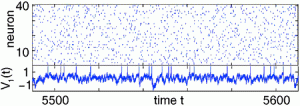
How sensitive are neuronal networks to external interference? To what extent are neuronal network processes including the thinking patterns of the brain predefined? These questions have been investigated by Sven Jahnke, Raoul-Martin Memmesheimer and Marc Timme at the Bernstein Center for Computational Neuroscience and the Max Planck Institute for Dynamics and Self-Organisation. They have found that, under certain conditions, neuronal networks are more predictable than was previously assumed (Physical Review Letters, Feb. 1st, 2008).
The brain is one of the most complex objects that have evolved - more than 100 billion neurons communicate with one another through a widely branched network. Neurons process information represented as electrical impulses. Each cell computes the signals of the presynaptic cells. When it generates an impulse itself, depends on the result of this calculation.
Marc Timme and collaborators have now mathematically analyzed such a system of neuronal signal transmission and have verified their theory by means of computer simulations. As in the brain, the dynamics of neuronal signal transmission in the mathematical model does not follow a recognizable order; the way in which neuronal impulses are transmitted appears to be unforeseeable. But how unpredictable is such a system really?
Researchers call a system "chaotic" if slight differences in the initial states lead to very different outcomes after a period of time. The behaviour of chaotic systems thus cannot be predicted in the long-term. "The beat of a butterfly’s wing in the Amazon jungle can cause a hurricane in Europe", as the mathematician and meteorologist Edward N. Lorenz visualized this effect in the 1960s.
In 1996 researchers of the Hebrew University in Israel demonstrated in a theoretical study that the observed irregular neuronal activity of the brain may be explained by chaotic behaviour. Thus, the network would develop a very different dynamics, even if only a single neuron transmitted a signal a fraction of a second earlier or later. In the last ten years many neuroscientists assumed that such chaotic behaviour generally accounts for the observed irregularities.
As Timme and colleagues have now uncovered, chaotic activity only arises under certain conditions and may not be a general rule in such networks. "A combination of various new methods has made it possible for us to consider every single impulse of a neuron in a network", Jahnke explains. The researchers could show that, under certain conditions, a neuronal network is astonishingly insensitive to small temporal shifts of neuronal impulses.
"If patterns of neuronal activity are similar enough, they do not develop an entirely different dynamics, as would be expected from a chaotic system. Quite in contrast, they conform to one another in the long-term", Memmesheimer explains. In the brain this could contribute to the highly precise emergence of temporal activity patterns, so that information in such networks can be processed and calculated to a high accuracy.
Although the network appears to be highly irregular according to statistical measures, this is not necessarily an indication of a chaotic system. Rather, it can be predictable over a longer period of time. "We still have to more closely examine the circumstances under which the brain’s reaction is predictable rather that chaotic", Timme adds. In any case, the dynamics of neuronal networks is, even though highly irregular, not always as complicated as previously thought.
Citation: Sven Jahnke, Raoul-Martin Memeshimer and Marc Timme (2007), Stable irregular dynamics in complex neural networks, Physical Review Letters 100, 048102. DOI: 10.113/PhysRevLett.100.048102
Source: Max Planck Society


