With Mini in vivo Robots, Anyone Can do Surgery
February 5, 2008 By Lisa Zyga feature
With Mini in vivo Robots, Anyone Can do Surgery

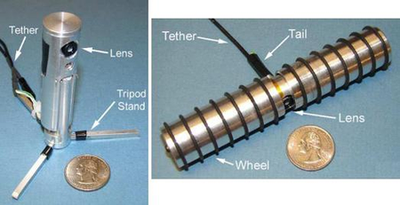
Two in vivo camera robots used by the Aquanauts during the NEEMO mission. Image credit: Rentschler, et al. ©IEEE 2008.

By attaching a millimeter-sized camera robot to a tether, scientists have designed a way to allow individuals with non-medical backgrounds to perform minimally invasive surgery in almost any location. Unlike room-size and expensive surgical robots, mini in vivo robots are inexpensive and mobile enough to support emergency surgeries almost anywhere, from the battlefield to outer space.

The University of Nebraska researchers hope that the inexpensive version of the da Vinci surgical robot system will make the advantages of robotic-assisted surgery more widely available, and open the doors for telesurgeries that were previously impossible. In a recent study, the team evaluated the ease of use and time required to perform simple abdominal surgeries with the in vivo camera robots. Their results are published in a recent issue of IEEE Transactions on Information Technology in Biomedicine.

“A new area of surgical robotics focuses on placing robots entirely inside the patient,” wrote Mark Rentschler et al. in their study. “In vivo robots are small, inexpensive, and easily transported, making it more likely that this technology can be more widely adopted. . . . The use of these robots can potentially reduce patient trauma in traditional medical centers, while the size of the robots makes them ideal for transportation to and use in remote or harsh environments.”

The researchers tested the mini robots on three NASA astronauts and one surgeon who were undergoing long-term training in an underwater habitat called the NASA Extreme Environment Mission Operations (NEEMO), located 20 meters underwater off the coast of Key Largo, Florida. The four “Aquanauts” received brief training on how to perform two surgeries – bowel inspection and stretch-and-dissect – and were also evaluated on how well they could perform another surgery – an appendectomy – for which they received no training.

In the test, the Aquanauts performed the surgeries on synthetic materials inside an abdominal cavity simulator, and were telementored via videoconferencing by the University of Nebraska team in Omaha. The crew used two robots: one was 20 mm in diameter and 110 mm in length, and the other was 15 mm in diameter and 60 mm in length. Both robots were equipped with a CMOS camera and inserted into the abdominal cavity (which measures 20 x 15 x 8 cm when artificially inflated) through a trocar port. Controlling the robots with either a joystick or a switch, the crew members could see various angles and adjust the focus of the images, receiving feedback at 30 frames per second.

The crew members also performed the same surgeries using a standard laparoscope – a tube that’s inserted into the body in which a camera can be used. The results showed that the crew members achieved about equal levels of accuracy with both systems, but the camera robots enabled the crew members to work significantly faster at all three surgeries. Performing surgeries quicker could minimize patient trauma and the risk of infection.

Another notable result was that the crew members were able to successfully perform the appendectomy, even though they had not been trained on that procedure. This success demonstrates that telementoring can be used to enable individuals trained on basic skills to build upon their skills to complete more complex procedures.

“The telementoring results demonstrated that nonsurgeons having been trained with a specified skill set can be telementored to build on that skill set and perform a more complex laparoscopic procedure using in vivo robots,” the researcher concluded. “The combined results of these tests suggest that the use of miniature surgical robots could be used in place of standard laparoscopic surgical equipment without loss of performance.”

In the future, the team hopes to add further developments to the mini in vivo robot system, such as task assistance (where the robot can be used to manipulate tissue), telecontrol (where the robot is controlled remotely) and some autonomy (where the robot can make some decisions on its own). Thanks to these tiny robots, emergency surgery may one day be performed in extreme environments, and save lives where it would otherwise be impossible.

More information: Rentschler, Mark E., Platt, Stephen R., Berg, Kyle, Dumpert, Jason, Oleynikov, Dmitry, and Farritor, Shane M. “Miniature in vivo Robots for Remote and Harsh Environments.” IEEE Transactions on Information Technology in Biomedicine, Vol. 12, No. 1, January 2008.

Copyright 2008 PhysOrg.com.
All rights reserved. This material may not be published, broadcast, rewritten or redistributed in whole or part without the express written permission of PhysOrg.com.

4.5 /5 (67 votes)  

Filter


Move the slider to adjust rank threshold, so that you can hide some of the comments.


Display comments: newest first

BigTone
Feb 05, 2008

Rank: 5 / 5 (4)
So scary and so cool... I wish we had them implanted at birth in multiple locations monitoring us and auto-performing routine procedures or joysticked from a wireless Internet connection 24/7... The suck factor is the myriad of ways they can be weaponized or abused (hacked)...
Nikola
Feb 05, 2008

Rank: 4.5 / 5 (4)
D.I.Y Surgery! I wonder when "Tumor Removal for Dummies" will be published.
TomJames
Feb 05, 2008

Rank: not rated yet
I agree with Big Tone. However it is probable that the first problems will emerge because of equipment failures rather than malicious hacking.
HeRoze
Feb 05, 2008

Rank: 5 / 5 (1)
As impressive as these results are, the 'telecontrol' potential is awesome; this is incrementally distant from remote-controlled surgery. If a novice with a joystick can perform an appendectomy locally, what is the potential for a skilled surgeon controlling this device via virtually any communications system? I think it is tremendous. Imagine ambulances with the ability to get a surgeon working on life-threatening injuries on the spot. Even though the field may not be prestine, sometimes the surgical environment may have to take a back seat to survival. Tremendous.
DGBEACH
Feb 05, 2008

Rank: not rated yet
Resistance is futile.
stealthc
Feb 06, 2008

Rank: not rated yet
I'll pass on this idea, what happens if the transmission is interrupted?
HeRoze
Feb 06, 2008

Rank: not rated yet
stealthc - Obviously this would be a problem. In the payback-analysis of dying on the spot v. having a reasonable chance of survival through a remote surgery, I will take the remote surgery. I am not suggesting that hospital surgeons be replaced by a bunch of robots networked to a central 'surgeon repository', but rather an alternative to get a surgeon working on a patient at an accident scene, or remote location (like hikers/climbers/explorers/soldiers). So, your concern is very reasonable, and the reliability of the connection would have to be considered in the decision to do a remote surgery. Again, I think the potential for this is truely staggering.
Rank 4.5 /5 (67 votes)
Tags

Relevant PhysicsForums posts
  • feed hold button on CNC lathe
    created18 hours ago
  • Mechanics of Solids ( Final exam question) please help!
    created19 hours ago
  • RFAC in Fortran
    created22 hours ago
  • dynamics 2/32
    createdFeb 08, 2012
  • dynamics
    createdFeb 08, 2012
  • Vibration Absorbtion Problem
    createdFeb 08, 2012
  • More from Physics Forums - General Engineering

More news stories

Google to make home entertainment system: report

Google will mirror Apple's winning hardware-software formula with an Android-powered entertainment system that wirelessly streams content through homes, the Wall Street Journal reported on Thursday.

Electronics / Consumer & Gadgets

created 6 hours ago | popularity 4.5 / 5 (2) | comments 0

New Kindle Touch is an impressive e-reader

When it comes to reading digital books, tablets are all the rage. But there's a lot to like about simple e-readers, which over the past year have become both a lot cheaper and a lot less clunky.

Electronics / Consumer & Gadgets

created 12 hours ago | popularity 5 / 5 (2) | comments 1

Apple to debut 'iPad 3' in March: report

Apple will unveil a new version of its market-ruling iPad table computer in March, according to a report in Dow Jones-owned technology blog All Things D.

Electronics / Consumer & Gadgets

created 13 hours ago | popularity 2.1 / 5 (18) | comments 0

Barriers fall between TV, Internet

You say TV, I say Internet. Toe-mate-o, toe-mah-to.

Electronics / Consumer & Gadgets

created 9 hours ago | popularity not rated yet | comments 0

Google rumored to have built Heads-Up-Display glasses prototype

(PhysOrg.com) -- 9to5Google is reporting that they have received a tip from someone they believe to be a reliable source saying that Google is working on a Heads-Up-Display (HUD) pair of eye-glasses. The per ...

Electronics / Consumer & Gadgets

created Feb 08, 2012 | popularity 4.3 / 5 (8) | comments 2 | with audio podcast weblog


'Dark plasmons' transmit energy

Microscopic channels of gold nanoparticles have the ability to transmit electromagnetic energy that starts as light and propagates via "dark plasmons," according to researchers at Rice University.

Hydrogen from acidic water: Researchers develop potential low cost alternative to platinum for splitting water

A technique for creating a new molecule that structurally and chemically replicates the active part of the widely used industrial catalyst molybdenite has been developed by researchers with the Lawrence Berkeley ...

FDA-approved drug rapidly clears amyloid from the brain, reverses Alzheimer's symptoms in mice

Neuroscientists at Case Western Reserve University School of Medicine have made a dramatic breakthrough in their efforts to find a cure for Alzheimer's disease. The researchers' findings, published in the journal Science, show t ...

Ultraviolet protection molecule in plants yields its secrets

Lying around in the sun all day is hazardous not just for humans but also for plants, which have no means of escape. Ultraviolet (UV) radiation from the sun can damage proteins and DNA inside cells, leading ...

Anyone can learn to be more inventive, cognitive researcher says

There will always be a wild and unpredictable quality to creativity and invention, says Anthony McCaffrey, a cognitive psychology researcher at the University of Massachusetts Amherst, because an "Aha moment" is rare and ...

New method makes culture of complex tissue possible in any lab

Scientists at the University of California, San Diego have developed a new method for making scaffolds for culturing tissue in three-dimensional arrangements that mimic those in the body. This advance, published online in ...