RNA-associated introns guide nerve-cell channel production
February 5, 2008 RNA-associated introns guide nerve-cell channel production

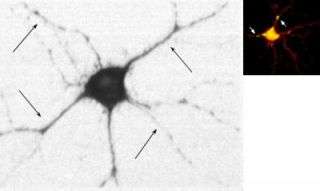
Image of a neuron. Dendrites (highlighted by arrows), which branch from the cell body of the neuron, detect the electrical and chemical signals transmitted to the neuron by the axons of other neurons. Credit: Kevin Miyashiro and James Eberwine, PhD, University of Pennsylvania School of Medicine

Researchers at the University of Pennsylvania School of Medicine have discovered that introns, or junk DNA to some, associated with RNA are an important molecular guide to making nerve-cell electrical channels. Senior author James Eberwine, PhD, Elmer Bobst Professor of Pharmacology, and lead authors Kevin Miyashiro, and Thomas J. Bell, PhD, both in Eberwine’s lab, report their findings in this week's early online edition of the Proceedings of the National Academy of Sciences.

In nerve cells, some ion channels are located in the dendrite, which branch from the cell body of the neuron. Dendrites detect the electrical and chemical signals transmitted to the neuron by the axons of other neurons. Abnormalities in the dendrite electrical channel are involved in epilepsy, neurodegenerative diseases, and cognitive disorders, among others.

Introns are commonly looked on as sequences of "junk" DNA found in the middle of gene sequences, which after being made in RNA are simply excised in the nucleus before the messenger RNA is transported to the cytoplasm and translated into a protein. In 2005, the Penn group first found that dendrites have the capacity to splice messenger RNA, a process once believed to only take place in the nucleus of cells.

Now, in the current study, the group has found that an RNA encoding for a nerve-cell electrical channel, called the BK channel, contains an intron that is present outside the nucleus. This intron plays an important role in ensuring that functional BK channels are made in the appropriate place in the cell.

When this intron-containing RNA was knocked out, leaving the maturely spliced RNA in the cell, the electrical properties of the cell became abnormal. “We think the intron-containing mRNA is targeted to the dendrite where it is spliced into the channel protein and inserted locally into the region of the dendrite called the dendritic spine. The dendritic spine is where a majority of axons from other cells touch a particular neuron to facilitate neuronal communication” says Eberwine. “This is the first evidence that an intron-containing RNA outside of the nucleus serves a critical cellular function.”

“The intron acts like a guide or gatekeeper,” says Eberwine. “It keys the messenger RNA to the dendrite for local control of gene expression and final removal of the intron before the channel protein is made. Just because the intron is not in the final channel protein doesn’t mean that it doesn’t have an important purpose.”

The group surmises that the intron may control how many mRNAs are brought to the dendrite and translated into functional channel proteins. The correct number of channels is just as important for electrical impulses as having a properly formed channel.

The investigators believe that this is a general mechanism for the regulation of cytoplasmic RNAs in neurons. Given the central role of dendrites in various physiological functions they hope to relate this new knowledge to understanding the molecular underpinnings of memory and learning, as well as components of cognitive dysfunction resulting from neurological disease.

Source: University of Pennsylvania


print this article email this article download pdf blog this article bookmark this article     Stumble it Digg this share on Facebook retweet share on Reddit add to delicious
Rate this story - 4.7 /5 (10 votes)

Rank Filter

Move the slider to adjust rank threshold, so that you can hide some of the comments.


Display comments: newest first

  • barakn - Feb 05, 2008
    • Rank: 1 / 5 (1)
    A lot of textbooks will need to be rewritten.

February 5, 2008 all stories

Comments: 1

4.7 /5 (10 votes)
  • Stumble this up

  • Digg this

  • share this

  • hide
  • Related Stories

  • Computational microscope peers into the working ribosome (w/ Video)
    created Nov 23, 2009 | popularity not rated yet | comments 0
  • Nanotech researchers develop artificial pore
    created Sep 28, 2009 | popularity not rated yet | comments 0
  • Meet DNA's personal assistants
    created May 07, 2009 | popularity not rated yet | comments 0
  • Microfluidic Devices Capture and Analyze Single Cancer Cells
    created Jan 16, 2009 | popularity not rated yet | comments 0
  • Eating and weight gain not necessarily linked, study shows
    created Jun 03, 2008 | popularity not rated yet | comments 0


  • hide
  • Relevant PhysicsForums posts

  • Multiple Sclerosis & CCSVI
    created 12 hours ago
  • 23 Years in a Vegetative State....or not?
    created Nov 25, 2009
  • Has the H1N1 vaccine been scientifically proven to work?
    created Nov 24, 2009
  • nesfatin
    created Nov 22, 2009
  • More from Physics Forums - Medical Sciences

Other News

Nuclear science to fight sleeping sickness

Medicine & Health / Diseases

created 1hour ago | popularity not rated yet | comments 0

The International Atomic Energy Agency on Friday announced an agreement to help African nations battle the tsetse fly, the main carrier of parasites that causes sleeping sickness with its bites.


A costly diagnosis: Alzheimer's disease takes toll on memories, and money too

Medicine & Health / Health

created 2 hours ago | popularity not rated yet | comments 0

Alzheimer's disease takes a devastating emotional toll on families but it also is one of the most expensive conditions to treat because of its progressive nature, requiring increasing assistance with eating, bathing and other ...


eye

Over-the-counter eye drops raise concern over antibiotic resistance

Medicine & Health / Medications

created 4 hours ago | popularity not rated yet | comments 0

(PhysOrg.com) -- The use of antibiotic eye drops for conjunctivitis has increased by almost half since they became available over the counter at chemists in 2005, data obtained by Oxford University researchers ...


Hyperactivity associated with short sleep-time for young boys: study

Hyperactivity associated with short sleep-time for young boys: study

Medicine & Health / Psychology & Psychiatry

created 5 hours ago | popularity not rated yet | comments 0

(PhysOrg.com) -- Hyperactive boys don't get enough sleep, which can worsen their condition according to new research. Published in the November issue of Pediatrics, the study is the first to examine a larg ...


School closure could reduce swine flu transmission by 21 percent

Medicine & Health / Diseases

created 5 hours ago | popularity not rated yet | comments 0

A survey carried out in eight European countries has shown that closing schools in the event of an infectious disease pandemic could have a significant role in reducing illness transmission. Researchers writing in the open ...