Antarctic expedition provides new insights into the role of the Southern Ocean for global climate
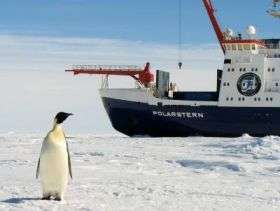
In the Southern Ocean, large quantities of surface-drifting plankton algae are able to significantly reduce the carbon dioxide content of the surface waters, which can affect the global carbon dioxide cycle. This is one of the results from an Antarctic expedition which has just drawn to a close in Cape Town on February 4, and which was led by the Alfred Wegener Institute, part of the Helmholtz Association.
On February 5, an international team of scientists will discuss the results obtained to date and pressing questions of Antarctic research as part of a workshop aboard the icebreaker Polarstern. Federal research minister Dr Annette Schavan will use the opportunity to meet representatives of leading research institutions and South African ministerial colleagues. On February 6, Polarstern will promptly leave again for her next Antarctic expedition which is motivated by the International Polar Year 2007/08 and whose goal it is to understand the role of the Southern Ocean for past, present and future climate.
During expeditions of the research vessel Polarstern, and within the framework of the International Polar Year 2007/08, researchers from all over the world are making pioneer contributions to the understanding of the Southern Ocean. This massive water body surrounding the Antarctic continues to be largely unexplored. However, since it has a significant effect on the climate of the entire earth, it is absolutely necessary to intensify research activities. The International Polar Year provides a unique opportunity for combining the scientific efforts of various countries in order to gain major insights.
The recently concluded Polarstern expedition had started in Cape Town on November 28, 2007 and was devoted primarily to organisms and materials cycles in the ocean. Under the leadership of Prof Dr Ulrich Bathmann of the Alfred Wegener Institute, 53 Scientists from nine countries have been studying the biological carbon pump in the Southern Ocean, among other topics. Algal plankton absorbs carbon through photosynthetic activity, hence removing carbon dioxide from the atmosphere. Researchers have discovered that melting sea ice has created a pool of fresh water on the sea surface. Algal plankton growing in this pool started to decay and to sink to the seafloor. There, metabolic processes occurred.
The scientists investigated an algal carpet drifting in the water near the edge of the sea ice. This algal bloom measured 700,000 square kilometres, i.e. approximately twice the size of Germany. The researchers wanted to find out which physical conditions lead to such algal blooms, and how they affect the living and non-living environment. Their measurements demonstrate a significant decrease in the carbon dioxide content of the surface water. In addition, the new data show the effect of the plankton bloom on the species community at the seafloor. For the first time ever the complete water column of the Southern Ocean – from the surface to the seafloor – was sampled simultaneously and comprehensively. The current inventory of the flora and fauna will also provide the basis for comparison with future investigations.
During the expedition, Polarstern also offered crucial support through her icebreaking capacity so that the construction materials for the new German Antarctic station Neumayer III could be unloaded despite severe ice conditions.
On February 5, an international workshop on climate research in the Southern Ocean will take place aboard Polarstern in Cape Town. The scientists aboard the French and German research vessels Marion Dufresne and Polarstern will meet South African partners to exchange results and plan future collaboration. Most German Antarctic expeditions leave from Cape Town, and it is intended to strengthen and intensify cooperation with South Africa regarding both marine sciences and logistics. Federal research minister Dr Annette Schavan will attend the workshop.
On February 6, Polarstern will leave for the next Antarctic expedition under the leadership of Dr Eberhard Fahrbach of the Alfred Wegener Institute. The main expedition programme is motivated by the International Polar Year 2007/08. The two projects, CASO (Climate of Antarctica and the Southern Ocean) and GEOTRACES are focused on recording current physical and biogeochemical conditions in the Southern Ocean. Recording equipment aboard Polarstern, as well as ocean-deployed buoys and drift units designed to sink to deep water will be measuring ocean currents in the Southern Ocean, distribution of trace substances, transport of water bodies, and interactions between sea and ice as well as ocean and atmosphere. This expedition is scheduled to end on April 16 in Punta Arenas, Chile.
Gaining insights into the global climate system is not the only objective of the International Polar Year. Involving the public, specifically the young generation, in ongoing research and provision of extensive information are central goals. For this reason, two teachers will also be aboard Polarstern. Charlotte Lohse from Hamburg and Stefan Theisen from Kiel will be actively involved in the expedition research, allowing them not only to refresh their knowledge about current climate research, but also to communicate their insights via telephone and internet to their students. “I hope that I can personally bring home many impressions from this research voyage, so that I can provide the students with a more accurate representation of the Polar Regions. During preparations for the trip and in conversations with my students, I have experienced great enthusiasm in these young people when it comes to the subject Antarctic”, says Charlotte Lohse, teacher at Heisenberg Gymnasium in Hamburg.
Source: Alfred Wegener Institute for Polar and Marine Research


