Gargantuan galaxy NGC 1132 -- a cosmic fossil?
February 5, 2008 Gargantuan galaxy NGC 1132 -- a cosmic fossil?

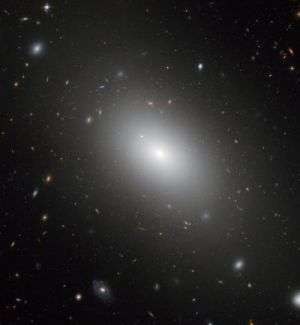
The NASA/ESA Hubble Space Telescope has captured a new image of the galaxy NGC 1132 which is, most likely, a cosmic fossil -- the aftermath of an enormous multi-galactic pile-up, where the carnage of collision after collision has built up a brilliant but fuzzy giant elliptical galaxy far outshining typical galaxies. NGC 1132, together with the small dwarf galaxies surrounding it, are dubbed a 'fossil group" as they are most likely the remains of a group of galaxies that merged together in the recent past. In this Hubble image, NGC 1132 is seen surrounded by thousands of ancient globular clusters, swarming around the galaxy like bees around a hive. These globular clusters are likely to be the survivors of the disruption of their cannibalised parent galaxies that have been eaten by NGC 1132 and may reveal its merger history. In the background, there is a stunning tapestry of numerous galaxies that are much further away. Credit: NASA, ESA, M. West (ESO, Chile)

The elliptical galaxy NGC 1132, seen in this latest image from Hubble, belongs to a category of galaxies called giant ellipticals. NGC 1132, together with the small dwarf galaxies surrounding it, are dubbed a “fossil group” as they are most likely the remains of a group of galaxies that merged together in the recent past.

In visible light NGC 1132 appears as a single, isolated, giant elliptical galaxy, but this is only the tip of the iceberg. Scientists have found that NGC 1132 resides in an enormous halo of dark matter, comparable to the amount of dark matter usually found in an entire group of tens or hundreds of galaxies. It also has a strong X-ray glow from an abundant amount of hot gas – an amount normally only found in galaxy groups. Its X-ray glow extends over a region of space ten times larger than the 120,000 light-year radius it has in visible light. An X-ray glow that is equal in size to that of an entire group of galaxies.

The origin of fossil group systems remains a puzzle. The most likely explanation is that they are the end-products of a cosmic feeding frenzy in which a large cannibal galaxy devours all of its neighbours. A less likely explanation is that they may be very rare objects that formed in a region or period of time where the growth of moderate-sized galaxies was somehow suppressed, and only one large galaxy formed.

Many galaxies reside in groups that are gravitationally bound together, including our own Milky Way, which is part of the Local Group. Sometimes gravity makes galaxies collide and eventually merge into one single galaxy. There is strong evidence that the Milky Way is one such cannibal that has snacked on numerous smaller galaxies during its lifetime, inheriting their stars in the process. Scientists are keenly studying the environment surrounding galaxies such as NGC 1132 using space telescopes like Hubble, and they try to trace the history of the formation these galaxies by analysing their properties.

In this Hubble image, NGC 1132 is seen surrounded by thousands of ancient globular clusters, swarming around the galaxy like bees around a hive. These globular clusters are likely to be the survivors of the disruption of their cannibalised parent galaxies that have been eaten by NGC 1132 and may reveal its merger history. In the background, there is a stunning tapestry of numerous galaxies that are much further away.

Elliptical galaxies are smooth and featureless. They contain hundreds of millions to trillions of stars, and their shapes range from nearly spherical to very elongated in shape. Their overall yellowish colour is a telltale sign of their great age. Because elliptical galaxies do not contain much cool gas they can no longer make new stars.

NGC 1132 is located approximately 320 million light-years away in the constellation of Eridanus, the River. This image of NGC 1132 was taken with Hubble’s Advanced Camera for Surveys. Data obtained in 2005 and 2006 through green and near-infrared filters were used to produce a colour composite.

Source: Hubble Information Centre


print this article email this article download pdf blog this article bookmark this article     Stumble it Digg this share on Facebook retweet share on Reddit add to delicious
Rate this story - 4.1 /5 (29 votes)

Rank Filter

Move the slider to adjust rank threshold, so that you can hide some of the comments.


Display comments: newest first

  • Tortue - Feb 05, 2008
    • Rank: not rated yet
    Cool
  • kon - Feb 05, 2008
    • Rank: not rated yet
    I'm guessing that at least some of the galaxies in the background, are duplicates due to the lensing effect of this massive galaxy.

    Does anyone know if this effect is also possible within the galaxy itself? For example if the light from the star in NGC 1132 furthest from us, could also be subject to the gravitational lensing effect due to the mass of NGC 1132?

February 5, 2008 all stories

Comments: 2

4.1 /5 (29 votes)
  • Stumble this up

  • Digg this

  • share this

  • hide
  • Related Stories

  • Maps Unveil the Source of Starburst Galaxy's Winds
    created Nov 18, 2009 | popularity not rated yet | comments 0
  • NGC 4710 galaxy: Baffling boxy bulge (w/ Video)
    created Nov 18, 2009 | popularity not rated yet | comments 0
  • Swift, XMM-Newton satellites tune into a middleweight black hole
    created Nov 10, 2009 | popularity not rated yet | comments 0
  • Rapid supernova could be new class of exploding star
    created Nov 05, 2009 | popularity not rated yet | comments 0
  • Fermi Telescope Detects Gamma-Ray From 'Star Factories' in Other Galaxies
    created Nov 02, 2009 | popularity not rated yet | comments 0


  • hide
  • Relevant PhysicsForums posts

  • Some help with a X-Ray astronomy question please!
    created 5 hours ago
  • Help with Images and Optical Instrument Question..
    created 16 hours ago
  • Redshift as a distance indicator
    created 23 hours ago
  • Question about 2-body gravity
    created Nov 24, 2009
  • More from Physics Forums - General Astronomy

Other News

Past regional cold and warm periods linked to natural climate drivers

Space & Earth / Earth Sciences

created 20 hours ago | popularity 3.7 / 5 (13) | comments 22

Intervals of regional warmth and cold in the past are linked to the El Niño phenomenon and the so-called "North Atlantic Oscillation" in the Northern hemisphere's jet stream, according to a team of climate scientists. These ...


China is set to launch its second moon orbiter next October, state media have reported

China to launch second lunar probe: state media

Space & Earth / Space Exploration

created 4 hours ago | popularity 5 / 5 (3) | comments 0

China will launch its second moon orbiter next October, state media reported Friday, as it powers ahead with a space programme that has sparked concerns abroad.


In Greenland, warming fuels dream of hidden wealth (AP)

In Greenland, warming fuels dream of hidden wealth

Space & Earth / Environment

created 2 hours ago | popularity 3 / 5 (2) | comments 0

(AP) -- Gert Ignatiussen returns to this fjord-front Inuit town with the spoils of his hunting trip. Six seals, all killed with a single shot to the head.


Space shuttle Atlantis, 7 astronauts back on Earth

Space & Earth / Space Exploration

created 10 minutes ago | popularity not rated yet | comments 0

(AP) -- Space shuttle Atlantis and its seven astronauts returned to Earth with a smooth touchdown Friday to end an 11-day flight that resupplied the International Space Station.


New climate targets may not change daily life much (AP)

New climate targets may not change daily life much

Space & Earth / Environment

created 3 hours ago | popularity 1 / 5 (1) | comments 0

(AP) -- Americans' day-to-day lives won't change noticeably if President Barack Obama achieves his newly announced goal of slashing carbon dioxide pollution by one-sixth in the next decade, experts say.