New 3-D Printer Churns Out Complex Prototypes
February 5, 2008 New 3-D Printer Churns Out Complex Prototypes

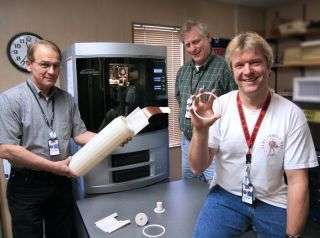
To show colleagues how a design for an accelerator component works, designer Gene Anzalone can now carry a lightweight plastic model to meetings. More tangible than a set of design drawings, and more totable than a 35-pound metal model, the working 3-D plastic model of a collimator took about five days to make with SLAC Mechanical Design Department's new rapid prototyping machine, also called a 3-D printer.

Since the Dimension Elite printer arrived in early January, its tea-box-sized printing head has been on the move day and night, whirring and clicking like a home inkjet printer while it automatically builds up models by depositing thin layers of melted plastic, layer by layer. Once engineer Kurt Vaillancourt sets up the printer, which takes very little time, he lets it work unattended, saving money on machinist costs and material costs.

"It's a service for engineers and designers across the lab to study the form, fit and function of their design before cutting them in metal," Vaillancourt said.

The SLAC arm of the Large Hadron Collider (LHC) Accelerator Research Program has eagerly taken advantage of the printer—which looks like a snack vending machine—to build models of a rotatable collimator that could be part of the upgrades to the LHC. Collimators block stray particles inside a beam pipe.

"The model is accurate enough to gain an understanding of how well the parts fit together into a working assemblage, and it gives us tangible results at an early phase of the project," said engineer Steve Lundgren.

The group can test and refine its designs before sending them to the Machine Shop to build parts from quality, expensive metals.

Anzalone and Lundgren electronically sent their CAD (computer-aided design) data to the printer. Several days later, they sandwiched ball bearings between two printer-made plastic rings, and screwed the rings together to form a functional bearing at the end of the prototype collimator. Very quickly, they determined that this design for the ball bearing race worked well. Eventually, when the LHC beam accidentally strikes and damages the collimator, operators will simply rotate it to present a fresh piece of metal without interrupting collider operations.

The printer is available for SLAC use, and can support pieces up to 8 inches square by 12 inches high, in layers as thin as 0.007 inches. Pieces can be glued together, and several parts can be fabricated in one run. The printer can also automatically enlarge or reduce parts.

Source: by Heather Rock Woods, SLAC


print this article email this article download pdf blog this article bookmark this article     Stumble it Digg this share on Facebook retweet share on Reddit add to delicious
Rate this story - 4.6 /5 (24 votes)

Rank Filter

Move the slider to adjust rank threshold, so that you can hide some of the comments.


Display comments: newest first

  • KB6 - Feb 06, 2008
    • Rank: not rated yet
    OK, when can we get ours?

February 5, 2008 all stories

Comments: 1

4.6 /5 (24 votes)
  • Stumble this up

  • Digg this

  • share this

  • hide
  • Related Stories

  • From cars to cancer: Researcher employs auto industry tools for tumor therapy
    created May 06, 2009 | popularity not rated yet | comments 0
  • Un-masking a faster solution for chip-making
    created Nov 27, 2008 | popularity not rated yet | comments 0
  • Memjet Customers, Roadmap Start Taking Shape
    created Mar 27, 2007 | popularity not rated yet | comments 0
  • Muscle and bone from an ink-jet printer
    created Dec 10, 2006 | popularity not rated yet | comments 0
  • Designing the missions of the future
    created Dec 05, 2005 | popularity not rated yet | comments 0


  • hide
  • Relevant PhysicsForums posts

  • Control System
    created 12 hours ago
  • Base Isolation Systems in Skyscrapers?
    created Nov 23, 2009
  • Need to interview a Computer Hardware Engineer for school project
    created Nov 23, 2009
  • transient heat transfer
    created Nov 23, 2009
  • More from Physics Forums - General Engineering

Other News

Software takes a hard look at traffic fatalities

Technology / Software

created 1hour ago | popularity not rated yet | comments 0

Bergen County Police and a Hackensack, N.J., drug treatment center are among a growing number of agencies using a software program to identify dangerous intersections, spot teen driving trends and reduce accident fatalities.


Selling chip makers on optical computing

Selling chip makers on optical computing

Technology / Semiconductors

created 9 hours ago | popularity 5 / 5 (5) | comments 0

(PhysOrg.com) -- Computer chips that transmit data with light instead of electricity consume much less power than conventional chips, but so far, they've remained laboratory curiosities. Professors Vladimir ...


Facebook creates dual-class structure, but no IPO (AP)

Facebook creates dual-class structure, but no IPO

Technology / Business

created 5 hours ago | popularity 1 / 5 (1) | comments 0

(AP) -- Facebook has created a dual-class stock structure designed to give founder Mark Zuckerberg and other existing shareholders control over the company.


Taking the drudgery out of software development

Taking the drudgery out of software development

Technology / Software

created 6 hours ago | popularity 3 / 5 (2) | comments 1

(PhysOrg.com) -- Software developers will no longer have to reinvent the wheel when writing new programs and applications thanks to a clever new set of tools and a central repository of 'building blocks'.


Google, Yahoo zero in on Internet 'freedom' bill

Technology / Internet

created 4 hours ago | popularity not rated yet | comments 0

Google Inc. and other Internet companies have zeroed in on a resilient effort by a Republican lawmaker to pass legislation that could restrict their ability to take a nuanced approach to operating in "repressive" foreign ...