Chronic Pain Harms the Brain
February 6, 2008 Chronic Pain Harms the Brain

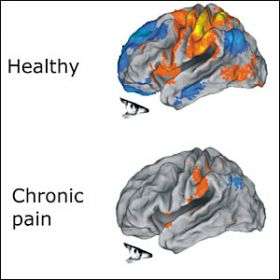
This illustration shows the same brain images from a different angle (same color codes as above). These show the brain from the left side, again demonstrating striking differences between chronic pain patients and healthy subjects. Credit: Northwestern University

People with unrelenting pain don't only suffer from the non-stop sensation of throbbing pain. They also have trouble sleeping, are often depressed, anxious and even have difficulty making simple decisions.

In a new study, investigators at Northwestern University's Feinberg School of Medicine have identified a clue that may explain how suffering long-term pain could trigger these other pain-related symptoms.

Researchers found that in a healthy brain all the regions exist in a state of equilibrium. When one region is active, the others quiet down. But in people with chronic pain, a front region of the cortex mostly associated with emotion "never shuts up," said Dante Chialvo, lead author and associate research professor of physiology at the Feinberg School. "The areas that are affected fail to deactivate when they should."

They are stuck on full throttle, wearing out neurons and altering their connections to each other.

This is the first demonstration of brain disturbances in chronic pain patients not directly
related to the sensation of pain. The study will be published Feb. 6 in The Journal of Neuroscience.

Chialvo and colleagues used functional magnetic resonance imaging (fMRI) to scan the brains of people with chronic low back pain and a group of pain-free volunteers while both groups were tracking a moving bar on a computer screen. The study showed the pain sufferers performed the task well but "at the expense of using their brain differently than the pain-free group," Chialvo said.

When certain parts of the cortex were activated in the pain-free group, some others were deactivated, maintaining a cooperative equilibrium between the regions. This equilibrium also is known as the resting state network of the brain. In the chronic pain group, however, one of the nodes of this network did not quiet down as it did in the pain-free subjects.

This constant firing of neurons in these regions of the brain could cause permanent damage, Chialvo said. "We know when neurons fire too much they may change their connections with other neurons and or even die because they can't sustain high activity for so long," he explained.

'If you are a chronic pain patient, you have pain 24 hours a day, seven days a week, every minute of your life," Chialvo said. "That permanent perception of pain in your brain makes these areas in your brain continuously active. This continuous dysfunction in the equilibrium of the brain can change the wiring forever and could hurt the brain."

Chialvo hypothesized the subsequent changes in wiring "may make it harder for you to make a decision or be in a good mood to get up in the morning. It could be that pain produces depression and the other reported abnormalities because it disturbs the balance of the brain as a whole."

He said his findings show it is essential to study new approaches to treat patients not just to control their pain but also to evaluate and prevent the dysfunction that may be generated in the brain by the chronic pain.

Source: Northwestern University


print this article email this article download pdf blog this article bookmark this article     Stumble it Digg this share on Facebook retweet share on Reddit add to delicious
Rate this story - 4.3 /5 (16 votes)

Rank Filter

Move the slider to adjust rank threshold, so that you can hide some of the comments.


Display comments: newest first

  • manifespo - Feb 07, 2008
    • Rank: not rated yet
    I wish they had the citation clearly on each article.

February 6, 2008 all stories

Comments: 1

4.3 /5 (16 votes)
  • Stumble this up

  • Digg this

  • share this

  • hide
  • Related Stories

  • Unlocking mysteries of the brain with PET
    created Oct 30, 2009 | popularity not rated yet | comments 0
  • Seeing is relieving: New hope for chronic pain sufferers
    created Oct 29, 2009 | popularity not rated yet | comments 0
  • Member of NFL Hall of Fame diagnosed with degenerative brain disease
    created Oct 28, 2009 | popularity not rated yet | comments 0
  • Childhood cancer survivors experience suicidal thoughts decades after diagnosis
    created Oct 23, 2009 | popularity not rated yet | comments 0
  • Nanowire biocompatibility in the brain: So far so good
    created Oct 22, 2009 | popularity not rated yet | comments 0


  • hide
  • Relevant PhysicsForums posts

  • Improving the brain through chemistry
    created 17 hours ago
  • Sleep / REM Sleep and homeostasis
    created Nov 07, 2009
  • The Biceps Reflex
    created Nov 05, 2009
  • Consequenses of striking a Vein and an artery?
    created Nov 05, 2009
  • More from Physics Forums - Medical Sciences

Other News

Developmental delay could stem from nicotinic receptor deletion

Medicine & Health / Genetics

created 3 hours ago | popularity 4.5 / 5 (2) | comments 0

The loss of a gene through deletion of genetic material on chromosome 15 is associated with significant abnormalities in learning and behavior, said a consortium of researchers led by Baylor College of Medicine in a report ...


House passes health care bill on close vote (AP)

Landmark health bill passes House on close vote

Medicine & Health / Health

created 11 hours ago | popularity 3.3 / 5 (7) | comments 1

(AP) -- The Democratic-controlled House narrowly passed far-reaching health care legislation, handing President Barack Obama a hard-won victory on his chief domestic priority though the road ahead in the ...


Children who often drink full-fat milk weigh less

Medicine & Health / Health

created Nov 03, 2009 | popularity 5 / 5 (4) | comments 5

Eight-year-old children who drink full-fat milk every day have a lower BMI than those who seldom drink milk. This is not the case for children who often drink medium-fat or low-fat milk. This is one conclusion of a thesis ...


Turn On, Tune In, Develop?

Turn On, Tune In, Develop? Researchers Examine How Brain Benefits From Musical Training

Medicine & Health / Neuroscience

created Nov 06, 2009 | popularity 5 / 5 (11) | comments 4

For most people music is an enjoyable, although momentary, form of entertainment. But for those who seriously practiced a musical instrument when they were young, perhaps when they played in a school orchestra ...


'All-natural' sex pill contains Viagra chemical: FDA

Medicine & Health / Medications

created Nov 05, 2009 | popularity 3 / 5 (2) | comments 4

The US food and drug safety watchdog warned Thursday that an over-the-counter men's sex aid, labeled as all-natural, contains a chemical similar to the active ingredient in Viagra and could be dangerous.