First Handheld Bluetooth RFID Reader
September 20, 2004
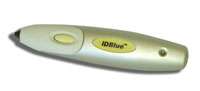
Cathexis Innovations Inc., a leader in RFID-enabling technologies, and Baracoda SA, which is at the forefront of Bluetooth wireless technology, announced today that they have developed and launched the beta version of the first handheld Bluetooth 13.56MHz RFID Reader, dubbed IDBlue™. The two companies have chosen a pen-type design for IDBlue™ that is revolutionary, given the device’s size, ease of use and versatility.
The design and shape of the IDBlue™ device — similar to a marker-pen — differentiate it from typical RFID handhelds readers (with ‘RFID’ standing for ‘Radio Frequency Identification’), making it truly innovative thanks to its size (small and lightweight) as well as its ease and flexibility of use. Indeed, IDBlue™ is compatible with a range of machines, from PDAs to PCs.
IDBlue™ is ideal for applications requiring pinpoint accuracy reading — a feature that is currently not possible with most RFID devices on the market today. In addition, the Bluetooth Reader developed by Baracoda and Cathexis is one of the first to harness the power of RFID.
While IDBlue™ is a horizontal technology, it is suitable for most industries. It is proving particularly attractive in the health care, defence and retail sectors for applications as diverse as inventory management, supply-chain and maintenance management, as well as document tracking.
Cathexis has teamed up with Baracoda to develop this next-generation Bluetooth RFID-model. As Steve Taylor, CEO of Cathexis, explains, “When I saw how Baracoda implemented Bluetooth into their other wireless mobility solutions, I knew we’d be a great team. By bringing both our strengths together, we created something revolutionary that all businesses could benefit from.”
The two companies are the first to create a Bluetooth reader that affords wireless freedom by eliminating the need for a wired connection between the RFID reader and the central database. Thomas Serval, president & CEO of Baracoda, explains, “We´re very excited about the capabilities of the Bluetooth RFID Reader. Its implications are huge for businesses. We believe our partnership with Cathexis will result not only in a lot more innovative products, but real solutions that will enable our users to increase efficiency and their bottom line. Because, in today’s business world, technology is the key to streamlining processes, improving reach and increasing value. And we can provide the solutions to achieve that".
-
The NutriSmart system would put RFIDs into your food for enhanced information
May 31, 2011 |
2.5 / 5 (4) |
10
-
Scientists design system using RFID devices to guide blind visitors inside unfamiliar buildings
Dec 16, 2010 |
not rated yet |
2
-
Go-anywhere tracking of first responders with WIISARD radio-frequency system
Nov 11, 2010 |
not rated yet |
1
-
Lastest graphene research could lead to improvements in bluetooth headsets and other devices
Oct 18, 2010 |
5 / 5 (7) |
2
-
Imec achieves breakthrough in battery-less radios
Feb 09, 2010 |
4.8 / 5 (17) |
2
-
Engineers build first sub-10-nm carbon nanotube transistor
Feb 01, 2012 |
4.9 / 5 (31) |
30
-
Something old, something new: Evolution and the structural divergence of duplicate genes
Jan 31, 2012 |
4.6 / 5 (7) |
1
-
The hidden nanoworld of ice crystals: Revealing the dynamic behavior of quasi-liquid layers
Jan 30, 2012 |
5 / 5 (3) |
1
-
Stock market network reveals investor clustering
Jan 27, 2012 |
3.9 / 5 (23) |
8
-
Of microchemistry and molecules: Electronic microfluidic device synthesizes biocompatible probes
Jan 26, 2012 |
5 / 5 (1) |
0
More news stories
Japan scientist makes 'Avatar' robot
A Japanese-developed robot that mimics the movements of its human controller is bringing the Hollywood blockbuster "Avatar" one step closer to reality.
14 hours ago |
5 / 5 (5) |
5
Intel packs performance and reliability into its latest SSD 520 series
Intel Corporation announced today its fastest, most robust client/consumer solid-state drive (SSD) to date, the Intel Solid-State Drive 520 Series (Intel SSD 520), a 6 gigabit-per-second (gbps) SATA III SSD ...
Feb 07, 2012 |
5 / 5 (1) |
4
Google rumored to have built Heads-Up-Display glasses prototype
(PhysOrg.com) -- 9to5Google is reporting that they have received a tip from someone they believe to be a reliable source saying that Google is working on a Heads-Up-Display (HUD) pair of eye-glasses. The per ...
Apple to debut 'iPad 3' in March: report
Apple will unveil a new version of its market-ruling iPad table computer in March, according to a report in Dow Jones-owned technology blog All Things D.
Electronics / Consumer & Gadgets
Feb 09, 2012 |
1.9 / 5 (21) |
0
New Kindle Touch is an impressive e-reader
When it comes to reading digital books, tablets are all the rage. But there's a lot to like about simple e-readers, which over the past year have become both a lot cheaper and a lot less clunky.
Electronics / Consumer & Gadgets
Feb 09, 2012 |
5 / 5 (3) |
1
Google users warned of threat to smartphone wallets
Users of Google smartphone wallets were being warned on Friday that there is a way to crack pass codes intended to thwart thieves from going on illicit shopping sprees.
Anonymous knocks CIA website offline (Update)
The website of the Central Intelligence Agency was inaccessible on Friday after the hacker group Anonymous claimed to have knocked it offline.
Complex wiring of the nervous system may rely on a just a handful of genes and proteins
Researchers at the Salk Institute have discovered a startling feature of early brain development that helps to explain how complex neuron wiring patterns are programmed using just a handful of critical genes. ...
Putting the squeeze on planets outside our solar system
(PhysOrg.com) -- Using high-powered lasers, scientists at Lawrence Livermore National Laboratory and collaborators discovered that molten magnesium silicate undergoes a phase change in the liquid state, abruptly ...
NASA sees wide-eyed cyclone Jasmine
Cyclone Jasmine's eye has opened wider on NASA satellite imagery, as it moves through the Southern Pacific Ocean.
New error-correcting codes guarantee the fastest possible rate of data transmission
Error-correcting codes are one of the triumphs of the digital age. Theyre a way of encoding information so that it can be transmitted across a communication channel such as an optical fiber o ...