Scientists make breakthrough in single-molecule sensing
February 6, 2008 Scientists make breakthrough in single-molecule sensing

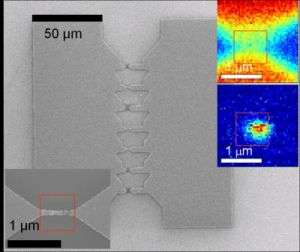
Rice University scientists used tiny gaps in narrow gold wires to simultaneously capture electronic and optical measurements of the same molecule. These scanning electron images show the wires and gaps. The color insets are maps of optical signals from the gap. Credit: D. Natelson/Rice University

In a study that could lay the foundation for mass-produced single-molecule sensors, physicists and engineers at Rice University have demonstrated a means of simultaneously making optical and electronic measurements of the same molecule.

The research, which is available online, is slated to appear in an upcoming issue of the journal Nano Letters. The experiments were performed on a nanoelectronic device consisting to two tiny electrodes separated by a molecule-sized gap. Using electric current, the researchers measured conduction through single molecules in the gap. In addition, light-focusing properties of the electrodes allowed the researchers to identify the molecule by a unique optical fingerprint.

"We can mass-produce these in known locations, and they have single-molecule sensitivity at room temperature in open air," said study co-author Douglas Natelson, associate professor of physics and astronomy and co-director of Rice's Quantum Magnetism Laboratory (QML). "In principle, we think the design may allow us to observe chemical reactions at the single-molecule level."

While scientists have used electronic and optical instruments to measure single molecules before, Rice's system is the first that allows both simultaneously -- a process known as "multimodal" sensing -- on a single small molecule.

The research sprang from a collaboration between Natelson's group -- where the electrodes were developed -- and Rice's Laboratory for Nanophotonics (LANP), where the simultaneous electronic and optical testing was performed. In research published last year, the two groups explained how the electrodes focus near-infrared light into the molecule-sized gap, increasing light intensity in the gap by as much as a million times. The increased intensity allows the team to collect unique optical signatures for molecules trapped there via a technique called surface enhanced Raman spectroscopy (SERS).

"Our latest results confirm that we have the sensitivity required to measure single molecules," said LANP Director Naomi Halas, the Stanley C. Moore Professor of Electrical and Computer Engineering and professor of chemistry. "That sensitivity, and the multimodal capabilities of this system, gives us a great tool for fundamental science at the nanoscale."

Daniel Ward, a student in Natelson's research group, built the electrodes from tiny gold wires on silicon wafers and performed the critical measurements. The group specializes in studying the electronic and magnetic properties of nanoscale objects -- particles and devices that are built with atomic precision. The devices are so small they can only be seen with certain types of microscopes, and even those provide unclear pictures at best. Natelson said the new multimodal device gives researchers a much clearer idea of what is going on by combining two different kinds of measurements, electronic and optical.

"Conduction across our electrodes is known to depend on a quantum effect called 'tunneling,'" Natelson said. "The gaps are so small that only one or two molecules contribute to the conduction. So when we get conduction, and we see the optical fingerprint associated with a particular molecule, and they track each other, then we know we're measuring a single molecule and we know what kind of molecule it is. We can even tell when it rotates and changes position."

Source: Rice University


print this article email this article download pdf blog this article bookmark this article     Stumble it Digg this share on Facebook retweet share on Reddit add to delicious
Rate this story - 4.6 /5 (28 votes)


February 6, 2008 all stories

Comments: 0

4.6 /5 (28 votes)
  • Stumble this up

  • Digg this

  • share this

  • hide
  • Related Stories

  • Researchers create molecular diode
    created Oct 22, 2009 | popularity not rated yet | comments 0
  • Researchers create molecular diode
    created Oct 13, 2009 | popularity not rated yet | comments 0
  • Photoswitches shed light on spontaneous free swimming in zebrafish (w/ Video)
    created Sep 16, 2009 | popularity not rated yet | comments 0
  • 'Flexible camera' replaces lens with fiber web
    created Jul 07, 2009 | popularity not rated yet | comments 0
  • Scientists develop novel ion trap for sensing force and light
    created Jul 01, 2009 | popularity not rated yet | comments 0


  • hide
  • Relevant PhysicsForums posts

Other News

Findings show nanomedicine promising for treating spinal cord injuries

Findings show nanomedicine promising for treating spinal cord injuries

Nanotechnology / Bio & Medicine

created 10 hours ago | popularity 4.3 / 5 (3) | comments 0

(PhysOrg.com) -- Researchers at Purdue University have discovered a new approach for repairing damaged nerve fibers in spinal cord injuries using nano-spheres that could be injected into the blood shortly ...


New Digital 'Electronics' Concept May Continue Moore's Law

New Digital 'Electronics' Concept May Continue Moore's Law

Nanotechnology / Nanophysics

created Nov 05, 2009 | popularity 4.6 / 5 (53) | comments 9

(PhysOrg.com) -- Computers of the future could be operating not on electrons, but on tiny waves traveling through an electron "fluid," if a new proposal is successful. The new circuit design, recently introduced ...


Nanoparticles for gene therapy improve

Nanoparticles for gene therapy improve

Nanotechnology / Bio & Medicine

created Nov 06, 2009 | popularity 5 / 5 (4) | comments 3

(PhysOrg.com) -- About five years ago, Professor Janet Sawicki at the Lankenau Institute in Pennsylvania read an article about nanoparticles developed by MIT's Robert Langer for gene therapy, the insertion ...


Breakthrough in industrial-scale nanotube processing

Breakthrough in industrial-scale nanotube processing

Nanotechnology / Nanomaterials

created Nov 02, 2009 | popularity 4.9 / 5 (20) | comments 3

(PhysOrg.com) -- Rice University scientists today unveiled a method for the industrial-scale processing of pure carbon-nanotube fibers that could lead to revolutionary advances in materials science, power ...


Scientists witness nature's complexity unfold in self-assembling quasicrystals

Scientists witness nature's complexity unfold in self-assembling quasicrystals

Nanotechnology / Nanomaterials

created Oct 31, 2009 | popularity 4.9 / 5 (17) | comments 3

(PhysOrg.com) -- Just a few decades ago, scientists believed that all ordered matter consists of self-repeating building blocks -- atoms, ions or molecules. In this view, the ordinary solids of everyday life ...