Transparent fish to make human biology clearer
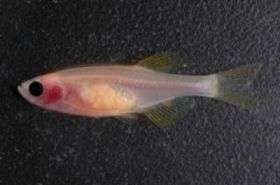
Zebrafish are genetically similar to humans and are good models for human biology and disease. Now, researchers at Children's Hospital Boston have created a zebrafish that is transparent throughout its life. The new fish allows scientists to directly view its internal organs, and observe processes like tumor metastasis and blood production after bone-marrow transplant in a living organism.
The fish, described in the February 7 issue of Cell Stem Cell, was created by Richard White, MD, PhD, a clinical fellow in the Stem Cell Program at Children's, with others in the laboratory of Leonard Zon, PhD.
The classic method for studying human diseases in animals is to allow the animal to get the disease, kill and dissect the animal, then ask, "what happened?" But in cancer and other fast-changing processes that traverse the body, this method is bound to miss something. "It's like taking a photograph when you need a video," says White, also an instructor of medicine at the Dana-Farber Cancer Institute.
Zebrafish embryos have enabled researchers to study disease in live organisms, since they are transparent. But zebrafish adults are opaque. "Everything after four weeks has been invisible to us," says White.
White's first experiment on the zebrafish examined how a cancer spreads. "The process by which a tumor goes from being localized to widespread and ultimately fatal is the most vexing problem that oncologists face," says White. "We don't know why cancer cells decide to move away from their primary site to other parts in the body."
White created a fluorescent melanoma tumor in the transparent fish's abdominal cavity. Viewing the fish under a microscope, White saw the cancer cells begin to spread within five days. He even saw individual cells metastasize, something that has not been observed, so readily and in real-time, in a living organism.
The spreading melanoma cells appeared to "home" to the skin after leaving the abdominal cavity. "This told us that when tumor cells spread to other parts in the body, they don't do it randomly," says White. "They know where to go."
White plans to study tumor cell homing, then look for ways to modify the tumor cells or cells of the host so that the spreading cells never find their new location.
The fish may also answer questions about stem cell transplants. While transplants of blood-forming stem cells help cancer patients rebuild healthy blood, some transplants don't "take," for reasons that are unknown. Scientists have lacked a full understanding what steps blood stem cells must take to do their job, says White.
White showed the process is observable in the fish. He first irradiated a transparent fish's bone marrow, then transplanted fluorescent blood-forming stem cells from another zebrafish. By four weeks, the fluorescent stem cells had visibly migrated and grown in the fish's bone marrow, which is in the kidney. Even individual stem cells were visible, something researchers haven't easily observed in a living organism, White says.
By studying how the stem cells embed and build blood in the fish, scientists can look for ways to help patients rebuild their blood faster. Drugs and genes could be tested in the living fish, with direct observation of results, White says.
White created the transparent fish simply by mating two existing zebrafish breeds. Zebrafish have three pigments in their skin—reflective, black, and yellow. White mated a breed that lacks reflective pigment, called "roy orbison," with one that lacks black pigment, called "nacre." The offspring had only yellow pigment in their skin, essentially looking clear. White named the new breed "casper."
The fish's brain, heart, and digestive tract are also visible, allowing researchers to study genetic defects of these organs from early embryonic development through adulthood. White hopes this tool will provide insight into how mutated genes cause diseases ranging from Alzheimer's disease to inflammatory bowel disease.
"What happens in a living organism is different than what happens in a dish," White says.
Source: Children's Hospital Boston


