3D breakthrough with updatable holographic displays
February 6, 2008
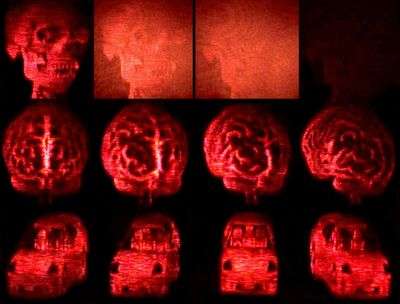
Top row: Erasing of the hologram; Mid and bottom rows: 3D images shown from different angles, demonstrating horizontal parallax. Credit: UA
University of Arizona optical scientists have broken a technological barrier by making three-dimensional holographic displays that can be erased and rewritten in a matter of minutes.
The holographic displays – which are viewed without special eyewear – are the first updatable three-dimensional displays with memory ever to be developed, making them ideal tools for medical, industrial and military applications that require "situational awareness."
"This is a new type of device, nothing like the tiny hologram of a dove on your credit card," UA optical sciences professor Nasser Peyghambarian said. "The hologram on your credit card is printed permanently. You cannot erase the image and replace it with an entirely new three-dimensional picture."
Watch Holographic Display Video: Mp4 (9Mb)
"Holography has been around for decades, but holographic displays are really one of the first practical applications of the technique," UA optical scientist Savas Tay said.
Dynamic hologram displays could be made into devices that help surgeons track progress during lengthy and complex brain surgeries, show airline or fighter pilots any hazards within their entire surrounding airspace, or give emergency response teams nearly real-time views of fast-changing flood situations or traffic problems, for example.
And no one yet knows where the advertising and entertainment industries will go with possible applications, Peyghambarian said. "Imagine that when you walk into the supermarket or department store, you could see a large, dynamic, three-dimensional product display," he said.
Tay, Peyghambarian, their colleagues from the UA College of Optical Sciences and collaborators from Nitto Denko Technical Corp., of Oceanside, Calif., report on the research in the Feb. 7 issue of the journal Nature.
Their device basically consists of a special plastic film sandwiched between two pieces of glass, each coated with a transparent electrode. The images are "written" into the light-sensitive plastic, called a photorefractive polymer, using laser beams and an externally applied electric field. The scientists take pictures of an object or scene from many two-dimensional perspectives as they scan their object, and the holographic display assembles the two-dimensional perspectives into a three-dimensional picture.
The Air Force Office of Scientific Research, which has funded Peyghambarian's team to develop updatable holographic displays, has used holographic displays in the past. But those displays have been static. They did not allow erasing and updating of the images. The new holographic display can show a new image every few minutes.
The 4-inch-by-4-inch prototype display that Peyghambarian, Tay and their colleagues created now comes only in red, but the researchers believe much larger displays in full color could be developed. They next will make 1-foot-by-1-foot displays, then 3-foot-by-3-foot displays.
"We use highly efficient, low-cost recording materials capable of very large sizes, which is very important for life-size, realistic 3-D displays," Peyghambarian said. "We can record complete scenes or objects within three minutes and can store them for three hours."
The researchers also are working to write images even faster using pulsed lasers.
"If you can write faster with a pulsed laser, then you can write larger holograms in the same amount of time it now takes to write smaller ones," Tay said. "We envision this to be a life-size hologram. We could, for example, display an image of a whole human that would be the same size as the actual person."
Tay emphasized how important updatable holographic displays could be for medicine.
"Three-dimensional imaging techniques are already commonly used in medicine, for example, in MRI (magnetic resonance imaging) or CT scan (computerized tomography) techniques," Tay said. "However, the huge amount of data that is created in three dimensions is still being displayed on two-dimensional devices, either on a computer screen or on a piece of paper. A great amount of data is lost by displaying it this way. So I think when we develop larger, full-color 3-D holograms, every hospital in the world will want one."
Citation: Nature, 2008. DOI: 10.1038/nature06596 (http://dx.doi.org/ … /nature06596)
Source: University of Arizona, By Lori Stiles
-
Under the microscope #4 - Liquid crystals
Jan 31, 2012 |
not rated yet |
0
-
Holographic 3-D looks tantalizingly closer in 2012
Dec 28, 2011 |
4.9 / 5 (29) |
21
-
Using Xbox Kinect, standard graphics chips, researchers achieve highest frame rate yet for streaming holographic video
Jan 24, 2011 |
4.5 / 5 (14) |
2
-
Apple patents an inexpensive 3-D projection system
Dec 03, 2010 |
4.3 / 5 (26) |
20
-
Researchers analyze performance of first updatable holographic 3D display
May 26, 2010 |
4.8 / 5 (23) |
10
-
Engineers build first sub-10-nm carbon nanotube transistor
Feb 01, 2012 |
4.9 / 5 (29) |
30
-
Something old, something new: Evolution and the structural divergence of duplicate genes
Jan 31, 2012 |
4.6 / 5 (7) |
1
-
The hidden nanoworld of ice crystals: Revealing the dynamic behavior of quasi-liquid layers
Jan 30, 2012 |
5 / 5 (3) |
1
-
Stock market network reveals investor clustering
Jan 27, 2012 |
3.9 / 5 (23) |
8
-
Of microchemistry and molecules: Electronic microfluidic device synthesizes biocompatible probes
Jan 26, 2012 |
5 / 5 (1) |
0
-
Pure energy
3 hours ago
-
How to remove the magnetic property for screw driver?
6 hours ago
-
How to magnetize a concrete wall?
10 hours ago
-
Upward speed of an object in water
11 hours ago
-
flipping quarks
11 hours ago
-
partial derivation question
11 hours ago
- More from Physics Forums - General Physics
More news stories
Borexino Collaboration succeeds in spotting pep neutrinos emitted from the sun
(PhysOrg.com) -- To learn more about how the sun works, scientists study particles that are emitted from it into space due to thermonuclear reactions that occur inside; by applying known physics principles, ...
Explained: Sigma
It's a question that arises with virtually every major new finding in science or medicine: What makes a result reliable enough to be taken seriously? The answer has to do with statistical significance -- but ...
56 minutes ago |
not rated yet |
0
Transparent iron? For the first time, an experiment shows that atomic nuclei can become transparent
At the high-brilliance synchrotron light source PETRA III, a team of DESY scientists headed by Dr. Ralf Röhlsberger has succeeded in making atomic nuclei transparent with the help of X-ray light. At the ...
19 hours ago |
5 / 5 (8) |
2
|
Physicists build highly efficient 'no-waste' laser
A team of University of California, San Diego researchers has built the smallest room-temperature nanolaser to date, as well as an even more startling device: a highly efficient, "thresholdless" laser that ...
19 hours ago |
5 / 5 (17) |
3
|
Unusual 'collapsing' iron superconductor sets record for its class
(PhysOrg.com) -- A team from the National Institute of Standards and Technology and the University of Maryland has found an iron-based superconductor that operates at the highest known temperature for a material ...
23 hours ago |
4.5 / 5 (4) |
3
|
Inspired by steel, nanomanufacturing gets wear-resistant carbide tip
(PhysOrg.com) -- Scientists at the University of Pennsylvania, the University of Wisconsin-Madison and IBM Research - Zurich have fabricated an ultrasharp silicon carbide tip possessing such high strength ...
Samsung can continue selling Galaxy tabs in Germany: court
South Korea's Samsung Electronics can continue to sell its Galaxy Tab 10.1N tablet computer in Germany, a German court ruled Thursday, rejecting a bid by arch-rival Apple to have them banned.
New views show old NASA Mars landers
(PhysOrg.com) -- The High Resolution Imaging Science Experiment (HiRISE) camera on NASA's Mars Reconnaissance Orbiter recorded a scene on Jan. 29, 2012, that includes the first color image from orbit showing ...
Engineers find inspiration for new materials in Piranha-proof armor
(PhysOrg.com) -- Its a matchup worthy of a late-night cable movie: put a school of starving piranha and a 300-pound fish together, and who comes out the winner?
Many companies fall short of social responsibility promises
(PhysOrg.com) -- Whether eliminating child labor, creating environmentally friendly technology or working against all forms of corruption, many corporations fail to become socially responsible despite promises to change, ...
With optimal conversations, young couples experience less relationship stress, higher satisfaction: study
(Medical Xpress) -- The happiest young couples may be involved in a different kind of engagement. Young adults who easily engage in rewarding conversations with their partners are less likely to hold onto anger and stress ...
Feb 06, 2008
Rank: 1 / 5 (1)
Isn't a Hololithic projection something that appears 3D, but actually isn't from all viewing angles, while a Hologram is something that has actual volume in 3 dimensions from any angle, like what they have on Star Trek?
Feb 07, 2008
Rank: 1 / 5 (2)
Feb 07, 2008
Rank: not rated yet
http://http://colossalstorage.net/home_OLED_tv.htm
Out7x,
Goto http://colossalstorage.net if your interested on how they are going to do storage.
Feb 13, 2008
Rank: not rated yet
"Imagine that when you walk into the supermarket or department store, you could see a large, dynamic, three-dimensional product display,"
Well, we see them all the time, and I think the real thing is more relevant to customers than its hologram.