Compact, wavelength-on-demand Quantum Cascade Laser chip created
February 6, 2008 Compact, wavelength-on-demand Quantum Cascade Laser chip created

Engineers at Harvard's School of Engineering and Applied Sciences have demonstrated a highly versatile, compact and portable Quantum Cascade Laser sensor for the fast detection of a large number of chemicals, ranging from infinitesimal traces of gases to liquids, by broad tuning of the emission wavelength. The potential range of applications is huge, including homeland security, medical diagnostics such as breadth analysis, pollution monitoring, and environmental sensing of the greenhouse gases responsible for global warming.

The team, which reported its findings in the Dec. 3 issue of Applied Physics Letters, was headed by Federico Capasso, the Robert L. Wallace Professor of Applied Physics and Vinton Hayes Senior Research Fellow in Electrical Engineering, and includes graduate student Benjamin Lee, researchers Mikhail Belkin and Jim MacArthur, and undergraduate Ross Audet, all of Harvard's School of Engineering and Applied Sciences. The researchers have also filed for U.S. patents covering this new class of laser chips.

The broad emission spectrum of the Quantum Cascade Laser material, grown by a commercial reactor used for the mass production of semiconductor lasers, is designed using state-of-the-art nanotechnology by controlling the size of nanometric thin quantum wells in the active region.

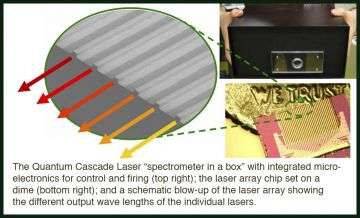
An array of 32 lasers, each designed to emit at a specific wavelength, is then fabricated on a single chip by standard semiconductor processing techniques to have a size of less than one-fourth of a dime. A microcomputer individually fires up and tunes each laser in the array in any desired sequence. This generates a broad and continuously tunable wavelength spectrum that can be used to detect a large number of chemical compounds.

"Our versatile laser spectrometer currently emits any wavelengths between 8.7 and 9.4 microns, in the so-called 'molecular fingerprint region' where most molecules have their telltale absorption features which uniquely identify them," Belkin says. "This ability to design a broad laser spectrum anywhere in the fingerprint region holds the promise of replacing the bulky and large infrared spectrometers currently used for chemical analysis and sensing."

The tunability of the laser chip can be extended up to 10-fold and several widely spaced absorption features can be targeted with the same chip, which will enable the detection in parallel of an extremely large number of trace gases in concentrations of parts per billion in volume. A portable compact spectrometer with this capability would revolutionize chemical sensing.

"These millimeter-size laser chips exploit the inherent enormous wavelength agility of state-of-the-art Quantum Cascade Lasers," says Capasso, who co-invented them in 1994 at Bell Labs. "As a first application we have shown that these widely tunable and extremely compact sensors can measure the spectrum of liquids with the same accuracy and reproducibility of state-of-the-art infrared spectrometers, but with inherently greater spectral resolution."

Source: Harvard University


print this article email this article download pdf blog this article bookmark this article     Stumble it Digg this share on Facebook retweet share on Reddit add to delicious
Rate this story - 4.6 /5 (16 votes)

Rank Filter

Move the slider to adjust rank threshold, so that you can hide some of the comments.


Display comments: newest first

  • h0dges - Feb 06, 2008
    • Rank: not rated yet
    One step closer to the star trek tricorder...
  • zevkirsh - Feb 06, 2008
    • Rank: not rated yet
    this is officially half on and off the quantum hook.

February 6, 2008 all stories

Comments: 2

4.6 /5 (16 votes)
  • Stumble this up

  • Digg this

  • share this

  • hide
  • Related Stories

  • Portable and precise gas sensor could monitor pollution and detect disease
    created Sep 25, 2009 | popularity not rated yet | comments 0
  • Portable and precise gas sensor could monitor pollution and detect disease
    created Sep 18, 2009 | popularity not rated yet | comments 0
  • Tiny lasers plug the 'green gap'
    created Apr 30, 2009 | popularity not rated yet | comments 0
  • Making quantum cryptography practical
    created Apr 30, 2009 | popularity not rated yet | comments 0
  • Scientists demonstrate laser with controlled polarization
    created Apr 13, 2009 | popularity not rated yet | comments 0


  • hide
  • Relevant PhysicsForums posts

  • about water pressure
    created 3 hours ago
  • Egg shaped movement
    created 3 hours ago
  • photons...
    created 11 hours ago
  • Why does air way collapse when pressure outside exceeds pressure inside?
    created 12 hours ago
  • More from Physics Forums - General Physics

Other News

Ionic Liquid's Makeup Measurably Non-Uniform at the Nanoscale

Physics / Condensed Matter

created 19 hours ago | popularity not rated yet | comments 0

(PhysOrg.com) -- Researchers at Texas Tech University, Queen's University in Belfast, Ireland, the University of Rome and the National Research Council in Italy recently made a discovery about the non-uniform chemical compositions ...


Sculptured materials allow multiple channel plasmonic sensors

Physics / Optics & Photonics

created 19 hours ago | popularity 5 / 5 (2) | comments 0

(PhysOrg.com) -- Sensors, communications devices and imaging equipment that use a prism and a special form of light -- a surface plasmon-polariton -- may incorporate multiple channels or redundant applications if manufacturers ...


The LHC tunnel

Peckish bird briefly downs big atom smasher

Physics / General Physics

created Nov 09, 2009 | popularity 3.9 / 5 (10) | comments 16

A peckish bird briefly knocked out part of the world's biggest atom smasher by causing a chain reaction with a piece of bread, the European Organisation for Nuclear Research (CERN) said Monday.


First Bose-Einstein condensation of strontium

First Bose-Einstein condensation of strontium

Physics / Quantum Physics

created Nov 09, 2009 | popularity 5 / 5 (7) | comments 4

In an international first, scientists from the Institute of Quantum Optics and Quantum Information (IQOQI, Austria) produced a Bose-Einstein condensate of the alkaline-earth element strontium, thus narrowly ...


Quantum gas microscope offers glimpse of quirky ultracold atoms

Quantum gas microscope offers glimpse of quirky ultracold atoms

Physics / Quantum Physics

created Nov 04, 2009 | popularity 4.7 / 5 (18) | comments 4

(PhysOrg.com) -- Physicists at Harvard University have created a quantum gas microscope that can be used to observe single atoms at temperatures so low the particles follow the rules of quantum mechanics, ...