Shear Ingenuity: Tweaking the Conductivity of Nanotube Composites
February 6, 2008 Shear Ingenuity: Tweaking the Conductivity of Nanotube Composites

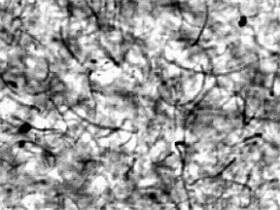
Confocal microscope image of a carbon nanotube/polypropylene composite. Small concentrations of carbon nanotubes–here about one percent by mass–can change the electrical properties of the polymer dramatically. Credit: NIST

One of the immediate applications of carbon nanotubes (CNT) is as an additive to polymers to create electrically conducting plastics—a relatively low CNT concentration can dramatically change the polymer‘s electrical conductivity by orders of magnitude, from an insulator to a conductor.

New measurements by scientists at the National Institute of Standards and Technology (NIST) have uncovered an intriguing wrinkle. For a given CNT concentration, the electrical properties of the composite can be tuned from being a conductor to a non-conductor simply by changing processing conditions—basically how fast the polymer flows.

Carbon nanotubes—sheets of graphite rolled up into nanoscale hollow cylinders—are under intense scrutiny for a wide range of materials applications. The NIST study shows how the conductivity and dielectric properties of these mixtures depend on flow and how they change once flow has stopped. These property changes have relevance to the process design of these materials in a long list of potential applications for conducting plastics including transparent electrodes, antennas, electronic packaging, sensors, automotive paint, anti-static fuel hoses and aircraft components.

The NIST researchers augmented a standard instrument, a shear rheometer, normally used for viscosity measurements, to simultaneously measure conductivity and dielectric properties Using this “rheo-dielectric spectrometer,” they discovered that the conductivity of the nanocomposite dramatically decreases with increasing flow rate, effectively changing the material from a conductor to an insulator.

This extraordinary sensitivity of the conductivity (and other properties) to flow is prevalent near a characteristic CNT concentration where an interpenetrating CNT network first forms. Surprisingly, once the flow is removed, they found that the nanocomposite reverts back to its original conductivity.

Based on these measurements, the NIST team proposed a theoretical model that successfully accounts for these dramatic effects. This model quantitatively predicts the observed conductor-insulator transition and is useful for optimizing and controlling the properties of these new polymer-nanotube composites.

Citation: J. Obrzut, J.F. Douglas, S.B. Kharchenko and K. B. Migler. Shear-induced conductor-insulator transition in melt-mixed polypropylene-carbon nanotube dispersions. Physical Review B 76, 195420-2007. Nov. 15, 2007.

Source: NIST


print this article email this article download pdf blog this article bookmark this article     Stumble it Digg this share on Facebook retweet share on Reddit add to delicious
Rate this story - 4.5 /5 (19 votes)


February 6, 2008 all stories

Comments: 0

4.5 /5 (19 votes)
  • Stumble this up

  • Digg this

  • share this

  • hide
  • Related Stories


  • hide
  • Relevant PhysicsForums posts

  • Ceramic Powder processing progress - urgent
    created 18 hours ago
  • Thin Film Laboratory resources
    created Nov 27, 2009
  • Theoretical air URGENT
    created Nov 26, 2009
  • photoconductivity of polymers
    created Nov 25, 2009
  • More from Physics Forums - Materials & Chemical Engineering

Other News

Nanowire Formation

Nanowires key to future transistors, electronics

Nanotechnology / Nanophysics

created Nov 26, 2009 | popularity 4.8 / 5 (8) | comments 2

(PhysOrg.com) -- A new generation of ultrasmall transistors and more powerful computer chips using tiny structures called semiconducting nanowires are closer to reality after a key discovery by researchers ...


Water droplets direct self-assembly process in thin-film materials

Nanotechnology / Nanomaterials

created Nov 23, 2009 | popularity 5 / 5 (4) | comments 2

You can think of it as origami - very high-tech origami. Researchers at the University of Illinois have developed a technique for fabricating three-dimensional, single-crystalline silicon structures from thin films by coupling ...


Using superconducting probes to get a picture of what it's like inside CNTs

Nanotechnology / Nanophysics

created Nov 20, 2009 | popularity 4.4 / 5 (9) | comments 0

(PhysOrg.com) -- "Carbon nanotubes are exciting for fundamental physics, and for potential technological applications," Nadya Mason tells PhysOrg.com. "However, we are generally limited in the way that we can study them. ...


Peptides control crystal growth with 'switches, throttles and brakes'

Peptides control crystal growth with 'switches, throttles and brakes'

Nanotechnology / Bio & Medicine

created Nov 23, 2009 | popularity 4.8 / 5 (5) | comments 0

(PhysOrg.com) -- By producing some of the highest resolution images of peptides attaching to mineral surfaces, scientists have a deeper understanding how biomolecules manipulate the growth crystals. This research ...


Fast, easy, and highly sensitive arsenic detection with gold nanoparticles

Nanotechnology / Nanomaterials

created Nov 25, 2009 | popularity 5 / 5 (1) | comments 0

(PhysOrg.com) -- Mention of arsenic poisoning usually brings to mind underhanded murder. However, the danger of arsenic poisoning from contaminated drinking water is far greater. Low concentrations of arsenic are found in ...