'Nitty-Gritty' but Vital Data Helps Field Rescue Robots
February 6, 2008
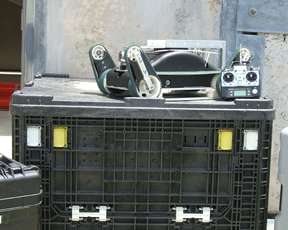
Urban search and rescue robot and its control unit sit atop one of the packing crates stipulated in a new ASTM International standard designed to help first responders manage storage and transportation logistics. Credit: NIST
A new ASTM International standard for urban search and rescue robots and components tackles humble logistics problems that, left unsolved, could hamper the use of life-saving robots in major disasters.
The advance, formally agreed to recently, is one result of a three-year National Institute of Standards and Technology coordinated effort with first responders and robot manufacturers to develop urban search and rescue robot consensus standards. The new standard details specific ways to describe requirements for the storage, shipping and deployment of urban search and rescue robots.
Sensor-laden robots, ranging from ball-shaped survey devices that can be thrown into disaster sites to radio-operated crawlers capable of exploring ruins and even rotary-winged aerial reconnaissance drones, are recognized as holding tremendous potential as additions to the responder’s toolkit.
The new voluntary standard reflects a priority expressed in a series of NIST-coordinated workshops to accelerate the development and deployment of such urban search and rescue robots and components. Federal Emergency Management Agency (FEMA) regional task force members and other first responders, technology developers and robot vendors said that access to standardized information concerning urban search and rescue robot logistics attributes would help response team managers integrate the devices into their operations.
A standard data form lists information relevant to robots that would be deployed for 10 days without re-supply for the first 72 hours. Seemingly mundane but essential information—the number and types of cases required for packing the robot and all associated components (such as sensors, tethers, operator control stations spare parts and specialized tools), for instance—should enable logistics managers to allocate appropriate warehouse space as well as transportation accommodations for shipment to and from the disaster site.
Estimates on the time required to unpack, set up and repair units also will help potential users estimate a realistic time to deployment. Finally data on the actual weight of the robots and its components should allow users to plan how to transport the devices to the worksite from the base of operations.
Further information on NIST’s urban search and rescue robot performance standards project, which is sponsored by the Department of Homeland Security (DHS) Science and Technology Directorate, can be found at http://www.isd.mel … ot_Standards . Additional information on the new standard, ASTM E2592-07, “Standard Practice for Evaluating Cache Packaged Weight and Volume of Robots for Urban Search and Rescue,” can be found at http://www.astm.org .
Source: NIST
-
Studying butterfly flight to help build bug-size flying robots
Feb 02, 2012 |
5 / 5 (2) |
1
-
Foldable robot scooter wows at Tokyo Motor Show
Dec 01, 2011 |
3.8 / 5 (4) |
4
-
NIST tests help ensure reliable wireless alarm beacons for first responders
Aug 17, 2011 |
not rated yet |
0
-
Practice can make search-and-rescue robot operators more accurate
May 05, 2011 |
not rated yet |
0
-
GoQBot: Caterpillars inspire new movements in soft robots (w/ video)
Apr 27, 2011 |
not rated yet |
0
-
Engineers build first sub-10-nm carbon nanotube transistor
Feb 01, 2012 |
4.9 / 5 (33) |
30
-
Something old, something new: Evolution and the structural divergence of duplicate genes
Jan 31, 2012 |
4.6 / 5 (7) |
1
-
The hidden nanoworld of ice crystals: Revealing the dynamic behavior of quasi-liquid layers
Jan 30, 2012 |
5 / 5 (4) |
1
-
Stock market network reveals investor clustering
Jan 27, 2012 |
3.9 / 5 (23) |
8
-
Of microchemistry and molecules: Electronic microfluidic device synthesizes biocompatible probes
Jan 26, 2012 |
5 / 5 (2) |
0
-
How to calculate total compressibility in liquid porous solid system
2 hours ago
-
Need help reading 3-D
22 hours ago
-
A way to send and receive wireless data
Feb 11, 2012
-
Calling function with no input argument
Feb 10, 2012
-
Force free body diagram problem on gym equipment
Feb 10, 2012
-
Empirical data regarding shower heads and water
Feb 10, 2012
- More from Physics Forums - General Engineering
More news stories
Google might launch Drive for cloud storage soon
(PhysOrg.com) -- Google's next big move, according to the Wall Street Journal, is a cloud storage service called Drive. Hardly first to the plate, Google is simply catching up to introducing its cloud reposi ...
Iran blocks email, restricts net access: reports
Iran has further restricted access to the Internet and blocked popular email services for the past few days, in a move a top lawmaker said could "cost the regime dearly," media reports said on Sunday.
4 hours ago |
5 / 5 (1) |
3
Love a click away in Indonesia's Twitter Republic
He was a geeky kid from Yogyakarta, she a glamorous city girl in Jakarta. In a country with one of the world's most vibrant social networking scenes they fell in love on Twitter.
12 hours ago |
4 / 5 (1) |
0
Walney offshore wind farm is world's biggest (for now)
(PhysOrg.com) -- The Walney wind farm on the Irish Sea--characterized by high tides, waves and windy weather--officially opened this week. The farm is treated in the press as a very big deal as the Walney ...
Navy to begin tests on electromagnetic railgun prototype launcher
The Office of Naval Research (ONR)'s Electromagnetic (EM) Railgun program will take an important step forward in the coming weeks when the first industry railgun prototype launcher is tested at a facility ...
Feb 06, 2012 |
4.5 / 5 (17) |
94
|
Overeating may double risk of memory loss
New research suggests that consuming between 2,100 and 6,000 calories per day may double the risk of memory loss, or mild cognitive impairment (MCI), among people age 70 and older. The study was released today and will be ...
Scientists discover molecular secrets of 2,000-year-old Chinese herbal remedy
For roughly two thousand years, Chinese herbalists have treated Malaria using a root extract, commonly known as Chang Shan, from a type of hydrangea that grows in Tibet and Nepal. More recent studies suggest that halofuginone, ...
New method to examine batteries -- MRI from the inside
There is an ever-increasing need for advanced batteries for portable electronics, such as phones, cameras, and music players, but also to power electric vehicles and to facilitate the distribution and storage of energy derived ...
Lab study raises questions over nano-particle impact
Tests involving chickens have raised questions about the impact on health from engineered nano-particles, the ultra-fine grains commonly used in drugs and processed foods, scientists said on Sunday.
Injured boomers beware: Know when to see doctor
(AP) -- It happened to nurse Jane Byron years after an in-line skating fall, business owner Haralee Weintraub while doing "men's" push-ups, and avid cyclist Gene Wilberg while lifting a heavy box.
A mitosis mystery solved: How chromosomes align perfectly in a dividing cell
Although the process of mitotic cell division has been studied intensely for more than 50 years, Whitehead Institute researchers have only now solved the mystery of how cells correctly align their chromosomes during symmetric ...