Clues to African archaeology found in lead isotopes
Microscopic specs of lead are offering clues about the enormous cultural changes that swept across northern Africa a thousand years ago. At The University of Arizona in Tucson, a young archaeologist is analyzing lead traces in artifacts to shed light on the relatively little-understood archaeology of Africa, especially the period marked by the spread of the new religion of Islam.
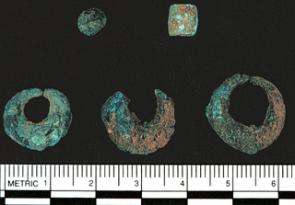
Thomas R. Fenn, a doctoral student in the UA anthropology department, is unraveling evidence of centuries-old trade patterns across the Sahara Desert by identifying smelted metal artifacts, mainly copper, found in the continent's sub-Saharan regions.
As Islamic forces moved across northern Africa, they set in motion trading opportunities between the arid lands bordering the Mediterranean and the dense jungles and savannahs south of the Sahara.
One of the questions Fenn wants to answer concerns the sources of copper and other raw materials that became manufactured goods that were traded throughout the region. Specifically, why were metal workers in a sophisticated metallurgical industry in the sub-Sahara importing copper ingots when there were perfectly good copper ore deposits nearby?
Knowing where these and other materials originated, said Fenn, may offer larger insights about not only trade, but also about technologies, economics and social organization. Who controlled bankable natural resources and transportation routes? How was labor distributed in these societies?
David J. Killick, a UA associate professor of anthropology and expert on the archaeology of metallurgy in Africa, said tracing metals is a crucial part of understanding the development of trade in Africa.
"Most of the money circulating in the western half of the Islamic world between the 11th and 16th centuries was minted with gold from sub-Saharan west Africa, and competition for the wealth generated by the trade fueled the growth of major West African states like Ghana, Mali and Songhai," Killick said.
Using a process called lead isotope ratio analysis, or LIA, Fenn has examined more than 100 Iron-Age artifacts, most of them copper, from sub-Saharan Africa. The experiments were done in the W.M. Keck Isotope and Trace Element Laboratory at the UA. The lab is partially funded by the National Science Foundation and run by Joaquin Ruiz, a professor of geosciences and dean of the UA College of Science.
"LIA is extremely accurate as a forensic tool in identifying lead traces found in metal ores," said John Chesley, a research scientist in the UA department of geosciences who developed the laboratory and analytical techniques for Fenn's project.
Lead has four different isotopes, three of which occur as the natural decay of uranium and thorium. The isotopic ratios change as a function of time. Smelting doesn't change the ratios, making them a virtual fingerprint for a metal's source of origin. Scientists need only about 100 billionth of a gram for analysis.
The trick, said Chesley, is making sure the sample remains completely free of contamination. The process takes about two weeks, but offers a high degree of certainty of linking objects to their source. LIA has been used successfully to determine the sources of non-ferrous metals from sites in other parts of the world for years, but its use in African archaeology is fairly recent.
"In reality, I am dating the deposition of the ores on a geological timescale - millions of years - but I am not dating them within an archaeological time scale," Fenn said. "I am, in fact, using the geological age, derived from the lead isotope ratios, as a means of provenancing raw and refined copper metals, and metallurgical debris, to a potential ore source based on the similarity of their geological age, i.e., their lead isotope ratios, as well as by examining and comparing their chemical compositions."
From his analysis, Fenn theorizes that the ore used to make the copper ornaments and other items found in the sites in West Africa likely came from North Africa. He said merchants there traded gold from regions like present-day Niger for copper from the north via camel caravans across the desert.
Refined copper, Fenn said, likely was prized as a commodity that fit in with the value system of the region, where it was easily worked into ornamental objects and other items that could be bartered for other goods and services.
Source: University of Arizona


