Madagascar's tortoises are crawling toward extinction, groups say
February 7, 2008
Madagascar's tortoises are crawling toward extinction, groups say

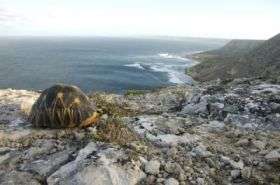
A radiated tortoise at Cap Saint Marie -- a protected area on the southernmost tip of Madagascar. Credit: Julie Larsen Maher/Wildlife Conservation Society

Madagascar’s turtles and tortoises, which rank among the most endangered reptiles on earth, will continue to crawl steadily toward extinction unless major conservation measure are enacted, according to a recent assessment by the Wildlife Conservation Society and other groups.

The groups, which met for four days in Madagascar’s capital city Antananarivo, said there is still hope to save these ancient animals, but time is running out as their habitat continues to shrink and illegal hunting worsens.

Five of the nine assessed species have been downgraded to critically endangered, with one variety – the ploughshare tortoise – now numbering only a few hundred individuals. The other critically endangered species include the radiated tortoise, flat-tailed tortoise, spider tortoise and Madagascar big-headed turtle, all of which are found nowhere else on earth.

“Madagascar’s ancient tortoises and turtles are marching toward extinction unless an all-out effort is made to protect these living national treasures,” said Dr. James Deutsch, director for the Wildlife Conservation Society’s Africa programs. “The good news is that there’s still time to save Madagascar’s tortoises and turtles from extinction, and we know how to tackle the issues.”

The workshop participants concluded that illegal trade continues to be the largest single threat for several of critically endangered species. Ploughshare, spider and flat-tailed tortoises, along with juvenile radiated tortoises, are particularly coveted by collectors and traded as pets on the international black market. Meanwhile, adult radiated tortoises are sold for food in regional markets in Tuléar and Fort-Dauphin.

In order to combat these illegal activities, the workshop participants recommended the creation of a “tortoise brigade” to monitor and control illegal trade. Confiscated tortoises could be repatriated to areas where populations had been decimated by illegal trade, and with subsequent enforcement eco-tourism opportunities could follow.

Moreso, the participants recognized that Madagascar’s traditions that once protected tortoises needed to be revitalized. Therefore, working with local people was identified as an essential component of any future conservation effort. The groups went onto say that more survey work was needed to identify unprotected tortoise populations, as well as increased captive breeding and reintroduction efforts.

The Wildlife Conservation Society, which operates field projects throughout the island nation, will open Madagascar! on June 19th – a new exhibit at its Bronx Zoo headquarters that showcases the country’s amazing biodiversity including radiated and spider tortoises. The exhibit will also be a state-of-the-art energy efficient, green building, and the first land-marked building in New York to receive a Leadership in Energy and Environmental Design (LEED) gold certification.

Source: Wildlife Conservation Society


Rank 5 /5 (2 votes)
Tags

Relevant PhysicsForums posts

More news stories

A mitosis mystery solved: How chromosomes align perfectly in a dividing cell

Although the process of mitotic cell division has been studied intensely for more than 50 years, Whitehead Institute researchers have only now solved the mystery of how cells correctly align their chromosomes during symmetric ...

Biology / Cell & Microbiology

created 2 hours ago | popularity 5 / 5 (3) | comments 0 | with audio podcast

The proteins ensuring genome protection

Researchers from the University of Geneva (UNIGE), Switzerland, have discovered the crucial role of two proteins in developing a cell 'anti-enzyme shield'. This protection system, which operates at the level of molecular ...

Biology / Cell & Microbiology

created 2 hours ago | popularity 5 / 5 (2) | comments 0 | with audio podcast

Researchers find extensive RNA editing in human transcriptome

In a new study published online in Nature Biotechnology, researchers from BGI, the world's largest genomics organization, reported the evidence of extensive RNA editing in a human cell line by analysis of RNA-seq data, demons ...

Biology / Biotechnology

created 2 hours ago | popularity 5 / 5 (3) | comments 0 | with audio podcast

Entire genome of extinct human decoded from fossil

(PhysOrg.com) -- In 2010, Svante Pääbo and his colleagues presented a draft version of the genome from a small fragment of a human finger bone discovered in Denisova Cave in southern Siberia. The ...

Biology / Biotechnology

created Feb 07, 2012 | popularity 4.7 / 5 (58) | comments 48 | with audio podcast

Why are there so few fish in the Earth's oceans?

(PhysOrg.com) -- A Stony Brook University researcher has found that, contrary to popular belief, there are not plenty of fish in the sea.

Biology / Plants & Animals

created Feb 08, 2012 | popularity 4.3 / 5 (17) | comments 27 | with audio podcast


Scientists discover molecular secrets of 2,000-year-old Chinese herbal remedy

For roughly two thousand years, Chinese herbalists have treated Malaria using a root extract, commonly known as Chang Shan, from a type of hydrangea that grows in Tibet and Nepal. More recent studies suggest that halofuginone, ...

New method to examine batteries -- MRI from the inside

There is an ever-increasing need for advanced batteries for portable electronics, such as phones, cameras, and music players, but also to power electric vehicles and to facilitate the distribution and storage of energy derived ...

Google might launch Drive for cloud storage soon

(PhysOrg.com) -- Google's next big move, according to the Wall Street Journal, is a cloud storage service called Drive. Hardly first to the plate, Google is simply catching up to introducing its cloud reposi ...

Lab study raises questions over nano-particle impact

Tests involving chickens have raised questions about the impact on health from engineered nano-particles, the ultra-fine grains commonly used in drugs and processed foods, scientists said on Sunday.

Starve a virus, feed a cure? Findings show how some cells protect themselves against HIV

A protein that protects some of our immune cells from the most common and virulent form of HIV works by starving the virus of the molecular building blocks that it needs to replicate, according to research published online ...

Injured boomers beware: Know when to see doctor

(AP) -- It happened to nurse Jane Byron years after an in-line skating fall, business owner Haralee Weintraub while doing "men's" push-ups, and avid cyclist Gene Wilberg while lifting a heavy box.