Barnacles go to great lengths for sex
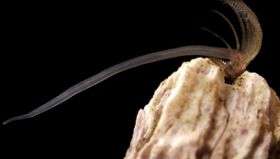
Compelled to mate, yet firmly attached to the rock, barnacles have evolved the longest penis of any animal for their size - up to eight times their body length - so they can find and fertilize distant neighbours.
Unlike animals that travel long distances to breeding grounds under a wide range of conditions, barnacles reproduce by extending impressively long penises to find and fertilize distant mates. (Barnacles are hermaphrodites, so they can mate with male or female neighbours).
However, such long penises pose a major challenge because many inter-tidal barnacle species live under a wide range of wave conditions in which water velocities greatly vary. Consequently, individuals with penises well suited for mating in quiet waters may be poorly suited for copulating on wave-exposed shores.
The research, conducted at Bamfield Marine Sciences Centre on Vancouver Island by biological sciences graduate student Chris Neufeld and his supervisor Richard Palmer, compared intertidal barnacles (Balanus glandula) in calm, protected harbours, with those from wave-exposed shores.
"Our results showed that barnacles appear to have acquired the capacity to change the size and shape of their penises to closely match local wave conditions," said Neufeld.
"When wave action is light, a longer (thinner) penis can reach more mates, but at times of higher wave action, a shorter (stouter) penis is more manoeuvrable in flow and therefore can reach more mates." In addition, when moved from their original shore, barnacles could modify their anatomy to suit the surrounding water conditions.
Published in the Proceedings of the Royal Society B, the research suggests that sexual selection - competition with other males, female choice, sexual conflict between males and females - is not required to explain variation in genital form. In barnacles, this variation appears to be driven largely by the hydrodynamic conditions experienced under breaking waves.
"Put another way," said Neufeld, "barnacles select mates simply by being able to reach them, not by what they may look like when they get there."
Source: University of Alberta


