First documented case of pest resistance to biotech cotton
February 7, 2008
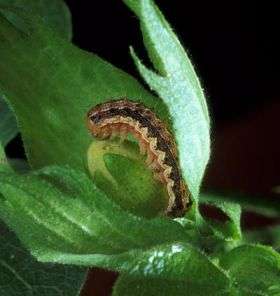
A bollworm, Helicoverpa zea, munches down on a cotton flower bud. This pest insect eats all parts of the cotton plant. In some places, bollworm have as many as six generations in one growing season. Credit: US Department of Agriculture
A pest insect known as bollworm is the first to evolve resistance in the field to plants modified to produce an insecticide called Bt, according to a new research report. Bt-resistant populations of bollworm, Helicoverpa zea, were found in more than a dozen crop fields in Mississippi and Arkansas between 2003 and 2006.
"What we're seeing is evolution in action," said lead researcher Bruce Tabashnik. "This is the first documented case of field-evolved resistance to a Bt crop.”
Bt crops are so named because they have been genetically altered to produce Bt toxins, which kill some insects. The toxins are produced in nature by the widespread bacterium Bacillus thuringiensis, hence the abbreviation Bt.
The bollworm resistance to Bt cotton was discovered when a team of University of Arizona entomologists analyzed published data from monitoring studies of six major caterpillar pests of Bt crops in Australia, China, Spain and the U.S. The data documenting bollworm resistance were first collected seven years after Bt cotton was introduced in 1996.
"Resistance is a decrease in pest susceptibility that can be measured over human experience," said Tabashnik, professor and head of UA's entomology department and an expert in insect resistance to insecticides. "When you use an insecticide to control a pest, some populations eventually evolves resistance."
The researchers write in their report that Bt cotton and Bt corn have been grown on more than 162 million hectares (400 million acres) worldwide since 1996, “generating one of the largest selections for insect resistance ever known."
Even so, the researchers found that most caterpillar pests of cotton and corn remained susceptible to Bt crops.
"The resistance occurred in one particular pest in one part of the U.S.," Tabashnik said. "The other major pests attacking Bt crops have not evolved resistance. And even most bollworm populations have not evolved resistance."
The field outcomes refute some experts' worst-case scenarios that predicted pests would become resistant to Bt crops in as few as three years, he said.
“The only other case of field-evolved resistance to Bt toxins involves resistance to Bt sprays," Tabashnik said. He added that such sprays have been used for decades, but now represent a small proportion of the Bt used against crop pests.
The bollworm is a major cotton pest in the southeastern U.S. and Texas, but not in Arizona. The major caterpillar pest of cotton in Arizona is a different species known as pink bollworm, Pectinophora gossypiella, which has remained susceptible to the Bt toxin in biotech cotton.
Tabashnik and his colleagues' article, "Insect resistance to Bt crops: evidence versus theory," will be published in the February issue of Nature Biotechnology. His co-authors are Aaron J. Gassmann, a former UA postdoctoral fellow now an assistant professor at Iowa State University; David W. Crowder, a UA doctoral student; and Yves Carrière, a UA professor of entomology. Tabashnik and Carrière are members of UA's BIO5 Institute.
"Our research shows that in Arizona, Bt cotton reduces use of broad-spectrum insecticides and increases yield," said Carrière. Such insecticides kill both pest insects and beneficial insects.
To delay resistance, non-Bt crops are planted near Bt crops to provide "refuges" for susceptible pests. Because resistant insects are rare, the only mates they are likely to encounter would be susceptible insects from the refuges. The hybrid offspring of such a mating generally would be susceptible to the toxin. In most pests, offspring are resistant to Bt toxins only if both parents are resistant.
In bollworm, however, hybrid offspring produced by matings between susceptible and resistant moths are resistant. Such a dominant inheritance of resistance was predicted to make resistance evolve faster.
The UA researchers found that bollworm resistance evolved fastest in the states with the lowest abundance of refuges.
The field outcomes documented by the global monitoring data fit the predictions of the theory underlying the refuge strategy, Tabashnik said.
Although first-generation biotech cotton contained only one Bt toxin called Cry1Ac, a new variety contains both Cry1Ac and a second Bt toxin, Cry2Ab. The combination overcomes pests that are resistant to just one toxin.
The next steps, Tabashnik said, include conducting research to understand inheritance of resistance to Cry2Ab and developing designer toxins to kill pests resistant to Cry1Ac.
Source: University of Arizona
-
New bacteria toxins against resistant insect pests
Oct 19, 2011 |
5 / 5 (3) |
0
-
Genetic engineers create smarter toxins to help crops fight resistant pests
Oct 09, 2011 |
4 / 5 (3) |
20
-
New insect birth control strategy zaps cotton pests
Nov 07, 2010 |
4.8 / 5 (4) |
1
-
GM crops protect neighbors from pests
Sep 18, 2008 |
3 / 5 (2) |
0
-
Entomologists devise new test for insecticide resistance
Jan 10, 2012 |
not rated yet |
0
-
Engineers build first sub-10-nm carbon nanotube transistor
Feb 01, 2012 |
4.9 / 5 (29) |
30
-
Something old, something new: Evolution and the structural divergence of duplicate genes
Jan 31, 2012 |
4.6 / 5 (7) |
1
-
The hidden nanoworld of ice crystals: Revealing the dynamic behavior of quasi-liquid layers
Jan 30, 2012 |
5 / 5 (3) |
1
-
Stock market network reveals investor clustering
Jan 27, 2012 |
4 / 5 (22) |
8
-
Of microchemistry and molecules: Electronic microfluidic device synthesizes biocompatible probes
Jan 26, 2012 |
5 / 5 (1) |
0
More news stories
Study shows how DNA finds its match
It's been more than 50 years since James Watson and Francis Crick showed that DNA is a double helix of two strands that complement each other. But how does a short piece of DNA find its match, out of the millions ...
2 hours ago |
5 / 5 (2) |
0
|
Obstacles no barrier to higher speeds for worms, researchers find
Obstacles in an organism's path can help it to move faster, not slower, researchers from New York University's Applied Math Lab at the Courant Institute of Mathematical Sciences have found through a series ...
4 hours ago |
3 / 5 (1) |
3
|
Transformational fruit fly genome catalog completed
Scientists searching for the genomics version of the holy grail more insight into predicting how an animal's genes affect physical or behavioral traits now have a reference manual that should ...
2 hours ago |
5 / 5 (1) |
0
|
Tiny primate 'talks' in ultrasound
One of the world's smallest primates, the Philippine tarsier, communicates in a range of ultrasound inaudible to predator and prey alike, according to a study published on Wednesday.
11 hours ago |
4.8 / 5 (5) |
0
Scared of a younger rival? Not for some male songbirds
When mature male white-crowned sparrows duel to win a mate or a nesting territory, a young bird just doesn't get much respect.
11 hours ago |
4 / 5 (2) |
0
|
Short fasting cycles work as well as chemotherapy in mice
Man may not live by bread alone, but cancer in animals appears less resilient, judging by a study that found chemotherapy drugs work better when combined with cycles of short, severe fasting.
Physicists build highly efficient 'no-waste' laser
A team of University of California, San Diego researchers has built the smallest room-temperature nanolaser to date, as well as an even more startling device: a highly efficient, "thresholdless" laser that ...
Transparent iron? For the first time, an experiment shows that atomic nuclei can become transparent
At the high-brilliance synchrotron light source PETRA III, a team of DESY scientists headed by Dr. Ralf Röhlsberger has succeeded in making atomic nuclei transparent with the help of X-ray light. At the ...
Quantum physicist explains $100K offer for proof scaled-up quantum computing is impossible
(PhysOrg.com) -- MIT researcher Scott Aaronson has certainly riled the physics community with his offer this past Friday, of $100,000 to anyone who can prove that scaled-up quantum computing is impossible. ...
'Explorers,' who embrace the uncertainty of choices, use specific part of cortex
Life shrouds most choices in mystery. Some people inch toward a comfortable enough spot and stick close to that rewarding status quo. Out to dinner, they order the usual. Others consider their options systematically ...
Scientists delve into the brain roots of hunger and eating
Synaptic plasticity the ability of the synaptic connections between the brain's neurons to change and modify over time -- has been shown to be a key to memory formation and the acquisition of new learning behaviors. ...
Feb 11, 2009
Rank: not rated yet
Feb 11, 2009
Rank: not rated yet
I am more worried about the failure of refuge strategy itself because ultimately the refuge plants will be outcompeted by Bt-carrying plants and what then? Add to this the possibility of Bt-carriers mating with not-carriers thus spreading the transgene, thus transforming the refuge itself, and so apart from failure of refuge-strategy, you also have an essential loss of biodiversity at hand!