Knee brace generates electricity from walking
February 7, 2008
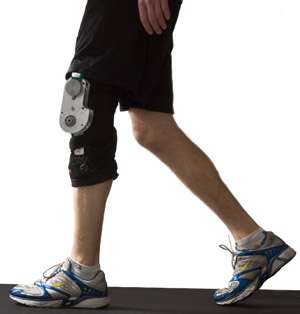
The biomechanical energy harvester includes an aluminum chassis and generator mounted on a customized orthopaedic knee brace. The device weighs 3.5 lbs. Credit: Greg Ehlers/Simon Fraser University
A new energy-capturing knee brace can generate enough electricity from walking to operate a portable GPS locator, a cell phone, a motorized prosthetic joint or an implanted neurotransmitter, research involving the University of Michigan shows.
A report on the device is published in the Feb. 8 issue of the journal Science. Authors include researchers from Simon Fraser University in Canada and the University of Pittsburgh, in addition to U-M.
The wearable mechanism works much like regenerative braking charges a battery in some hybrid vehicles, said Arthur Kuo, an associate professor of mechanical engineering at U-M and an author of the paper.
Regenerative brakes collect the kinetic energy that would otherwise be dissipated as heat when a car slows down. This knee brace harvests the energy lost when a human brakes the knee after swinging the leg forward to take a step.
Kuo, who called the device "a cocktail-napkin idea," says knee joints are uniquely suited for this endeavor.
"There is power to be harvested from various places in the body, and you can use that to generate electricity. The knee is probably the best place," he said. "During walking, you dissipate energy in various places, when your foot hits the ground, for example. You have to make up for this by performing work with your muscles.
"The body is clever," Kuo said. "In a lot of places where it could be dissipating energy, it may actually be storing it and getting it back elastically. Your tendons act like springs. In many places, we're not sure whether the energy is really being dissipated or you're just storing it temporarily. We believe that when you're slowing down the knee at the end of swinging the leg, most of that energy normally is just wasted."
The scientists tested the knee brace on six men walking leisurely on a treadmill at 1.5 meters per second, or 2.2 miles per hour. They measured the subjects' respiration to determine how hard they were working. A control group wore the brace with the generator disengaged to measure how the weight of the 3.5-pound brace affected the wearer.
In the mode in which the brace is only activated while the knee is braking, the subjects required less than one watt of extra metabolic power for each watt of electricity they generated. A typical hand-crank generator, for comparison, takes an average of 6.4 watts of metabolic power to generate one watt of electricity because of inefficiencies of muscles and generators.
"We've demonstrated proof of concept," Kuo said. "The prototype device is bulky and heavy, and it does affect the wearer just to carry. But the energy generation part itself has very little effect on the wearer, whether it is turned on or not. We hope to improve the device so that it is easier to carry, and to retain the energy-harvesting capabilities."
A lighter version would be helpful to hikers or soldiers who don't have easy access to electricity. And the scientists say similar mechanisms could be built into prosthetic knees other implantable devices such as pacemakers or neurotransmitters that today require a battery, and periodic surgery to replace that battery.
"A future energy harvester might be implanted along with such a device and generate its own power from walking," Kuo said.
Source: University of Michigan
-
Getting caffeine fix as easy as taking deep breath
Feb 08, 2012 |
5 / 5 (1) |
0
-
Competitive soccer linked to increased injuries and menstrual dysfunction in girls
Feb 07, 2012 |
not rated yet |
0
-
Nanodiamond coatings safe for implants: study
Feb 05, 2012 |
5 / 5 (8) |
5
-
Markerless motion capture offers a new angle on tennis injuries
Jan 17, 2012 |
not rated yet |
0
-
Researchers seek ways to beef up military armor
Nov 21, 2011 |
not rated yet |
0
-
Engineers build first sub-10-nm carbon nanotube transistor
Feb 01, 2012 |
4.9 / 5 (30) |
30
-
Something old, something new: Evolution and the structural divergence of duplicate genes
Jan 31, 2012 |
4.6 / 5 (7) |
1
-
The hidden nanoworld of ice crystals: Revealing the dynamic behavior of quasi-liquid layers
Jan 30, 2012 |
5 / 5 (3) |
1
-
Stock market network reveals investor clustering
Jan 27, 2012 |
3.9 / 5 (23) |
8
-
Of microchemistry and molecules: Electronic microfluidic device synthesizes biocompatible probes
Jan 26, 2012 |
5 / 5 (1) |
0
-
Empirical data regarding shower heads and water
2 hours ago
-
feed hold button on CNC lathe
21 hours ago
-
Mechanics of Solids ( Final exam question) please help!
23 hours ago
-
RFAC in Fortran
Feb 09, 2012
-
dynamics 2/32
Feb 08, 2012
-
dynamics
Feb 08, 2012
- More from Physics Forums - General Engineering
More news stories
Soraa LED light may dim 50-watt halogen rivals
(PhysOrg.com) -- Soraa, a Fremont, California company founded in 2008, this week launched its first product, a light that uses LEDS (light emitting diodes). The "Soraa LED MR16 lamp" is the "perfect" replacement ...
Samsung can continue selling Galaxy tabs in Germany: court
South Korea's Samsung Electronics can continue to sell its Galaxy Tab 10.1N tablet computer in Germany, a German court ruled Thursday, rejecting a bid by arch-rival Apple to have them banned.
20 hours ago |
3.7 / 5 (3) |
3
Digital photos could put kids at risk
A study published in the International Journal of Electronic Security and Digital Forensics this month suggests that parents and carers could be putting children at risk if they upload digital photos that are automatically "geota ...
16 hours ago |
5 / 5 (1) |
3
Google launches Chrome browser for Android smartphones
With more and more people connecting to the Internet through a phone or a tablet instead of a PC, Google Inc. is bringing its fast-growing browser, Chrome, to the newest Android-powered mobile devices.
18 hours ago |
5 / 5 (4) |
0
Model analyzes shape-memory alloys for use in earthquake-resistant structures
Recent earthquake damage has exposed the vulnerability of existing structures to strong ground movement. At the Georgia Institute of Technology, researchers are analyzing shape-memory alloys for their potential ...
16 hours ago |
5 / 5 (1) |
0
|
'Dark plasmons' transmit energy
Microscopic channels of gold nanoparticles have the ability to transmit electromagnetic energy that starts as light and propagates via "dark plasmons," according to researchers at Rice University.
FDA-approved drug rapidly clears amyloid from the brain, reverses Alzheimer's symptoms in mice
Neuroscientists at Case Western Reserve University School of Medicine have made a dramatic breakthrough in their efforts to find a cure for Alzheimer's disease. The researchers' findings, published in the journal Science, show t ...
Hydrogen from acidic water: Researchers develop potential low cost alternative to platinum for splitting water
A technique for creating a new molecule that structurally and chemically replicates the active part of the widely used industrial catalyst molybdenite has been developed by researchers with the Lawrence Berkeley ...
Ultraviolet protection molecule in plants yields its secrets
Lying around in the sun all day is hazardous not just for humans but also for plants, which have no means of escape. Ultraviolet (UV) radiation from the sun can damage proteins and DNA inside cells, leading ...
Anyone can learn to be more inventive, cognitive researcher says
There will always be a wild and unpredictable quality to creativity and invention, says Anthony McCaffrey, a cognitive psychology researcher at the University of Massachusetts Amherst, because an "Aha moment" is rare and ...
Engineers find inspiration for new materials in Piranha-proof armor
(PhysOrg.com) -- Its a matchup worthy of a late-night cable movie: put a school of starving piranha and a 300-pound fish together, and who comes out the winner?
Feb 08, 2008
Rank: not rated yet
Feb 08, 2008
Rank: not rated yet