Science, not romance, controls mating at Smithsonian's National Zoo
This Valentine’s Day, Cupid won’t be making a stop at the Smithsonian’s National Zoo. Unlike the spontaneous attraction that most humans equate with love and romance, mating and dating at the National Zoo is planned, strategic and science-based—quite an unromantic encounter.
Successful breeding is often much more complicated than putting a male and female together and expecting nature to take its course. Animals in captivity need to be managed carefully to ensure the most genetically diverse population—which leads to healthier animals and a sustainable population that can safeguard a species from extinction.
The National Zoo facilitates this controlled and strategic breeding through its participation in the Species Survival Plan, a cooperative population management program among the Association of Zoos and Aquariums. Species Survival Plans maintain the pedigree of each animal in a particular program and make breeding recommendations for those animals based on which is most genetically important, as well as taking into account whether the facility has space for potential offspring. Without a Species Survival Plan, animal populations are at risk of stagnation and eventual extinction. The plan ensures both a good genetic match and an environment that enables optimal breeding conditions for the animal, such as healthy diets and environmental control.
At the National Zoo, having a pair of animals with the right genetics is only half the battle in successful breeding. The science of managing the animals and ensuring they have the right habitat for their needs are also essential to successful reproduction. National Zoo animal care staff are experts in ensuring quality habitat and have had numerous successes during the past years in captive breeding.
-- The Zoo’s cheetah population requires strategic planning prior to breeding times due to their notorious resistance to reproduce. Scientists at the Zoo’s Cheetah Conservation Station found that when two females are housed together, either one or both females will shut down ovulation, making it difficult to breed them with the male cheetahs. In order to create suitable breeding conditions, the Zoo has housed its female cheetahs separately since the opening of the Cheetah Conservation Station in 1992. National Zoo scientists have also monitored cheetah breeding based on age, weight and artificial insemination.
-- The kori bustard, a large African bird, requires flat, savanna-like terrain, secluded “hiding” spots and a proper male-to-female ratio to adequately perform during breeding season. Scientists at the National Zoo used a “telemetric” egg placed under the bird to learn more about how this species incubates its eggs. This technology records incubation temperature and the rate of turning, sending the data from the egg to a receiver that records data on each egg for 24 hours a day.
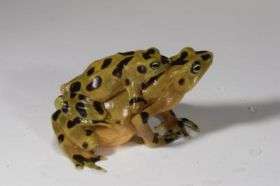
-- The Panamanian golden frog, now extinct in the wild, has a unique style of breeding. Male golden frogs are quite persistent when it comes to mating and will attach themselves to a specific female for 120 days before mating with her. Since females must lay their eggs in dark areas, scientists create wet, humid environments by covering the tanks with dark plastic, misting the inside for a prolonged period while the females lay their eggs. The National Zoo is one of six zoos in North America to have a specialized breeding program for this amphibian.
-- At the Invertebrates exhibit, biologists began studying how to breed Hercules beetles in captivity. These insects are most active and ready to breed after dark, but when brought into human care, these beetles often lose their interest in mating and spend most of their time eating. The only option for reproduction so far has been hand pairing, which requires a zookeeper to hold the female beetle with one hand and place the male on top of the female’s back in the proper direction to initiate breeding.
-- Sometimes two animals might be the right genetic match but moving them to the same facility is not feasible. In these cases, the National Zoo’s world-renowned reproductive science team steps in with assisted reproductive techniques. The Zoo’s female giant panda and one of their elephants have both undergone artificial insemination procedures with sperm from males at different facilities. The Zoo’s first successful elephant birth from artificial insemination occurred in 2001 when Shanthi was artificially inseminated using new catheter and ultrasound techniques developed by Zoo scientists.
Source: Smithsonian


