Teams battle to on-screen victory
February 8, 2008
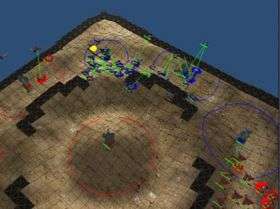
A screenshot of pre-programmed strategies for a match between two of the teams participating in MIT's BattleCode programming competition held during IAP.
Tanks, soldiers, snipers, mortars and bombers fanned out rapidly over unfamiliar undulating terrain, searching for their enemy counterparts and trying to seize control of battle towers. Some armies swarmed frenetically over the land, searching and fighting as they went, while others moved cautiously while staying huddled in a tight group, building their strength slowly and methodically.
Hundreds of spectators watched and cheered Feb. 1 as the rival armies battled it out on giant screens in Kresge Auditorium. Out of 150 teams that signed up to write the programs controlling those battle swarms during IAP, the best eight, chosen after a full day of one-to-one matches earlier in the week, slogged it out for the final victory in a double-elimination tournament.
The BattleCode software competition has become an annual tradition at MIT, and this year's battle was the fastest, most complex and most detailed yet. As second-year computer sciences student Joel Stein, one of the event's organizers, explained before the final tournament, the 300 students who participated ended up writing a total of 350,000 lines of computer code.
The BattleCode contest has become an even bigger event than MIT's fabled 6.270 annual autonomous robot competition, Stein said.
Although the teams who wrote the code stood on the stage and narrated the action while the battles unfolded, they had no control over the action at that point--everything was determined by the strategies built into the software ahead of time, and by the vagaries of the undulating terrain, filled with obstacles, whose contours were different in each round of the contest.
In the end, adaptability and responsiveness won the day. A team called "in memory of James Albrecht," whose program was especially adept at discerning its opponents' strategies and modifying its own accordingly, swept to victory in a record about as strong as that of the New England Patriots. The team, named in honor of an MIT senior who died last summer and had been a former teammate, lost only a single game out of the 16 played through to the finals.
The four-member winning team walked away with the $5,000 first prize, as well as several additional prizes, but overall more than 20 teams ended up with cash prizes, certificates and trophies by the evening's end, and even the hundreds of spectators got a free T-shirt just for watching the action. In addition to cash awards totaling $40,000 for the top 16 teams (donated by a long list of corporate sponsors), prizes were awarded for everything from cleverest strategy and most-unusual formation (one team had its soldiers dash out onto the field to form the letters "LOL" before actually beginning to fight) to the best team name.
BattleCode is also known as course 6.370, and contestants whose code was good enough to overcome a basic reference program and who wrote up descriptions of the strategy they used earned six credits for participating.
Following last week's final tournament, there is also an open version of the contest that can be entered by anyone outside the MIT community. That final competition will be held in March.
Source: MIT, by David Chandler
-
Russia 'drills into' Antarctic subglacial lake
Feb 06, 2012 |
4.8 / 5 (11) |
13
-
Major electric utility buys US Solar Decathlon winner
Jan 30, 2012 |
not rated yet |
0
-
British team devises method for separating carbon nanotubes cheaply
Jan 19, 2012 |
5 / 5 (8) |
1
-
Planck instrument loses its cool
Jan 17, 2012 |
4.7 / 5 (11) |
18
-
New automated imaging to greatly speed whole-brain mapping efforts
Jan 15, 2012 |
4.3 / 5 (14) |
3
-
Engineers build first sub-10-nm carbon nanotube transistor
Feb 01, 2012 |
4.9 / 5 (31) |
30
-
Something old, something new: Evolution and the structural divergence of duplicate genes
Jan 31, 2012 |
4.6 / 5 (7) |
1
-
The hidden nanoworld of ice crystals: Revealing the dynamic behavior of quasi-liquid layers
Jan 30, 2012 |
5 / 5 (3) |
1
-
Stock market network reveals investor clustering
Jan 27, 2012 |
3.9 / 5 (23) |
8
-
Of microchemistry and molecules: Electronic microfluidic device synthesizes biocompatible probes
Jan 26, 2012 |
5 / 5 (1) |
0
-
Need help reading 3-D
17 hours ago
-
A way to send and receive wireless data
23 hours ago
-
Calling function with no input argument
Feb 10, 2012
-
Force free body diagram problem on gym equipment
Feb 10, 2012
-
Empirical data regarding shower heads and water
Feb 10, 2012
-
feed hold button on CNC lathe
Feb 09, 2012
- More from Physics Forums - General Engineering
More news stories
Google might launch Drive for cloud storage soon
(PhysOrg.com) -- Google's next big move, according to the Wall Street Journal, is a cloud storage service called Drive. Hardly first to the plate, Google is simply catching up to introducing its cloud reposi ...
Love a click away in Indonesia's Twitter Republic
He was a geeky kid from Yogyakarta, she a glamorous city girl in Jakarta. In a country with one of the world's most vibrant social networking scenes they fell in love on Twitter.
6 hours ago |
4 / 5 (1) |
0
Europeans protest controversial Internet pact
Tens of thousands of people marched in protests in more than a dozen European cities Saturday against a controversial anti-online piracy pact that critics say could curtail Internet freedom.
22 hours ago |
4.6 / 5 (9) |
1
Walney offshore wind farm is world's biggest (for now)
(PhysOrg.com) -- The Walney wind farm on the Irish Sea--characterized by high tides, waves and windy weather--officially opened this week. The farm is treated in the press as a very big deal as the Walney ...
Navy to begin tests on electromagnetic railgun prototype launcher
The Office of Naval Research (ONR)'s Electromagnetic (EM) Railgun program will take an important step forward in the coming weeks when the first industry railgun prototype launcher is tested at a facility ...
Feb 06, 2012 |
4.7 / 5 (16) |
93
|
Injured boomers beware: Know when to see doctor
(AP) -- It happened to nurse Jane Byron years after an in-line skating fall, business owner Haralee Weintraub while doing "men's" push-ups, and avid cyclist Gene Wilberg while lifting a heavy box.
Latin America mining boom clashes with conservation
Latin America is experiencing a mining boom as prices rise fuelled by a hike in global demand, but the region is also being hit by a wave of violent protests, strikes and rallies by environmentalists.
Explained: Sigma
It's a question that arises with virtually every major new finding in science or medicine: What makes a result reliable enough to be taken seriously? The answer has to do with statistical significance -- but ...
Political leaders play key role in how worried Americans are by climate change: study
More than extreme weather events and the work of scientists, it is national political leaders who influence how much Americans worry about the threat of climate change, new research finds.
NASA budget will axe Mars deal with Europe: scientists
US President Barack Obama's budget proposal to be submitted next week for 2013 will cut NASA's budget by 20 percent and eliminate a major partnership with Europe on Mars exploration, scientists said Thursday.
New power source discovered
(PhysOrg.com) -- Researchers at the Massachusetts Institute of Technology (MIT) and RMIT University have made a breakthrough in energy storage and power generation.