Earth's orbit creates more than a leap year
February 8, 2008 Earth's orbit creates more than a leap year

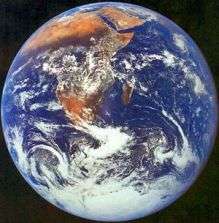
Earth's orbit creates more than leap years. Image courtesy of NASA

The Earth's orbital behaviors are responsible for more than just presenting us with a leap year every four years. According to Michael E. Wysession, Ph.D., associate professor of earth and planetary sciences in Arts & Sciences at Washington University in St. Louis, parameters such as planetary gravitational attractions, the Earth's elliptical orbit around the sun and the degree of tilt of our planet's axis with respect to its path around the sun, have implications for climate change and the advent of ice ages.

People often think of orbits as circular, but they're not that smooth and simple. They are often a less-than-perfect eccentric circle.

"All planets travel in an ellipse around the sun, but the shape of that ellipse oscillates," he explains. "When the Earth's orbit is more elliptical, the planet spends more time farther away from the sun, and the Earth gets less sunlight over the course of the year. These periods of more-elliptical orbits are separated by about 100,000 years. Ice ages occur about every 100,000 years, and they line up exactly with this change in the Earth's elliptical shape."

The purpose of the leap year is to keep our artificial calendars aligned with what the Earth actually does in its orbit around the sun and to ensure that roughly at noon on the winter solstice (Dec. 21) each year, the same point on the Earth is tilted toward the sun.

As in much of nature, the process is both neat and messy.

Wandering solstice

While we are accustomed to thinking that the Earth takes 365 days to go around the sun, it actually takes about 365.25 days. Thus, every four years the quarter days add up to one whole day. If the quarter days were unaccounted for, the solstice would wander away from its Dec. 21 date over time.

"Earth's 24 hour day is a transient thing," Wysession says. "It actually takes 23 hours, 56 minutes and four seconds to make one revolution around its axis — that is, to go all the way around so that the stars will appear in the same point in the sky day after day.

"However, during that time, the Earth also has moved one more day along its orbit around the sun, so it actually has to spin a little bit more for the sun to arrive back in the same place in the sky. This amount of time is three minutes and 56 seconds, which makes the 24 hours."

However, Wysession notes that our time units — 60 seconds, 60 minutes, 24 hours — would mean nothing had humans evolved 100 million years earlier or later because the Earth spun much faster then, and today, like aging baby boomers, it is slowing down.

Extreme seasons in the future

Despite what many people believe, seasons on Earth are not determined by the nearness of the northern and summer hemispheres to the sun.

"Seasons occur because in January, for instance, the North Pole points away from the sun, so the southern hemisphere gets more direct sunlight," Wysession says. "Six months later, that will be reversed. In terms of climate change, this has an impact because land heats up much more quickly than water, five times more quickly. The northern hemisphere has most of the land on Earth; the southern has most of the water. On January 3 or 4 (it varies) the Earth is at its closest point to the sun (the perihelion), but because water heats up so slowly, it doesn't make as much difference in temperature in the southern hemisphere as it otherwise might.

"In the northern hemisphere summer, despite the Earth being farther away from the sun, land heats up much more quickly than the southern hemisphere's water, and heats up about the same amount consistently. The two hemispheres end up buffering the climate swing, producing less severe winters than we would have otherwise."

Stick around, though, if you like extremes. Wysession says that in the future, the Earth will be farther away from the sun in winter and closer to it in the summer, causing more severe temperature swings in these two seasons. This will happen about 12,000 years from now.

"Orbital parameters of Earth, the sun and moon and the planets have great effects on ice ages and other climatic changes," he says. "Those major events are driven by very small changes in the planetary orbital functions."

Source: Washington University in St. Louis


print this article email this article download pdf blog this article bookmark this article     Stumble it Digg this share on Facebook retweet share on Reddit add to delicious
Rate this story - 4.6 /5 (35 votes)

Rank Filter

Move the slider to adjust rank threshold, so that you can hide some of the comments.


Display comments: newest first

  • out7x - Feb 09, 2008
    • Rank: 2 / 5 (4)
    Poo-poo to those global warmers who believe CO2 is the dominant factor.
  • mikiwud - Feb 11, 2008
    • Rank: 1 / 5 (1)
    We were taught the basics of this at school in the 1950s,but to the Gorites it is another inconvenient truth. Sigh! you can't teach sheep!
  • EarthScientist - Feb 14, 2008
    • Rank: 1 / 5 (1)
    there is no global warming from a greenhouse effect.Its grid revv and we have different anomalous energetic processes that return with perfect periodicity,just as the weather anomalies of late and the magma heating is from this extra energy coming into our grid field,just as our 10.5 year solar max cycle is just remnants of energy returning to us and cometary showers are not dirthy snowballs ,you foolish NASA boys,you boys need to go home and stay there.Cometary showers are left over core remnants from the 28 thou ago system explosion and since our crystalline ammonia core pulls energy to it from our grid field,it also pulls aetheric energy to it when on an oxygen line and so is very bright from that process and draws things to it from that fact of gravity in our engineered system. This Earth Scientist says so and says you boys will eventually get in line,this has gone on long enough.

February 8, 2008 all stories

Comments: 3

4.6 /5 (35 votes)
  • Stumble this up

  • Digg this

  • share this

  • hide
  • Related Stories

  • The Stars My Destination
    created 17 hours ago | popularity not rated yet | comments 0
  • Commercialization of new solar technology to boost solar efficiency
    created Nov 09, 2009 | popularity not rated yet | comments 0
  • Kepler Mission Update
    created Nov 06, 2009 | popularity not rated yet | comments 0
  • Starring Intelligent Aliens
    created Nov 05, 2009 | popularity not rated yet | comments 0
  • New type of supernova explosion reported; predicted by theoretical physicists at UCSB
    created Nov 05, 2009 | popularity not rated yet | comments 0


  • hide
  • Relevant PhysicsForums posts

  • upcoming GRL paper shows CO2 fraction is constant
    created 2 hours ago
  • Is there a point to buying organic?
    created 5 hours ago
  • cycles
    created Nov 08, 2009
  • The Origin of the term 'fossil' fuels
    created Nov 05, 2009
  • More from Physics Forums - Earth

Other News

Rapid star formation spotted in 'stellar nurseries' of infant galaxies

Rapid star formation spotted in 'stellar nurseries' of infant galaxies

Space & Earth / Astronomy

created 4 hours ago | popularity not rated yet | comments 0

The Universe's infant galaxies enjoyed rapid growth spurts forming stars like our sun at a rate of up to 50 stars a year, according to scientists at Durham University.


Reducing greenhouse gases may not be enough to slow climate change

Space & Earth / Environment

created 4 hours ago | popularity 3 / 5 (2) | comments 1

Georgia Tech City and Regional Planning Professor Brian Stone publishes a paper in the December edition of Environmental Science and Technology that suggests policymakers need to address the influence of global deforestation ...


The Stars My Destination

The Stars My Destination

Space & Earth / Space Exploration

created 17 hours ago | popularity 4.8 / 5 (18) | comments 0

The Voyager spacecraft are now in the outermost layer of the heliosphere, traveling toward interstellar space - the first man-made spacecraft to travel such a vast distance from Earth.


Earth

Atomic Particles Help Solve Planetary Puzzle

Space & Earth / Earth Sciences

created 16 hours ago | popularity 4.7 / 5 (9) | comments 0

(PhysOrg.com) -- A University of Arkansas professor and his colleagues have shown that the Earth's mantle contains the same isotopic signatures from magnesium as meteorites do, suggesting that the planet formed ...


The 2009 Leonid Meteor Shower

The 2009 Leonid Meteor Shower

Space & Earth / Space Exploration

created 17 hours ago | popularity 5 / 5 (2) | comments 0

This year's Leonid meteor shower peaks on Tuesday, Nov. 17th. If forecasters are correct, the shower should produce a mild but pretty sprinkling of meteors over North America followed by a more intense outburst ...