Researchers produce nanowires easier, faster than before
February 8th, 2008 Researchers produce nanowires easier, faster than before

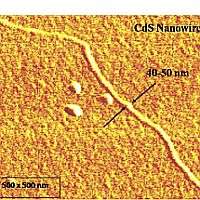
A section of nanowire produced by Texas A&M mechanical engineering researchers postdoctoral researcher Subrata Kundu and associate professor Hong Liang. The electrically conducting nanowire is about 1/1,000 the width of a human hair and could be used in developing nanoscale electronic devices.

Sometimes simpler is better. Engineering researchers at Texas A&M University have developed a new way to produce ultra-thin electricity-conducting wire that is simpler and faster than existing processes.

"Other methods used to produce nanowires use high temperatures and high pressure," said Subrata Kundu, a post-doctoral researcher in the research group of Hong Liang, an associate professor in Texas A&M's Department of Mechanical Engineering. "This method is much simpler and faster."

Kundu and Liang described the process in an article in the current issue of the journal Advanced Materials.

The process developed by Kundu and Liang works by shining ultraviolet light on a mixture of strands of DNA, cadmium sulfate and thioacetamide for about six hours. UV light breaks thioacetamide to produce sulfide ions (S2-). Chemical changes produced by the UV light allow the cadmium sulfate molecules to bind to the DNA. The resulting nanowires — about 1,000 times thinner than a human hair — conduct electricity and could be used in the development of so-called nano-scale electronic devices like small chips to make tiny computer or medical devices.

Nano-scale devices range in size from the size of a molecule to about 100 nanometers. One meter is 1 billion nanometers long.

Liang and Kundu plan to continue research in this area using different metals — lead, zinc and molybdenum — to produce the nanowires. Kundu said working with the other metals will give the researchers important information about how the process works.

The UV process also allows nanowires to be built on DNA arranged in two or three dimensions, t-joints and cubes, for example. This opens the possibility of using the process to build entire nano-scale circuits.

Source: Texas A&M University


print this article email this article download pdf blog this article bookmark this article     Digg this Stumble it share on Facebook share on Reddit add to delicious save to Yahoo! bookmarks
4.5/5 after 26 votes


February 8th, 2008 all stories
Nanotechnology / Nanomaterials

Comments: 0
Rank: 4.5/5 after 26 votes

  • Stumble this up

  • Digg this

  • Share it:
  • share on Facebook
  • share on MySpace
  • share on Slashdot
  • rss-newsfeed
  • share on Google
  • share on Reddit
  • add to delicious
  • save to Yahoo! bookmarks
  • share on Windows Live
  • Add to Mixx!
Rating: 4.5/5 after 26 votes


Tags


  • Physicists Demonstrate Quantum Memory with Matter Qubits
    Physicists Demonstrate Quantum Memory with Matter Qubits
    Physics / General Physics
    created Jul 03, 2009 | popularity 4.4 / 5 (17) | comments 1
  • 'Holey' Nanosheets for Wastewater Dye Removal
    Nanotechnology / Nanomaterials
    created Jul 01, 2009 | popularity 5 / 5 (5) | comments 1
  • Jellyfish Robot Swims Like its Biological Counterpart
    Jellyfish Robot Swims Like its Biological Counterpart
    Electronics / Robotics
    created Jun 26, 2009 | popularity 4.4 / 5 (8) | comments 1
  • Could Maxwell's Demon Exist in Nanoscale Systems?
    Could Maxwell's Demon Exist in Nanoscale Systems?
    Physics / General Physics
    created Jun 24, 2009 | popularity 4.4 / 5 (18) | comments 29
  • Living Safely with Robots, Beyond Asimov's Laws
    Living Safely with Robots, Beyond Asimov's Laws
    Electronics / Robotics
    created Jun 22, 2009 | popularity 4.6 / 5 (52) | comments 40
  • Other News

    A 'quantum of sol' -- how nanotechnology could hold the key to a solar-powered future

    A 'quantum of sol' -- how nanotechnology could hold the key to a solar-powered future

    Nanotechnology / Nanomaterials

    created Jun 30, 2009 | popularity 3.8 / 5 (13) | comments 16

    (PhysOrg.com) -- A new generation of 'nano-structured' millimetre-sized solar cells that could convert the sun's energy to electricity more than twice as efficiently as current technology, is the subject of ...


    Australian researchers are set to begin human trials of a tiny nano-cell that acts as a "Trojan horse" against cancer

    Hi-tech 'Trojan horse' can kill cancer cells: researchers

    Nanotechnology / Bio & Medicine

    created Jun 29, 2009 | popularity 4.6 / 5 (11) | comments 7

    Australian researchers are set to begin human trials of a tiny nano-cell that acts as a "Trojan horse" against cancer cells, a breakthrough they say may curb the need for debilitating chemotherapy.


    Harnessing Nanoparticles To Track Cancer Cell Changes

    Nanotechnology / Bio & Medicine

    created Jul 03, 2009 | popularity not rated yet | comments 1

    The more dots there are, the more accurate a picture you get when you connect them. Cancer researchers adopting that philosophy have developed a new imaging technology that could give scientists the ability to simultaneously ...


    'Holey' Nanosheets for Wastewater Dye Removal

    Nanotechnology / Nanomaterials

    created Jul 01, 2009 | popularity 5 / 5 (5) | comments 1

    (PhysOrg.com) -- Researchers have discovered that extremely thin sheets of nickel oxide with hexagonally shaped holes can absorb hazardous dyes from wastewater nearly as well as the best traditional methods, but are recyclable. ...


    Computer-Guided Nanoparticle Therapy Destroys Tumors

    Nanotechnology / Bio & Medicine

    created Jun 29, 2009 | popularity 5 / 5 (11) | comments 0

    Gold nanoshells are among the most promising new nanoscale therapeutics being developed to kill tumors, acting as antennas that turn light energy into heat that cooks cancer to death. Now, a multi-institutional research team ...