Iron banded worms drying out of blood could be linked to Parkinson's and Alzheimer's
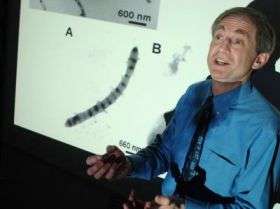
Researchers at the University of Warwick and the Indian Institute of Technology Kanpur have discovered that the mechanism that we rely on to transport iron safely through our blood stream can, in certain circumstances, collapse into a state which grows long worm-like “fibrils” banded by lines of iron rust. This process could provide the first insight into how iron gets deposited in the brain to cause some forms of Parkinson’s & Alzheimer’s and Huntington’s diseases.
Human blood relies on a protein called transferrin to safely transport iron through the bloodstream to points were it can be usefully and safely used in the body. In most other circumstances exposed iron contains many dangers for human cells. When deposited in such a state in the brain it can play a role in neurodegenerative diseases such as Parkinson’s, Huntington’s and Alzheimer’s
Transferrin takes up iron out of bloodstream and transports it by a method that combines it with carbonate to bind to two sites on the surface of the transferrin protein. It then curls around the iron and seals it in, almost like a Venus flytrap plant, to prevent it from interacting with anything else until it reaches where it is needed and can safely be used.
The research team led by Professor Peter Sadler from the University of Warwick, and Professor Sandeep Verma from the Indian Institute of Technology, found that if they took transferrin and left it to dry out on a surface, molecules of the safe transporter of iron assembled themselves into tendril - or worm-like fibrils. Even more interestingly the iron that was once safely wrapped up inside the transferrin now appeared to be settling along the length of these fibrils plating them in a series of spots or bands along the length of the tendril shape. This leaves the iron dangerously exposed and available to interact in ways that could cause cell damage.
Deposits of iron exposed in this way and found in the brain are a possible cause of some forms of Parkinson’s, Alzheimer’s and Huntington’s diseases. Until now there has been no real idea as to how iron becomes deposited there in such a dangerous way. As it is essential for the brain to have iron safely delivered to it, this observation could provide the first real clue as to how that iron comes to be deposited there in such a dangerous way. The research chemists who led this study hope that neurology researchers will be able to build on this work to gain more understanding of how these forms of Parkinson’s, Huntington’s and Alzheimer’s occur and how they can be countered.
The full research paper entitled Periodic Iron Nanomineralization in Human Serum Transferrin Fibrils, by Surajit Ghosh, Arindam Mukherjee, Peter J. Sadler, Sandeep Verma, has just been published in the online edition of Angewandte Chemie.
Source: University of Warwick


