Ultrasound And Algae Team Up To Clean Mercury From Sediments
March 28, 2006
Ultrasound And Algae Team Up To Clean Mercury From Sediments

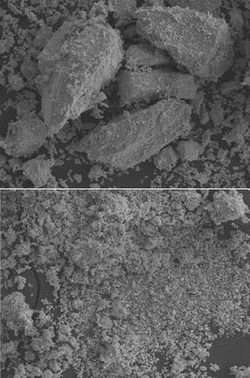
These scanning electron microscope images show particles of cinnabar before sonication (above) and after (below). Ohio State University scientists are developing a technique to clean mercury from contaminated sediment. In this technique, ultrasonic waves vibrate sediment particles so that the mercury is released into the water, then algae absorbs the mercury form the water. Here, cinnabar (mercury sulfide) is used in the laboratory to demonstrate the process. Images courtesy of Ziqi He, Ohio State University.

Ultrasound and algae can be used together as tools to clean mercury from contaminated sediment, according to an Ohio State University study. This research could one day lead to a ship-borne device that cleans toxic metals from waterways without harming fish or other wildlife, said Linda K. Weavers, the John C. Geupel Chair in Civil Engineering at Ohio State.

Doctoral student Ziqi He described the group's latest results in a poster session March 27 at the American Chemical Society meeting in Atlanta.

Weavers' research group previously determined that ultrasonic vibrations can shake mercury loose from sediment.

"We found ultrasound to be very effective at getting mercury out of sediment and into water," He explained. "But then we needed a third party to get the mercury out of the water. That's how we got the idea to add a biological element to the treatment."

Weavers and He joined with Richard Sayre, professor of plant, cellular and molecular biology at Ohio State, and Surasak Siripornadulsil, a former graduate student in the university's biophysics program. Sayre's team has genetically modified a species of algae to boost its natural ability to absorb heavy metals.

In laboratory tests, student He vibrated an ultrasonic probe inside beakers containing water, sediment, and algae. The vibrations freed mercury from the sediment, and within seconds, the algae adsorbed up to 60 percent of the mercury from the water. The combined system of ultrasound and algae removed 30 percent of the mercury from sediment within the first few minutes.

There are alternative cleanup methods that also absorb a high percentage of metals, Sayre admitted, but they are less selective -- they absorb all metals. His modified algae species absorbs five times the normal amount of a select group of toxic metals, including mercury, cadmium, copper, and zinc.

"Say you were trying to clean water that contained effluent with a lot of calcium or iron in it -- or seawater, which contains sodium," Sayre said. "If your algae aren't selective, they'll absorb those other metals and you'll recover less mercury. So the advantage of these modified algae is that other metals don't interfere with the cleanup."

Weavers envisions that boats could dredge sediments from contaminated waterways and clean them on board using ultrasonic equipment and algae-based filters. Then the clean sediment could be returned to its original location. Or, the equipment could be placed directly on sediment to treat it in place. Either procedure would leave wildlife unharmed, she said.

Source: Ohio State University

4.5 /5 (6 votes)  

Rank 4.5 /5 (6 votes)
Tags

Relevant PhysicsForums posts

More news stories

Deconstructing a mystery: What caused Snowmaggedon?

In the quiet after the storms, streets and cars had all but disappeared under piles of snow. The U.S. Postal Service suspended service for the first time in 30 years. Snow plows struggled to push the evidence ...

Space & Earth / Earth Sciences

created 7 hours ago | popularity 4.7 / 5 (3) | comments 1 | with audio podcast

Ocean microbe communities changing, but long-term environmental impact is unclear

As oceans warm due to climate change, water layers will mix less and affect the microbes and plankton that pump carbon out of the atmosphere – but researchers say it's still unclear whether these processes ...

Space & Earth / Earth Sciences

created 9 hours ago | popularity 5 / 5 (2) | comments 2 | with audio podcast

Researchers create 3-D laser maps that show how earthquake changes landscape

Geologists have a new tool to study how earthquakes change the landscape down to a few inches, and it's giving them insight into how earthquake faults behave. In the Feb. 10 issue of the journal Science, a team ...

Space & Earth / Earth Sciences

created 9 hours ago | popularity 5 / 5 (4) | comments 0 | with audio podcast

New views show old NASA Mars landers

(PhysOrg.com) -- The High Resolution Imaging Science Experiment (HiRISE) camera on NASA's Mars Reconnaissance Orbiter recorded a scene on Jan. 29, 2012, that includes the first color image from orbit showing ...

Space & Earth / Space Exploration

created 15 hours ago | popularity 4.9 / 5 (7) | comments 5 | with audio podcast

NASA's TRMM satellite sees Cyclone Jasmine in 3-D

Data from NASA's TRMM satellite was used to create a 3-Dimensional look at Cyclone Jasmine, currently moving through the South Pacific Ocean.

Space & Earth / Earth Sciences

created 5 hours ago | popularity not rated yet | comments 0


'Dark plasmons' transmit energy

Microscopic channels of gold nanoparticles have the ability to transmit electromagnetic energy that starts as light and propagates via "dark plasmons," according to researchers at Rice University.

Hydrogen from acidic water: Researchers develop potential low cost alternative to platinum for splitting water

A technique for creating a new molecule that structurally and chemically replicates the active part of the widely used industrial catalyst molybdenite has been developed by researchers with the Lawrence Berkeley ...

Ultraviolet protection molecule in plants yields its secrets

Lying around in the sun all day is hazardous not just for humans but also for plants, which have no means of escape. Ultraviolet (UV) radiation from the sun can damage proteins and DNA inside cells, leading ...

FDA-approved drug rapidly clears amyloid from the brain, reverses Alzheimer's symptoms in mice

Neuroscientists at Case Western Reserve University School of Medicine have made a dramatic breakthrough in their efforts to find a cure for Alzheimer's disease. The researchers' findings, published in the journal Science, show t ...

Anyone can learn to be more inventive, cognitive researcher says

There will always be a wild and unpredictable quality to creativity and invention, says Anthony McCaffrey, a cognitive psychology researcher at the University of Massachusetts Amherst, because an "Aha moment" is rare and ...

Cell biologists describes mechanism by which some people may be more susceptible to colon cancer

An international research team led by cell biologists at the University of California, Riverside has uncovered a new insight into colon cancer, the third leading cause of cancer-related deaths in the United ...