Light echoes whisper the distance to a star
February 11, 2008
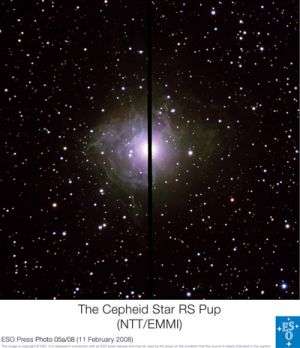
The nebula around the Cepheid star RS Pup undoubtedly holds a wealth of information about the mass-loss history of this star. It will thus be instrumental to understand the evolution of Cepheids. Less than five years away from the centenary of the discovery of the Period-Luminosity relation by Leavitt & Pickering, RS Pup could well become a 'Rosetta stone' for this important class of stars. This colour composite image is based on observations made with the 3.6-m ESO New Technology Telescope (NTT) installed at the La Silla Observatory (Chile) and equipped with the ESO Multi-Mode Instrument (EMMI). The image is based on data obtained through B, V, and R-filters. In order to avoid a heavy saturation of the detector, RS Pup was positioned in the gap between the detectors.
Taking advantage of the presence of light echoes, a team of astronomers have used an ESO telescope to measure, at the 1% precision level, the distance of a Cepheid - a class of variable stars that constitutes one of the first steps in the cosmic distance ladder.
"Our measurements with ESO's New Technology Telescope at La Silla allow us to obtain the most accurate distance to a Cepheid," says Pierre Kervella, lead-author of the paper reporting the result.
Cepheids are pulsating stars that have been used as distance indicators since almost a hundred years. The new accurate measurement is important as, contrary to many others, it is purely geometrical and does not rely on hypotheses about the physics at play in the stars themselves.
The team of astronomers studied RS Pup, a bright Cepheid star located towards the constellation of Puppis ('the Stern') and easily visible with binoculars. RS Pup varies in brightness by almost a factor of five every 41.4 days. It is 10 times more massive than the Sun, 200 times larger, and on average 15 000 times more luminous.
RS Pup is the only Cepheid to be embedded in a large nebula, which is made of very fine dust that reflects some of the light emitted by the star.
Because the luminosity of the star changes in a very distinctive pattern, the presence of the nebula allows the astronomers to see light echoes and use them to measure the distance of the star.
"The light that travelled from the star to a dust grain and then to the telescope arrives a bit later than the light that comes directly from the star to the telescope," explains Kervella. "As a consequence, if we measure the brightness of a particular, isolated dust blob in the nebula, we will obtain a brightness curve that has the same shape as the variation of the Cepheid, but shifted in time."
This delay is called a 'light echo', by analogy with the more traditional echo, the reflection of sound by, for example, the bottom of a well.
By monitoring the evolution of the brightness of the blobs in the nebula, the astronomers can derive their distance from the star: it is simply the measured delay in time, multiplied by the velocity of light (300 000 km/s). Knowing this distance and the apparent separation on the sky between the star and the blob, one can compute the distance of RS Pup.
From the observations of the echoes on several nebular features, the distance of RS Pup was found to be 6500 light years, plus or minus 90 light years.
"Knowing the distance to a Cepheid star with such an accuracy proves crucial to the calibration of the period-luminosity relation of this class of stars," says Kervella. "This relation is indeed at the basis of the distance determination of galaxies using Cepheids."
RS Pup is thus distant by about a quarter of the distance between the Sun and the Centre of the Milky Way. RS Pup is located within the Galactic plane, in a very populated region of our Galaxy.
"The long-period Galactic Cepheid RS Puppis - I. A geometric distance from its light echoes", P. Kervella et al. is in press in Astronomy and Astrophysics.
Source: ESO
-
AGNs as a new standard candle?
Sep 27, 2011 |
5 / 5 (3) |
2
-
Hubble views the star that changed the universe
May 23, 2011 |
4.3 / 5 (6) |
51
-
Hubble rules out one alternative to dark energy
Mar 14, 2011 |
4.6 / 5 (25) |
92
-
The dusty disc of NGC 247
Mar 02, 2011 |
5 / 5 (3) |
0
-
A picture-perfect pure-disc galaxy (w/ Video)
Feb 02, 2011 |
4.8 / 5 (8) |
3
-
Engineers build first sub-10-nm carbon nanotube transistor
Feb 01, 2012 |
4.9 / 5 (31) |
30
-
Something old, something new: Evolution and the structural divergence of duplicate genes
Jan 31, 2012 |
4.6 / 5 (7) |
1
-
The hidden nanoworld of ice crystals: Revealing the dynamic behavior of quasi-liquid layers
Jan 30, 2012 |
5 / 5 (3) |
1
-
Stock market network reveals investor clustering
Jan 27, 2012 |
3.9 / 5 (23) |
8
-
Of microchemistry and molecules: Electronic microfluidic device synthesizes biocompatible probes
Jan 26, 2012 |
5 / 5 (1) |
0
-
Never ending outer space.....
12 hours ago
-
Neutron Star fragments?
14 hours ago
-
stationary or not?
18 hours ago
-
Scale of the Universe
Feb 10, 2012
-
Titan's lack of impact craters
Feb 09, 2012
-
Real pictures of black hole eating a star?
Feb 08, 2012
- More from Physics Forums - General Astronomy
More news stories
Latin America mining boom clashes with conservation
Latin America is experiencing a mining boom as prices rise fuelled by a hike in global demand, but the region is also being hit by a wave of violent protests, strikes and rallies by environmentalists.
5 hours ago |
not rated yet |
0
Political leaders play key role in how worried Americans are by climate change: study
More than extreme weather events and the work of scientists, it is national political leaders who influence how much Americans worry about the threat of climate change, new research finds.
Feb 06, 2012 |
5 / 5 (6) |
72
NASA budget will axe Mars deal with Europe: scientists
US President Barack Obama's budget proposal to be submitted next week for 2013 will cut NASA's budget by 20 percent and eliminate a major partnership with Europe on Mars exploration, scientists said Thursday.
Space & Earth / Space Exploration
Feb 10, 2012 |
5 / 5 (3) |
55
Humans may have helped the decline of African rainforests 3000 years ago
(PhysOrg.com) -- Large areas of rainforests in Central Africa mysteriously disappeared over three thousand years ago, to be replaced by savannas. The prevailing theory has been that the cause was a change ...
Study shows global glaciers, ice caps, shedding billions of tons of mass annually
Earth's glaciers and ice caps outside of the regions of Greenland and Antarctica are shedding roughly 150 billion tons of ice annually, according to a new study led by the University of Colorado Boulder.
Space & Earth / Earth Sciences
Feb 08, 2012 |
4.4 / 5 (9) |
14
|
Google might launch Drive for cloud storage soon
(PhysOrg.com) -- Google's next big move, according to the Wall Street Journal, is a cloud storage service called Drive. Hardly first to the plate, Google is simply catching up to introducing its cloud reposi ...
Love a click away in Indonesia's Twitter Republic
He was a geeky kid from Yogyakarta, she a glamorous city girl in Jakarta. In a country with one of the world's most vibrant social networking scenes they fell in love on Twitter.
Europeans protest controversial Internet pact
Tens of thousands of people marched in protests in more than a dozen European cities Saturday against a controversial anti-online piracy pact that critics say could curtail Internet freedom.
Walney offshore wind farm is world's biggest (for now)
(PhysOrg.com) -- The Walney wind farm on the Irish Sea--characterized by high tides, waves and windy weather--officially opened this week. The farm is treated in the press as a very big deal as the Walney ...
Navy to begin tests on electromagnetic railgun prototype launcher
The Office of Naval Research (ONR)'s Electromagnetic (EM) Railgun program will take an important step forward in the coming weeks when the first industry railgun prototype launcher is tested at a facility ...
Explained: Sigma
It's a question that arises with virtually every major new finding in science or medicine: What makes a result reliable enough to be taken seriously? The answer has to do with statistical significance -- but ...
Jul 25, 2008
Rank: not rated yet