Why anyone can make a sandcastle
February 11, 2008
X-ray Microtomography

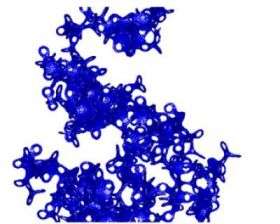
X-ray microtomography of a dense fluid cluster consisting of spherical glass beads (0.8 millimeters in diameter). Credit: Max Planck Institute for Dynamics and Self-Organization

Anyone trying to build sandcastles on the beach will need some degree of skill and imagination, but not an instruction manual. The water content is actually relatively unimportant to the mechanical properties of the sand. This observation, which is borne out by precise measurements in the laboratory, puzzles researchers. Even with water content of just 3%, the fluid inside represents a highly-complex structure.

The mechanical stiffness of the wet sand remains practically constant with moisture ranging from less than 1% to well over 10%, although the fluid structure changes enormously internally. Researchers at the Max Planck Institute for Dynamics and Self-Organisation in Göttingen, the Australia National University in Canberra, the University of Erlangen, and the ESRF in Grenoble have studied the fluid structures in moist granules using x-ray microtomography to discover their laws (Nature Materials, online publication of February 10, 2008).

In medicine, x-ray microtomography is also known as computer tomography. Scientists x-ray an object from various angles to produce an outline image similar to a standard x-ray. A computer evaluates all of these images and determines which kind of three-dimensional structure the object must have to produce the outline images. When scientists use a bright x-ray source, such as the synchrotron source of radiation at the ESRF in Grenoble, computer tomography is produced with a resolution of thousandths of a millimetre. That is sufficient to resolve the tiny, highly-complex fluid structures that form in a moist granule, like inside a sandcastle for example.

What the research team saw was initially quite astonishing. The fluid did not fully push through the granulate structure and therefore did not force the air out of the interstitial space. More significantly, a filigree structure emerged in which the fluid, grains and air existed equally side by side. The reason for this is easy to understand. As the fluid moistens the grains (it would not otherwise be possible to get them into the granule), it tries to surround itself with as much "grain" as possible. This is best achieved at the points of contact where two grains touch. The "empty" space in between is relatively unattractive for the fluid and fills with air.

When the Göttingen scientists then carried out a more exact study of the geometry of these filigree fluid structures, they established that not only did they all have the same pressure, but that the pressure had to be independent of the fluid content. This explains the universal stiffness of the material. The equal pressure corresponds to an equal force inside and therefore results in the moist granules having the same mechanical properties.

"These properties are not only significant to the building of sandcastles," said Stephan Herminghaus, the head of the study. "They are relevant to the pharmaceutical and food-production industries and help us to understand certain natural catastrophes, such as landslides. Wet granules are relevant in many fields and we now have a better understanding of their mechanical properties."

Citation: M. Scheel, R. Seemann, M. Brinkmann, M. DiMichiel, A. Sheppard, B. Breidenbach, S. Herminghaus, Morphological clues to wet granular pile stability, Nature Materials, March edition 2008

Source: Max-Planck-Gesellschaft

3.9 /5 (13 votes)  

Filter


Move the slider to adjust rank threshold, so that you can hide some of the comments.


Display comments: newest first

zevkirsh
Feb 11, 2008

Rank: 5 / 5 (1)
so...i can still build sandcastles right?
vivcollins
Feb 11, 2008

Rank: 1 / 5 (1)
so...i can still build sandcastles right?


Yes! but now you know how.
LearmSceince
Feb 11, 2008

Rank: not rated yet
Salt water complicates things.
Wicked
Feb 12, 2008

Rank: not rated yet
These poor physicists can't seem to enjoy their beach vacation without modeling something.
Rank 3.9 /5 (13 votes)
Tags

Relevant PhysicsForums posts
  • Doubts about surface plasmons
    createdFeb 11, 2012
  • excited U-236 decay time in the U235 fission chain
    createdFeb 09, 2012
  • Polar catastrophe?
    createdFeb 09, 2012
  • Large scale field sonication
    createdFeb 09, 2012
  • states and energy of paired electrons in BCS
    createdFeb 08, 2012
  • difference between longitudinal and transverse refractive indices
    createdFeb 08, 2012
  • More from Physics Forums - Atomic, Solid State, Comp. Physics

More news stories

Explained: Sigma

It's a question that arises with virtually every major new finding in science or medicine: What makes a result reliable enough to be taken seriously? The answer has to do with statistical significance -- but ...

Physics / General Physics

created Feb 09, 2012 | popularity 5 / 5 (20) | comments 76

Quantum physicist explains $100K offer for proof scaled-up quantum computing is impossible

(PhysOrg.com) -- MIT researcher Scott Aaronson has certainly riled the physics community with his offer this past Friday, of $100,000 to anyone who can prove that scaled-up quantum computing is impossible. ...

Physics / Quantum Physics

created Feb 08, 2012 | popularity 4.3 / 5 (15) | comments 37 | with audio podcast weblog

Diamond light, brighter than the sun

It’s the size of five football pitches and generates light 10 billion times brighter than the sun. As the Diamond Light Source celebrates its tenth anniversary this year, Penny Bailey visits one of the ...

Physics / General Physics

created Feb 07, 2012 | popularity 4.1 / 5 (10) | comments 18 | with audio podcast

Physicists 'record' magnetic breakthrough

An international team of scientists has demonstrated a revolutionary new way of magnetic recording which will allow information to be processed hundreds of times faster than by current hard drive technology.

Physics / General Physics

created Feb 07, 2012 | popularity 4.6 / 5 (43) | comments 15 | with audio podcast

Hints of the Higgs - papers are submitted

Back in December 2011, the ATLAS and CMS experiments at CERN presented some exciting results that provided tantalising hints of the Higgs boson.

Physics / General Physics

created Feb 08, 2012 | popularity 4.3 / 5 (8) | comments 10


Scientists discover molecular secrets of 2,000-year-old Chinese herbal remedy

For roughly two thousand years, Chinese herbalists have treated Malaria using a root extract, commonly known as Chang Shan, from a type of hydrangea that grows in Tibet and Nepal. More recent studies suggest that halofuginone, ...

New method to examine batteries -- MRI from the inside

There is an ever-increasing need for advanced batteries for portable electronics, such as phones, cameras, and music players, but also to power electric vehicles and to facilitate the distribution and storage of energy derived ...

Google might launch Drive for cloud storage soon

(PhysOrg.com) -- Google's next big move, according to the Wall Street Journal, is a cloud storage service called Drive. Hardly first to the plate, Google is simply catching up to introducing its cloud reposi ...

A mitosis mystery solved: How chromosomes align perfectly in a dividing cell

Although the process of mitotic cell division has been studied intensely for more than 50 years, Whitehead Institute researchers have only now solved the mystery of how cells correctly align their chromosomes during symmetric ...

Lab study raises questions over nano-particle impact

Tests involving chickens have raised questions about the impact on health from engineered nano-particles, the ultra-fine grains commonly used in drugs and processed foods, scientists said on Sunday.

Starve a virus, feed a cure? Findings show how some cells protect themselves against HIV

A protein that protects some of our immune cells from the most common and virulent form of HIV works by starving the virus of the molecular building blocks that it needs to replicate, according to research published online ...