Model of Easter Island Collapse Might Reveal Message for Today
February 11, 2008 By Lisa Zyga Model of Easter Island Collapse Might Reveal Message for Today

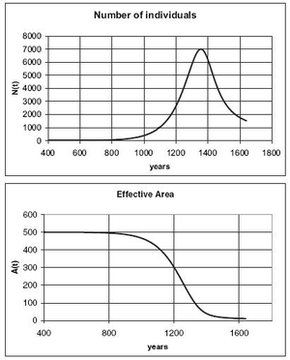
Graphs based on the researchers’ model, showing the population (top) and resources (bottom). The decline of resources coincides with a sharp population increase, followed by a sharp decrease. Image credit: M. Bologna and J. C. Flores.

When a thriving civilization suddenly collapses, it’s often a mystery – and an ominous one, at that. For Easter Island circa 1000-1400 AD, experts believe it was a case of humans overexploiting their natural resources – mostly, the palm tree. But exactly where did the culturally rich Rapanui society go too far?

Researchers Mauro Bologna and J. C. Flores from the University de Tarapacá in Arica, Chile, have recently developed a mathematical model that describes the evolution – the quick rise and fall – of Easter Island during its golden age. Their model considers the interaction between natural resources and population, and generates a close estimation of the civilization’s collapse time, which can be applied to other similar civilizations.

Easter Island, located about 2,230 miles (3,600 km) off the coast of Chile in the Pacific Ocean, was, and is, one of the most isolated inhabited islands in the world. Unlike most individual societies of today or even in the past, it can be considered as a closed system.

The first settlers were thought to arrive around 400 AD from one of the other Polynesian islands to the west. Over the next 1,000 years, the Rapanui people developed a relatively advanced and complex culture. They farmed a variety of crops, built more than a thousand 30-foot-tall “moai” (stone statues), and saw their population increase to at least 7,000 (some archaeologists estimate 20,000) inhabitants.

But, as Bologna and Flores explain in their study, Easter Island’s rapid growth also meant that the society was reaching the “carrying capacity” of its ecosystem. In other words, the isolated island could no longer support its human inhabitants. The Rapanui continued to cut down the island’s palm trees – which once covered nearly the entire 160-km2-island – at a steady rate, heedless to the long-term effects.

Using their model, Bologna and Flores could determine the civilization’s equilibrium point, where humans can coexist with the available natural resources indefinitely. However, the researchers noted that a minimum number of individuals is required to maintain a population, meaning some species cannot exist at all if there are too few natural resources to support their minimum size. In the researchers’ model, this requirement is the collapse condition of an isolated civilization with a primitive level of technology.

The researchers estimate that Easter Island’s equilibrium population size would have been about 2,000 individuals – as it was around 1175. But by 1300 – just 125 years later – the population spiked to its peak of an estimated 7,000 individuals. As part of the collapse condition, each individual requires a certain amount of natural resources. For Easter Island, the minimum number of individuals required to sustain the species was higher than the maximum number of individuals the island could provide for.

From there, it didn’t take long for the civilization to collapse. By 1225, the island had only half as many palm trees as it once had, and by 1400, there were practically none left. Consequently, the population size quickly reversed its ascent, and fell back to less than 2,000 individuals by 1600. These numbers, from Bologna and Flores’ model, are also supported by archeological data.

“Probably the relative peaceful life on the island at the beginning favored the development of the society,” Bologna explained to PhysOrg.com. “In my opinion, in general, the combination of the increase of individuals and exploitation of resources can cause many difficulties, even to a technologically advanced society.”

Whether or not these difficulties could have been avoided is complex. Bologna says that the question of whether the collapse of Easter Island was inevitable is not easy to answer.

“Surely they exhausted the most important resource (trees),” he said. “At that point, they were forced to change their lifestyle, and apparently they did it fighting among themselves instead of collaborating. Perhaps a collaboration among the several tribes could have changed the final part of the evolution of the Eastern Island society. Hard to say with certitude.”

Whatever the specific causes of decline were, the researchers’ model accurately describes the populations change. Further, when they applied their model to the ninth-century Copan Mayan civilization, it predicted that the population fell from 20,000 to 5,000 individuals in a period of 60 to 180 years – closely matching with historical estimates of about 100 years. Perhaps even more interesting are the implications that the model could have for our world today.

“Professor Flores and I, we think that the model could be, with the opportune changes, applied to the planet,” Bologna said. “Of course there are many differences, but surely the planet can be considered an isolated system as Eastern Island was. Professor Flores and I hope to work on this topic in the near future.”

More information: Bologna, M. and Flores, J. C. “A simple mathematical model of society collapse applied to Easter Island.” EPL, 81 (2008) 48006.

Copyright 2008 PhysOrg.com.
All rights reserved. This material may not be published, broadcast, rewritten or redistributed in whole or part without the express written permission of PhysOrg.com.


print this article email this article download pdf blog this article bookmark this article     Stumble it Digg this share on Facebook retweet share on Reddit add to delicious
Rate this story - 4.3 /5 (87 votes)

Rank Filter

Move the slider to adjust rank threshold, so that you can hide some of the comments.


Display comments: newest first

  • wesgeorge - Feb 11, 2008
    • Rank: 4.4 / 5 (5)
    Fascinating work. However, in applying it globally Bologna and Flores will have to avoid the Malthusian fallacy of simply extrapolating population growth, resource exploitation and waste production trends a la Paul Ehrlich in his wrongheaded 1968 book, The Population Bomb.

    Some equation for technological and culturally innovative evolution has to be introduced into the modeling. Far more attention to game theory and human cooperation strategies are needed before a global application could have any forecasting potential.

    In fact, a focus on the history of Easter Island merely reinforces the hackneyed apocalyptic tendencies that have dominated most researchers' attempts at forecasting the future since at least Biblical times.

    Isn't it time to research the multitude of historic examples of human innovation and cooperation in face of what seemed insurmountable challenges?

    And, finally, I would bet that the introduction of scientific methodology as a driving force of modern civilization is such a profound phase shift from the past that studying Star Trek episodes might be more relevant to forecasting the future than studies of Easter Island and the Copal Mayans!
  • Ashibayai - Feb 11, 2008
    • Rank: 1.7 / 5 (3)
    Earth is a small island with limited resources. Eventually this will become apparent.

    Not for now though...
  • fleem - Feb 11, 2008
    • Rank: 4 / 5 (2)
    Right. The biggest mistake I see in their conclusion (and its a whopper) is that they neglected to consider that the larger the environment, the more gradual are those curves. When it takes ten generations to see a notable drop in resources, there are other forces than war and famine that help balance things out--like innovation, gentle drops in proliferation, etc.
  • DrPhysics - Feb 12, 2008
    • Rank: not rated yet
    Earth is a small island with limited resources. Eventually this will become apparent.

    Not for now though...


    What isn't limited is man's imagination. You need more faith in that and less focus on inanimate objects.

February 11, 2008 all stories

Comments: 4

4.3 /5 (87 votes)
  • Stumble this up

  • Digg this

  • share this

  • hide
  • Related Stories


  • hide
  • Relevant PhysicsForums posts

  • Proving with Congruence of intergers
    created 1hour ago
  • Congruence of Intergers and modular arthimetic
    created 3 hours ago
  • Pascal's pyramid
    created 14 hours ago
  • list of index notation properties ??
    created Nov 20, 2009
  • confused about the concept of equality
    created Nov 20, 2009
  • Equation
    created Nov 20, 2009
  • More from Physics Forums - General Math

Other News

Museum: Galileo's fingers, tooth are found (AP)

Museum: Galileo's fingers, tooth are found

Other Sciences / Archaeology & Fossils

created 8 hours ago | popularity not rated yet | comments 4

(AP) -- Two fingers and a tooth removed from Galileo Galilei's corpse in a Florentine basilica in the 18th century and given up for lost have been found again and will soon be put on display, an Italian museum ...


Researcher: Faint writing seen on Shroud of Turin (AP)

Researcher: Faint writing seen on Shroud of Turin (Update)

Other Sciences / Archaeology & Fossils

created 23 hours ago | popularity 1.8 / 5 (20) | comments 21

(AP) -- A Vatican researcher has rekindled the age-old debate over the Shroud of Turin, saying that faint writing on the linen proves it was the burial cloth of Jesus. Experts say the historian may be reading ...


Measure to change U. of Neb. stem-cell rule fails (AP)

Measure to change U. of Neb. stem-cell rule fails (Update 2)

Other Sciences / Other

created 8 hours ago | popularity 5 / 5 (1) | comments 0

(AP) -- The University of Nebraska's governing board on Friday voted not to place tighter restrictions on embryonic stem cell research than those outlined under federal guidelines, which were expanded after ...


Three of a kind

Three of a kind: Revealing language’s universal essence

Other Sciences / Social Sciences

created Nov 20, 2009 | popularity 3.5 / 5 (8) | comments 6

(PhysOrg.com) -- On the surface, English, Japanese, and Kinande, a member of the Bantu family of languages spoken in the Democratic Republic of Congo, have little in common. It is not just that the vocabularies ...


Maya

New insights into the life of the Maya

Other Sciences / Archaeology & Fossils

created Nov 16, 2009 | popularity 4.6 / 5 (15) | comments 7

(PhysOrg.com) -- Ancient artifacts are almost always concerned with rich and powerful religious and political leaders, but new excavations of an ancient Maya site have unearthed a pyramid decorated with murals ...