NASA to Fly Viking Into Storms to Improve Aviation Safety
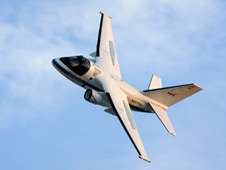
The S-3B Viking was built to take off and land on carrier ships, fly into enemy territory and take out threatening submarines. It's rugged, fast and powerful, but its fighting days are numbered.
Though the United States Navy is slowly decommissioning the fleet, one S-3B is still flying in hostile conditions. Its next mission? Venture into hazardous weather to study a phenomenon that has caused more than 100 commercial aircraft engines to fail, stall or temporarily lose power.
Engineers from NASA's Glenn Research Center, Boeing and the Navy have combined forces to transform the S-3B into a state-of-the-art NASA research aircraft. Last month, NASA Glenn unveiled the modified plane in Cleveland.
"We were able to capitalize on the decommissioning by acquiring the aircraft directly from the Navy," explained Dr. Rickey Shyne, director of Glenn's Facilities and Test Directorate. "This saved taxpayers millions of dollars compared to the cost of a new aircraft."
Workers at the Navy's Fleet Readiness Center - Southeast and a Boeing facility in Fla. enhanced the plane by adding commercial satellite communications, global positioning navigation and weather radar systems. They installed research equipment racks in what was once the plane's bomb bay. And they gave it a shiny blue-and-white NASA paint job.
With these new features, NASA's S-3B Viking is equipped to conduct science and aeronautics missions, such as environmental monitoring, satellite communications testing and aviation safety research. It can fly up to 40,000 feet high and reach speeds faster than 500 miles per hour, which makes it perfect for studying commercial airline safety issues.
This fall in Puerto Rico, Glenn pilots and researchers plan to use the S-3B to study icing conditions in convective storms, ranging from isolated thunderstorms to tropical storms.
"We'll be flying in the proximity of storms that we think have the elements that cause engine power loss to measure the cloud properties," said Icing Research Engineer Tom Ratvasky.
In conditions like these, ice crystals have been ingested into aircraft engines causing problems. The mission may sound risky, but Glenn Research Pilot Jim Demers isn't intimidated.
"This is an all-weather military aircraft. It was built to complete missions in any weather on only one engine if it has to," said Demers, a former Navy S-3 pilot. "It is a very capable aircraft in this environment."
During the flight, research equipment will collect data, such as the size of ice and liquid cloud particles, water content in the clouds, temperature and humidity. Glenn researchers will use this data to develop an engineering standard to test engines.
This mission is part of NASA's Aviation Safety Program, which partners with the Federal Aviation Administration, airlines and the Department of Defense, to reduce the rate of aircraft fatalities. NASA and its partners plan to build test facilities and computer codes that propulsion engineers can use when designing engines.
Glenn has been studying aircraft icing, the leading natural cause of airplane accidents, for 25 years using its Icing Research Tunnel and its Twin Otter research aircraft. Engineers at the center have helped the aviation industry to understand how ice forms in flight and how it affects aircraft performance. They have evaluated de-icing systems and developed new remote-sensing devices that warn pilots before flying into icy conditions.
The S-3B will allow NASA Glenn to study the phenomenon at altitudes, speeds and distances it was previously unable to reach.
"No other aircraft in the world has the capabilities to perform this ice crystal flight research," said Tom Bond, Chief Scientist and Technical Advisor for Flight Environmental Icing at the FAA. "With its unique icing cloud measurement instrumentation, robust framework, speed and onboard electrical power system, the S-3B is a tremendous asset for improving aviation safety."
Source: by Jan Wittry (SGT, Inc.), NASA's Glenn Research Center


