Researchers design copper connections for high-speed computing
As computers become more complex, the demand increases for more connections between computer chips and external circuitry such as a motherboard or wireless card. And as the integrated circuits become more advanced, maximizing their performance requires better connections that operate at higher frequencies with less loss.
Improving these two types of connections will increase the amount and speed of information that can be sent throughout a computer, according to Paul Kohl, Thomas L. Gossage chair and Regents’ professor in Georgia Tech’s School of Chemical and Biomolecular Engineering. Kohl presented his work in these areas at the Materials Research Society fall meeting.
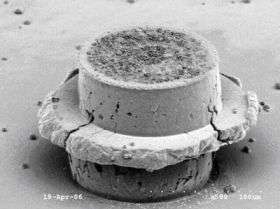
The vertical connections between chips and boards are currently formed by melting tin solder between the two pieces and adding glue to hold everything together. Kohl’s research shows that replacing the solder ball connections with copper pillars creates stronger connections and the ability to create more connections.
“Circuitry and computer chips are made with copper lines on them, so we thought we should make the connection between the two with copper also,” said Kohl.
Solder and copper can both tolerate misalignment between two pieces being connected, according to Kohl, but copper is more conductive and creates a stronger bond.
With funding from the Semiconductor Research Corporation (SRC), Kohl and graduate student Tyler Osborn have developed a novel fabrication method to create all-copper connections between computer chips and external circuitry.
The researchers first electroplate a bump of copper onto the surface of both pieces, a process that uses electrical current to coat an electrically conductive object with metal. Then, a solid copper connection between the two bumps is formed by electroless plating, which involves several simultaneous reactions that occur in an aqueous solution without the use of external electrical current.
Since the pillar, which is the same thickness as a dollar bill, is fragile at room temperature, the researchers anneal it, or heat it in an oven for an hour to remove defects and generate a strong solid copper piece. Osborn found that strong bonds were formed at an annealing temperature of 180 degrees Celsius. He has also been investigating how misalignments between the two copper bumps affect pillar strength.
“I’ve also studied the optimal shape for the connections so that they’re flexible and mechanically reliable, yet still have good electrical properties so that we can transmit these high frequency signals without noise,” said Osborn.
The researchers have been working with Texas Instruments, Intel and Applied Materials to perfect and test their technology. Jim Meindl, director of Georgia Tech’s Microelectronics Research Center and professor in the School of Electrical and Computer Engineering, and Sue Ann Allen, professor in the School of Chemical and Biomolecular Engineering, have also collaborated on the work.
In addition to this new method for making vertical connections between chips and external circuitry, Kohl is also developing an improved signal transmission line with the help of graduate student Todd Spencer.
“Several very long communication pathways exist inside a computer that require a very high performance electrical line that can transmit at higher frequencies over long distances,” explained Spencer.
This is especially important in high-performance servers and routers where inter-chip distances can be large and signal strength may be significantly degraded. Kohl and Spencer have developed a new way to link high-speed signals between chips using an organic substrate, with funding from the Interconnect Focus Center, one of the Semiconductor Research Corporation/Defense Advanced Research Projects Agency (DARPA) Focus Center Research Programs.
Fabrication begins with an epoxy fiberglass substrate with copper lines on one side. The substrate is coated with a polymer and the areas without copper lines are exposed to ultraviolet (UV) light, which disintegrates the polymer where it’s not wanted. Then, the researchers coat the substrate with another polymer that hardens when exposed to UV light. Layers of titanium and copper are added on top of each copper line. When the layered substrate is heated at 180 degrees Celsius, the first polymer layer decomposes into carbon dioxide and acetone, which diffuse out leaving an air pocket.
“The amount of electrical loss relates to the connection’s sensitivity at higher frequencies,” explained Spencer. “Just having this air pocket there reduces our signal loss greatly.”
The researchers are currently designing a coaxial cable for this chip-to-chip signal link, which should greatly increase the maximum signal frequency the connection can carry.
Companies that make computer chips and package them into a device are very interested in these technologies, said Kohl.
“If these connections can be produced at a reasonable cost, they could be very important in the future because you’re giving the customer a better product for the same cost,” said Kohl.
Source: Georgia Institute of Technology


