Dramatic declines in wild salmon populations are associated with exposure to farmed salmon
February 12, 2008 Atlantic Salmon

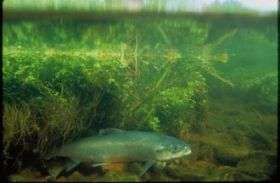
A global survey of wild salmon and trout populations reveals substantially reduced survival among those populations that migrate past salmon farms as juveniles on their way to the ocean. Credit: United States Fish and Wildlife Service

Since the late 1970s, salmon aquaculture has grown into a global industry, producing over 1 million tons of salmon per year. However, this solution to globally declining fish stocks has come under increasing fire. In a new study published this week in the open-access journal PLoS Biology, Jennifer Ford and Ransom Myers provide the first evidence on a global scale illustrating systematic declines in wild salmon populations that come into contact with farmed salmon.

Previous studies have clearly shown that escaped farm salmon breed with wild populations to the detriment of the wild stocks, and that diseases and parasites are passed from farm to wild salmon.

However, until now, there has been no assessment of the importance of these impacts at the population level and across the globe. Here, Ford & Myers compared the survival of salmon and trout that swim past salmon farms to the survival of those fish that never pass a salmon farm.

In five regions around the world, Ford and Myers find a significant decline in the survival of wild salmon populations that are exposed to salmon farms. This decline took place as farmed salmon production increased in each region. Combining these regional estimates, the authors find that wild populations suffer a reduction in survival or abundance of more than 50% when associated with farmed salmon.

These new results suggest that salmon farming could seriously compromise the persistence of the world’s salmonid populations.

Citation: Ford JS, Myers RA (2008) A global assessment of salmon aquaculture impacts on wild salmonids. PLoS Biol 6(2): e33. doi:10.1371/journal.pbio.0060033

Source: Public Library of Science


print this article email this article download pdf blog this article bookmark this article     Stumble it Digg this share on Facebook retweet share on Reddit add to delicious
Rate this story - 3.5 /5 (4 votes)


February 12, 2008 all stories

Comments: 0

3.5 /5 (4 votes)
  • Stumble this up

  • Digg this

  • share this

  • hide
  • Related Stories


Other News

Researchers engineer bacteria to turn carbon dioxide into liquid fuel

Researchers engineer bacteria to turn carbon dioxide into liquid fuel

Biology / Biotechnology

created 9 hours ago | popularity 4.7 / 5 (22) | comments 10

(PhysOrg.com) -- The genetically modified cyanobacterium consumes carbon dioxide and produces the liquid fuel isobutanol by using energy from sunlight.


 Killer catfish? Venomous species surprisingly common, study finds

Killer catfish? Venomous species surprisingly common, study finds

Biology / Plants & Animals

created 8 hours ago | popularity not rated yet | comments 3

(PhysOrg.com) -- Name all the venomous animals you can think of and you probably come up with snakes, spiders, bees, wasps and perhaps poisonous frogs. But catfish?


Introns: A mystery renewed

Introns: A mystery renewed

Biology / Cell & Microbiology

created 15 hours ago | popularity 4.5 / 5 (2) | comments 0

The sequences of nonsense DNA that interrupt genes could be far more important to the evolution of genomes than previously thought, according to a recent Science report by Indiana University Bloomington and ...


DNA study sheds new light on horse evolution

DNA study sheds new light on horse evolution

Biology / Evolution

created 17 hours ago | popularity 5 / 5 (2) | comments 30

(PhysOrg.com) -- Ancient DNA retrieved from extinct horse species from around the world has challenged one of the textbook examples of evolution - the fossil record of the horse family Equidae over the past ...


Sucking Up To Survive

Sucking Up To Survive

Biology / Plants & Animals

created 8 hours ago | popularity 5 / 5 (2) | comments 0

Shrink a human being down to the size of an insect, and you would no longer be able to sip lemonade from a straw. The forces that hold liquid together would simply be too great to overcome at that tiny scale.