Missing link shows bats flew first, developed echolocation later
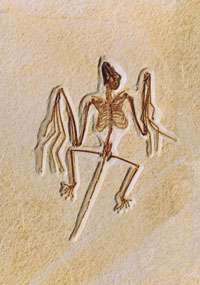
The discovery of a remarkably well-preserved fossil representing the most primitive bat species known to date demonstrates that the animals evolved the ability to fly before they could echolocate.
The new species, named Onychonycteris finneyi, was unearthed in 2003 in southwestern Wyoming and is described in a study in the Feb. 14 issue of the journal Nature, on which University of Michigan paleontologist Gregg Gunnell is a coauthor along with researchers from the American Museum of Natural History (AMNH) in New York, the Royal Ontario Museum in Canada and the Senckenberg Research Institute in Germany. A cast of one of the two known specimens is on permanent display in the U-M Exhibit Museum of Natural History's Hall of Evolution.
"There has been a longstanding debate about how bats evolved, centering around the development of flight and the development of the sonar system they use to navigate and hunt for prey," said Gunnell, an associate research scientist at the U-M Museum of Paleontology. "The three main theories have been that they developed the two abilities together, that flight came first, or that sonar came first. Based on the specimen described in this paper, we were able to determine that this particular animal was not capable of echolocating, which then suggests that bats flew before they developed their echolocation ability."
Bats represent one of the largest and most diverse orders of mammals, accounting for one-fifth of all living mammal species. The well-preserved condition of the new fossil permitted the scientists to take an unprecedented look at the most primitive known member of the order Chiroptera.
"When we first saw it, we knew it was special," said lead author Nancy Simmons of AMNH. "It's clearly a bat, but unlike any previously known. In many respects it is a missing link between bats and their non-flying ancestors."
Dating the rock formation in which the fossil was found put its age at 52 million years. Onychonycteris was not the only bat alive at the time---fossils of Icaronycteris, a more modern bat that could echolocate, are found in the same formations.
A careful examination of Onychonycteris's physical characteristics revealed several surprising features. For example, it had claws on all five of its fingers, whereas modern bats have, at most, claws on only two digits of each hand. The limb proportions of Onychonycteris are also different from all other bats---the hind legs are longer and the forearm shorter---and more similar to those of climbing mammals that hang under branches, such as sloths and gibbons.
The fossil's limb form and the appearance of claws on all the fingers suggest that Onychonycteris may have been a skilled climber. However, long fingers, a keeled breastbone and other features indicate that Onychonycteris could fly under its own power like modern bats. It had short, broad wings, which suggest that it probably could not fly as far or as fast as most bats that came after it. Instead of flapping its wings continuously while flying it may have alternated flapping and gliding while in the air. Onychonycteris's teeth indicate that its diet consisted primarily of insects, just like that of most living bats.
"We don't know what the initial incentive was to take to the air," Gunnell said. "My thought is that these bats probably were commuters at first---developing the ability to fly allowed them to travel to a particular place to feed, then fly back to their nesting area." Eventually, selective pressures likely favored the development of more sustained and agile flight, allowing bats to hunt on the wing.
Despite Onychonycteris's resemblance to animals that came after it, its skull lacks features in and around the ear seen in bats that use echolocation to navigate and hunt. The structure of its feet and ankles, which include a special, spur-like bone that likely supported a tail membrane, led the researchers to conclude that Onychonycteris had the broad tail that modern bats use to capture prey in flight, but that the structure probably was used as an airfoil to aid maneuvering. Without echolocation, Onychonycteris likely had to make do with visual, olfactory, or passive audio cues to hunt.
"It finally gives us an answer," Simmons said. "Flying evolved first, echolocation second."
Source: University of Michigan


