'Genetic corridors' are next step to saving tigers
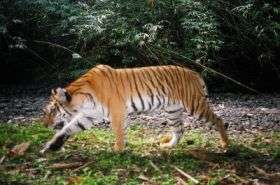
The Wildlife Conservation Society and the Panthera Foundation announced plans to establish a 5,000 mile-long “genetic corridor” from Bhutan to Burma that would allow tiger populations to roam freely across landscapes. The corridor, first announced at the United Nations on January 30th, would span eight countries and represent the largest block of tiger habitat left on earth.
Dr. Alan Rabinowitz, director of Science and Exploration Programs at the Wildlife Conservation Society, said that genetic corridors, where tigers can travel with less risk of inbreeding, are crucial for their long-term survival in Asia. The proposed corridor includes extensive areas of Bhutan, northeast India, Myanmar, Thailand and Malaysia, along with potential connectivity to Laos, Cambodia and Vietnam. It has already been endorsed by the new King of Bhutan, his Majesty Jigme Khesar Namgyel Wangchuck, who requested other heads of state to support similar efforts.
Rabinowitz, the co-director of Tigers Forever – a WCS/Panthera Foundation collaboration – made a clear request at the recent UN meeting that he and other tiger conservationists would be seeking additional approval and assistance from other heads of state.
“While Asia’s economic tigers are on the rise, wild tigers in Asia are in decline,” Rabinowitz said. “Much like the call-out for global agreements on banning tiger parts in trade, a similar cross-border initiative for genetic corridors is key to the survival of the tiger. Tiger range states need to work together, as tigers do not observe political borders nor do they require a visa or passport to travel where habitat and prey remain.”
Rabinowitz said corridors did not have to be pristine parkland but could in fact include agricultural areas, ranches, and other multi-use landscapes – just as long as tigers could use them to travel between wilderness areas.
“We’re not asking countries to set aside new parks to make this corridor a success,” Rabinowitz said. “This is more about changing regional zoning in tiger range states to allow tigers to move more freely between areas of good habitat.”
Twelve of 13 tiger range states were represented by ambassadors and delegates at the UN meeting. Other organizations working to save the tiger came out in force, including representatives from the National Fish and Wildlife Foundation’s Save the Tiger Fund, Conservation International, Rare Conservation, and the U.S. Fish and Wildlife Service. Actress Glenn Close was in attendance and spoke at the event.
Tigers Forever was launched in 2006 as a bold plan to grow tiger numbers by 50 percent at key sites over a ten year period. This increase is being achieved through collecting baseline data and long-term scientific monitoring of tigers, their prey, and their threats, to ensure that the goals can be met. Key threats are the direct killing of tigers, poaching of tiger prey, and habitat loss – all of which are being targeted and mitigated.
The meeting, hosted by UN Under-Secretary General Ambassador Joseph Verner Reed, was opened with a welcoming statement by Secretary-General Ban Ki-moon and marked the first time government, business, and conservationists have come together at the United Nations for the sake of conserving a single iconic species.
Source: Wildlife Conservation Society


