Is hybridoma production about to take a quantum leap forward?
Biopharmaceutical companies have started to evaluate the use of fully human monoclonal antibodies as a complementary or primary therapeutic agent against a variety of diseases. The most obvious advantage would be to bypass the interference from the patient's immune system that typically characterizes the use of chemerical or humanized antibodies. Due to the growing interest and the potential benefits, the efficient production of human monoclonal antibodies is a high priority. But any attempt to produce these by natural means encounters formidable obstacles, not only from an ethical standpoint but also from the difficulty inherent in generating human antibodies against human tissues.
The capacity to humanize monoclonal antibodies in 1988 through hybridoma cell production methods opened exciting new vistas in R&D and biomed products. If this method could be further refined to produce pure, natural human monoclonal antibodies, research would take a quantum leap forward in the development of new medical and pharmaceutical discoveries for serious and life-threatening conditions that cannot yet be successfully treated with synthesized hybrids.
One proven way to profoundly enhance the media solutions used for cell growth, and particularly membrane proteins, is Radio Frequency (RF) radiation. The RF is absorbed by the aqueous solution and stimulates new membrane formation - a vital stage in hybridoma cell growth. The problem is that the beneficial effect decays once the source of RF is removed, and the new membrane formation does not receive the full benefit. Without this extra "boost", the delicate process of producing viable, fully human monoclonal antibodies faces an insurmountable obstacle.
This obstacle has been effectively removed by Neowater®, a novel nanoparticle-doped (NPD) water created by a unique patented water-based nanotechnology.
Neowater® is a non-toxic form of water that mimics intracellular water, which is found uniquely in the human body and its cells. NPD water is characterized by a shifting in the physical properties of ordinary water, imparting new levels of compatibility with hydrophobic substances. Neowater® also maintains the beneficial effect of RF radiation on water for years after its production, thanks to its extraordinary structural stability.
The researchers performed numerous experiments to test the growth rate of hybridoma cells in NPD-based media. They specifically tested the effect of the NPD environment on the complete process of human monoclonal antibody production, and their results were published recently in the BMC Biotechnology Journal.
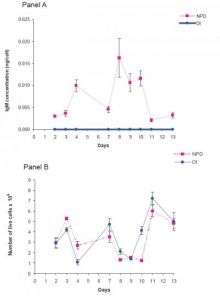
To evaluate the hybridoma formation process (utilizing the chemical fusion method), the researchers received samples of human peripheral blood mononuclear cells (PBMC) from several donors; each sample was tested either in a NPD or a DI (de-ionized) environment. In referring to the results, the researchers stated: “We witnessed a statistically significant difference in the yield of hybridoma cells between NPD and DI environments.”
In another experiment, the isolation of subclones and autocrine activity of hybridoma cells was tested. The researchers reported: “We observed greater clonal outgrowth of antibody-secreting hybridoma cells in NPD-based media as compared to DI-based media.” Moreover, they found that “the cloneability of cells from a semi-stable clone is also enhanced in NPD-based media.”
The researchers noted that hybridoma clones grown on NPD-based media secreted more monoclonal antibodies into their environment. However, they also observed that “Some cells grow faster in NPD-based media…This result might not reflect greater secretion per cell, but rather greater proliferation of cells with a similar secretion.” After normalization of this biased situation, the researchers calculated that “the secretion of monoclonal antibody in NPD-based media is roughly twice that obtained in DI-based media.”
This interesting and unexpected result led the researchers to conduct further tests: To what extent are cell proliferation rates affected by NPD-based media" Growing CHO (Chinese Hamster Ovary) cells in NPD-based and DI-based media, the researchers observed an unmistakable increase in proliferation when cells were incubated in NPD-based media, in comparison to the DI-based media: "an increase by an average of nearly 30%” .
The researchers then tested the proliferation rate of primary human fibroblast cells incubated either in NPD-based or DI-based media. Unlike the CHO cells, these are sensitive to cell density and were grown at two different starting dilutions. Here the NPD-based media had the opposite effect: the CHO cells displayed a slower proliferation rate than that of DI-based media (in both dilutions). The researchers concluded: “As is evident from the curves, primary human fibroblasts proliferated poorly in NPD-based media, compared to DI-based media.... they appear to sense the lower effective cell density.”
The above paper demonstrates the remarkable power of Neowater® for enhancing the stabilization, activity and proliferation of cells and antibodies - as well as inhibiting the proliferation of other cells. This is just one example of the wide research potential that Neowater® offers, which will eventually impact the healthcare industry. Imagine the novel and cutting-edge methodologies suddenly available to stem-cell therapeutics, site-specific antibody treatments, and targeted anti-cancer drugs using fully human mAbs.
Many promising biomed and therapeutic concepts that have been shelved, blocked by the basic difference between regular water and intracellular water, can now cross the "molecular water barrier", thanks to the nanoparticle restructuring capability of Neowater®. We can expect a new era in R&D as these concepts are facilitated by Neowater® technology and find realization in therapeutic applications.
Source: Do-Coop Technologies Ltd.


