Engineering students: Airbrush not just for artists
February 14, 2008 Engineering students: Airbrush not just for artists

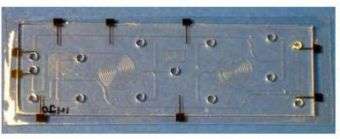
A microelectrode made in part with an airbrush is seen in this photo shot at a University of Florida laboratory. On a suggestion from a student who had a hobby making paper airplanes, UF engineering students came up with a way to use airbrushes to make the microelectrodes, which are used in glucose monitors for diabetics and other sensors. The airbrush technique is far cheaper and simpler than the standard one, though it works best for small, customized jobs rather than in mass production. Credit: University of Florida

The airbrush, that tool behind tattoos and T-shirts, may have an unexpected future … in technology.

A group of engineering students at the University of Florida has come up with a method for using an airbrush to make microelectrodes — tiny conductors used in an increasing range of consumer, research and medical products. The technique is simpler than the standard one, at least for small projects that require production of only a few electrodes.

“The idea was to try to find something cheap and quick, that we could do in our own lab without much expense,” said student Corey Walker.

Walker was one of four UF engineering students who worked on the project. Now a doctoral student in biomedical engineering at the University of California, Irvine, he is the lead author of a paper appearing this month in the online edition of the journal Electroanalysis.

Microelectrodes are highly sensitive, fingernail-sized devices used, for example, in off-the-shelf glucose monitors for diabetics. They are also vital to “lab on a chip” devices under development to identify substances in air, blood or other samples.

The industry standard for manufacturing microelectrodes is screen printing, a technique that, oddly, is also borrowed from the visual arts. But it requires a screen printer, and the students, who were trying to craft a hydrogen sensor, didn’t have one.

So a student who used airbrushes to build model airplanes suggested they try that tool. Trials and tests perfected the approach, with the students eventually using fully airbrushed electrodes to craft a working sensor. The technique works best for small projects because it requires each electrode to be made individually or in small batches.

“A screen-printing machine useful for fabricating microelectrodes might cost $10,000, whereas you can buy an airbrush for less than $200,” said Hugh Fan, an associate professor of mechanical and aerospace engineering who oversaw the project. “So this is a useful technique for small, custom projects.”

Source: University of Florida


print this article email this article download pdf blog this article bookmark this article     Stumble it Digg this share on Facebook retweet share on Reddit add to delicious
Rate this story - 3.4 /5 (16 votes)


February 14, 2008 all stories

Comments: 0

3.4 /5 (16 votes)
  • Stumble this up

  • Digg this

  • share this

  • hide
  • Related Stories


  • hide
  • Relevant PhysicsForums posts

  • Bread Board
    created 20 hours ago
  • Student team - building a satellite - want to join - problem:i'm a biotech student.
    created Nov 13, 2009
  • Motor Driver
    created Nov 13, 2009
  • Thermocouple Probe Selection
    created Nov 12, 2009
  • More from Physics Forums - General Engineering

Other News

Road trains may be coming soon to Europe

Road trains may be coming soon to Europe (w/ Video)

Technology / Engineering

created Nov 13, 2009 | popularity 4.8 / 5 (12) | comments 17

(PhysOrg.com) -- Road trains linking vehicles together in a traveling convoy are planned for Europe. With only the lead vehicle being actively driven, the road trains would allow commuters to sleep, read a ...


A system of space solar power system (SSPS)

Japan eyes solar station in space as new energy source

Technology / Energy

created Nov 08, 2009 | popularity 4.8 / 5 (22) | comments 28

It may sound like a sci-fi vision, but Japan's space agency is dead serious: by 2030 it wants to collect solar power in space and zap it down to Earth, using laser beams or microwaves.


Cars sit in traffic on a highway

Netherlands to levy 'green' road tax by the kilometre

Technology / Hi Tech

created Nov 13, 2009 | popularity 3 / 5 (4) | comments 8

The Dutch government said Friday it wants to introduce a "green" road tax by the kilometre from 2012 aimed at cutting carbon dioxide emissions by 10 percent and halving congestion.


Google Go

Google Go gets going (w/ Video)

Technology / Software

created Nov 11, 2009 | popularity 4.2 / 5 (10) | comments 6

(PhysOrg.com) -- Google has introduced its new experimental programming language Go, which aims to combine speedy application development through simplified coding with high-speed program execution.


Hydrogen milestone moves energy independence one step forward

Hydrogen milestone moves energy independence one step forward

Technology / Energy

created Nov 10, 2009 | popularity 3.9 / 5 (12) | comments 7

(PhysOrg.com) -- Big things often come in small packages. That's certainly the case with the potential created by recent successes in hydrogen research at Idaho National Laboratory.