Hareless: Yellowstone's rabbits have vanished, study says
February 14, 2008 Jack Rabbit

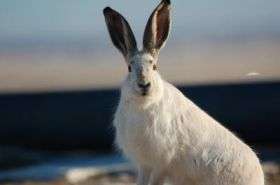
Jack rabbits like these have mysteriously vainished from Yellowstone, a Wildlife Conservation Society study says. Credit: Joel Berger/Wildlife Conservation Society

A new study by the Bronx Zoo-based Wildlife Conservation Society found that jack rabbits living in the Greater Yellowstone Ecosystem have apparently hopped into oblivion. The study, which appears in the latest issue of the journal Oryx, also speculates that the disappearance of jack rabbits may be having region-wide impacts on a variety of other prey species and their predators.

According to the study, historical records from more than 130 years ago indicate that white-tailed jack rabbits were once locally abundant in Greater Yellowstone, a 60,000 square kilometer (23,166 square mile) ecosystem that contains both Grand Teton and Yellowstone National Parks. However, the WCS study found that no jack rabbit sightings could be confirmed in Yellowstone since 1991 and only three in Grand Teton since 1978.

No one knows what caused the rabbits to disappear, according to the study’s lead author, Dr. Joel Berger, a Wildlife Conservation Society conservationist, and professor at the University of Montana. “It could be disease, extreme weather, predation or other factors,” Dr. Berger said. “Since the rabbits blipped off without knowledge, there has simply been no way to get at the underlying cause.”

Dr. Berger believes that the absence of jack rabbits – historically important prey species in the Greater Yellowstone Ecosystem – may be causing elevated predation by coyotes on juvenile elk, pronghorn and other ungulates. Elsewhere, when rabbit densities drop predators often turn to preying more on livestock, according to the study. But without baseline data on rabbit numbers in Greater Yellowstone, assessing the impacts of predators such as grey wolves, which were reintroduced in 1995, becomes more difficult.

“Lacking a sense of historical conditions, it will always be difficult to decide whether current systems function ecologically like past ones,” said Dr. Berger.

Berger goes on to suggest that wildlife managers should consider reintroduction of white-tailed jack rabbits into Grand Teton and Yellowstone National Parks. “Reintroduction may result in the establishment of dynamic ecological processes that were intact before rabbits vanished from the ecosystem,” Dr. Berger said. “From the perspective of ecological health and wildlife conservation, reintroduction would also show that species loss has serious ecological costs.”

Source: Wildlife Conservation Society


print this article email this article download pdf blog this article bookmark this article     Stumble it Digg this share on Facebook retweet share on Reddit add to delicious
Rate this story - 4 /5 (10 votes)

Rank Filter

Move the slider to adjust rank threshold, so that you can hide some of the comments.


Display comments: newest first

  • KB6 - Feb 15, 2008
    • Rank: not rated yet
    But should we just let nature "take its course" in national parks, just let species dominate or go extinct as is usual in nature? Or should we "manage" them as living museum exhibits of a particular point in the natural history of their ecosystems? Or something in between?

February 14, 2008 all stories

Comments: 1

4 /5 (10 votes)
  • Stumble this up

  • Digg this

  • share this

  • hide
  • Related Stories


Other News

Plants prefer their kin, but crowd out competition when sharing a pot with strangers

Biology / Plants & Animals

created 8 hours ago | popularity 4 / 5 (1) | comments 0

Plants don't mind sharing space with their kin but when they're potted with strangers of the same species they start invigorating their leaves, a study by McMaster University reveals.


Birds 'See' Earth's Magnetic Field

Birds 'See' Earth's Magnetic Field

Biology / Plants & Animals

created 9 hours ago | popularity 4.3 / 5 (4) | comments 1

When birds migrate over long distances -- sometimes thousands of miles -- they usually end up in exactly the same place year after year. Such accurate feats of navigation, accomplished by millions of birds ...


Watching Lyme disease-causing microbes move in ticks

Biology / Cell & Microbiology

created 1hour ago | popularity not rated yet | comments 0

Lyme disease is caused by the microbe Borrelia burgdorferi, which is transmitted to humans from feeding ticks.


The indefinite self-renewal of specialized cells without the need for stem cell intermediates

The indefinite self-renewal of specialized cells without the need for stem cell intermediates

Biology / Cell & Microbiology

created 2 hours ago | popularity 3 / 5 (2) | comments 0

(PhysOrg.com) -- Is the indefinite expansion of adult cells possible without recourse to stem cell intermediates? The team led by Michael Sieweke at the Centre d'immunologie de Marseille Luminy, France has ...


Simple test could offer cheap solution to detecting landmines

Biology / Cell & Microbiology

created 10 hours ago | popularity 5 / 5 (4) | comments 0

Scientists have developed a simple, cheap, accurate test to find undetected landmines.