First map of threats to marine ecosystems shows all the world's oceans are affected
February 14, 2008
Human Footprints Across the World's Oceans

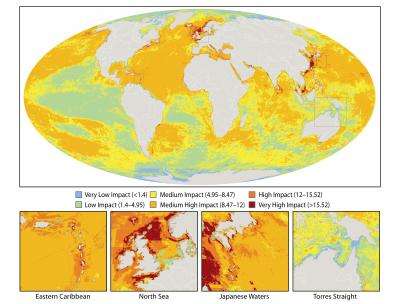
A global map of the overall impact that 17 different human activities are having on marine ecosystems. Insets show three of the most heavily impacted areas in the world [left], and one of the least impacted areas [right]. Credit: Image courtesy of B.S Halpern

As vast and far-reaching as the world’s oceans are, every square kilometer is affected by human activities, according to a study in the journal Science by researchers at the University of North Carolina at Chapel Hill and others.

The international team of scientists integrated global data from 17 aspects of global change – from overfishing to global warming – that threaten 20 different marine ecosystems, such as coral reefs and continental shelves. Similar to an online satellite map that lets you add layers of highways, retail stores, schools, parks, etc., to find the most congested areas or the highest concentration of fast food restaurants, the global threat map highlights areas in the ocean where threats overlap.

The researchers scored the potential threats – from having very-low to very-high impacts – and found that affects were ubiquitous, and more than 40 percent of the oceans experience medium- to very high-impact threats.

“For the first time we can see where some of the most threatened marine ecosystems are and what might be degrading them,” said Elizabeth Selig, an author on the study and a doctoral student in UNC’s curriculum in ecology in the College of Arts and Sciences.

The study, led by Benjamin Halpern at the National Center for Ecological Analysis and Synthesis in Santa Barbara, Calif., was presented today (Feb. 14, 2008) in Boston at the annual meeting of the American Association for the Advancement of Science.

“This study quantifies the extent of the problems that marine scientists have long known to be issues. But it’s not enough to just know something’s a problem,” said John Bruno, associate professor of Marine Sciences at UNC. “If you want to do something about it you have to know where the problems are and what’s causing them.”

“This information enables us to tailor strategies and set priorities for ecosystem management,” Selig said. “And it shows that while local efforts are important, we also need to be thinking about global solutions.”

Selig and Bruno contributed to the study satellite data on global ocean temperatures. The readings were then used to quantify changes in ocean temperature and estimate the threat from global warming. Such data usually covers areas of 50 square kilometers, but this study used a more precise dataset – down to four square kilometers – that Selig, Bruno and Kenneth Casey at the National Oceanic and Atmospheric Administration have worked for years to develop.

“This new database reveals for the first time the magnitude, geographic extent and precise locations of ocean warming. Armed with new information, the research team can now begin to tackle the bigger problem of understanding and forecasting how ocean warming will impact marine ecosystems,” Bruno said.

Future studies will do just that, focusing on what impact the threats have on coral reefs. Previous work by Bruno and Selig have shown how increases in water temperatures of just one or two degrees Celsius cause coral disease outbreaks.

The Science study showed that rising ocean temperatures are the most pervasive threat, and almost half of all the world’s coral reefs have recently experienced medium- to high-level impacts.

“Millions of people around the world depend on marine ecosystems for their livelihood, whether it’s from fishing or tourism, and millions more are affected by erosion, pollution and other disturbance events,” Selig said. “This information will help us make better management decisions.”

Other ecosystems in the study include sea grass, rocky reefs, deep water and mangroves. Other threats included ocean acidification, direct pollution, commercial shipping traffic and nutrient pollution.

According to the study, large areas of the Arctic and Antarctica have sustained very-low level impact, but the study did not measure ice melt due to global warming.

Source: University of North Carolina at Chapel Hill

4.1 /5 (16 votes)  

Filter


Move the slider to adjust rank threshold, so that you can hide some of the comments.


Display comments: newest first

Ragtime
Feb 16, 2008

Rank: not rated yet
This is american study, so it doesn't involve the USA caused contaminations, like this well known floating toxic plastic garbage island twice the size of Texas

http://www.boingb...ast.html
Rank 4.1 /5 (16 votes)
Tags

Relevant PhysicsForums posts
  • Do some geologists actually act a lot like Randy Marsh?
    created22 hours ago
  • Discrepancy between oxygen and carbon-dioxide levels
    createdFeb 09, 2012
  • where gems are found in the world
    createdFeb 09, 2012
  • Wind Waves in Reservoir ~ Wind run-up and Wind set-up
    createdFeb 08, 2012
  • Balance of oxygen in the atmosphere
    createdFeb 01, 2012
  • The case for a methanol-based economy
    createdJan 30, 2012
  • More from Physics Forums - Earth

More news stories

Latin America mining boom clashes with conservation

Latin America is experiencing a mining boom as prices rise fuelled by a hike in global demand, but the region is also being hit by a wave of violent protests, strikes and rallies by environmentalists.

Space & Earth / Environment

created 1 hour ago | popularity not rated yet | comments 0

Europe stakes billion-dollar bet on new rocket

A pencil-slim rocket is scheduled to lift into space from South America on Monday, carrying a billion-dollar bet that Europe can grab a juicy slice of the market to place satellites in low orbit.

Space & Earth / Space Exploration

created 20 hours ago | popularity 4 / 5 (3) | comments 0

Political leaders play key role in how worried Americans are by climate change: study

More than extreme weather events and the work of scientists, it is national political leaders who influence how much Americans worry about the threat of climate change, new research finds.

Space & Earth / Environment

created Feb 06, 2012 | popularity 5 / 5 (6) | comments 72

NASA budget will axe Mars deal with Europe: scientists

US President Barack Obama's budget proposal to be submitted next week for 2013 will cut NASA's budget by 20 percent and eliminate a major partnership with Europe on Mars exploration, scientists said Thursday.

Space & Earth / Space Exploration

created Feb 10, 2012 | popularity 5 / 5 (3) | comments 54

Humans may have helped the decline of African rainforests 3000 years ago

(PhysOrg.com) -- Large areas of rainforests in Central Africa mysteriously disappeared over three thousand years ago, to be replaced by savannas. The prevailing theory has been that the cause was a change ...

Space & Earth / Environment

created Feb 10, 2012 | popularity 4.1 / 5 (14) | comments 20 | with audio podcast report


Google might launch Drive for cloud storage soon

(PhysOrg.com) -- Google's next big move, according to the Wall Street Journal, is a cloud storage service called Drive. Hardly first to the plate, Google is simply catching up to introducing its cloud reposi ...

Love a click away in Indonesia's Twitter Republic

He was a geeky kid from Yogyakarta, she a glamorous city girl in Jakarta. In a country with one of the world's most vibrant social networking scenes they fell in love on Twitter.

Walney offshore wind farm is world's biggest (for now)

(PhysOrg.com) -- The Walney wind farm on the Irish Sea--characterized by high tides, waves and windy weather--officially opened this week. The farm is treated in the press as a very big deal as the Walney ...

GPS court ruling leaves US phone tracking unclear

A US Supreme Court decision requiring a warrant to place a GPS device on the car of a criminal suspect leaves unresolved the bigger issue of police tracking using mobile phones, legal experts say.

Europeans protest controversial Internet pact

Tens of thousands of people marched in protests in more than a dozen European cities Saturday against a controversial anti-online piracy pact that critics say could curtail Internet freedom.

Study finds that anti-diabetic medication can prevent the long-term effects of maternal obesity

In a study to be presented today at the Society for Maternal-Fetal Medicine's annual meeting, The Pregnancy Meeting, in Dallas, Texas, researchers will report findings that show that short therapy with the anti-diabetic medication ...