New materials can selectively capture carbon dioxide
UCLA chemists report a major advance in reducing heat-trapping carbon dioxide emissions in the Feb. 15 issue of the journal Science.
The scientists have demonstrated that they can successfully isolate and capture carbon dioxide, which contributes to global warming, rising sea levels and the increased acidity of oceans. Their findings could lead to power plants efficiently capturing carbon dioxide without using toxic materials.
"The technical challenge of selectively removing carbon dioxide has been overcome," said Omar M. Yaghi, UCLA's Christopher S. Foote Professor of Chemistry and co-author of the Science paper. "Now we have structures that can be tailored precisely to capture carbon dioxide and store it like a reservoir, as we have demonstrated. No carbon dioxide escapes. Nothing escapes — unless you want it to do so. We believe this to be a turning point in capturing carbon dioxide before it reaches the atmosphere."
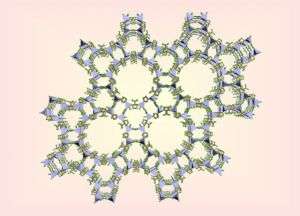
The carbon dioxide is captured using a new class of materials designed by Yaghi and his group called zeolitic imidazolate frameworks, or ZIFs. These are porous and chemically robust structures, with large surface areas, that can be heated to high temperatures without decomposition and boiled in water or organic solvents for a week and still remain stable.
Rahul Banerjee, a UCLA postdoctoral research scholar in chemistry and Anh Phan, a UCLA graduate student in chemistry, both of whom work in Yaghi's laboratory, synthesized 25 ZIF crystal structures and demonstrated that three of them have high selectivity for capturing carbon dioxide (ZIF-68, ZIF-69, ZIF-70).
"The selectivity of ZIFs to carbon dioxide is unparalleled by any other material," said Yaghi, who directs of UCLA's Center for Reticular Chemistry and is a member of the California NanoSystems Institute at UCLA. "Rahul and Anh were so successful at making new ZIFs that, for the purposes of reporting the results, I had to ask them to stop."
The inside of a ZIF can store gas molecules. Flaps that behave like the chemical equivalent of a revolving door allow certain molecules — in this case, carbon dioxide — to pass through and enter the reservoir while blocking larger molecules or molecules of different shapes.
"We can screen and select the one type of molecule we want to capture," Phan said. "The beauty of the chemistry is that we have the freedom to choose what kind of door we want and to control what goes through the door."
"The capture of carbon dioxide creates cleaner energy," Yaghi said. "ZIFs in a smokestack would trap carbon dioxide in the pores prior to its delivery to its geologic storage space."
In ZIFs 68, 69 and 70, Banerjee and Phan emptied the pores, creating an open framework. They then subjected the material to streams of gases -- carbon dioxide and carbon monoxide, for example, and another stream of carbon dioxide and nitrogen — and were able to capture only the carbon dioxide. They are testing other ZIFs for various applications.
Carbon dioxide is killing corral reefs and marine life, damage that will be irreversible, at least for many centuries, Yaghi noted.
Currently, the process of capturing carbon dioxide emissions from power plants involves the use of toxic materials and requires 20 to 30 percent of the plant's energy output, Yaghi said. By contrast, ZIFs can pluck carbon dioxide from other gases that are emitted and can store five times more carbon dioxide than the porous carbon materials that represent the current state-of-art.
"For each liter of ZIF, you can hold 83 liters of carbon dioxide," Banerjee said.
The word zif, Yaghi noted, is used in the Bible to describe a region of splendor. It also means comeliness and brightness. This name is fitting for this new class of materials, he said, because its members are many and of quite beautiful constructions.
On a fundamental level, the invention of ZIFs has also addressed two major challenges in zeolite science. Zeolites are stable, porous minerals made of aluminum, silicon and oxygen that are employed in petroleum refining and are used in detergents and other products. Yaghi's group has succeeded in replacing what would have been aluminum or silicon with metal ions like zinc and cobalt, and the bridging oxygen with imidazolate to yield ZIF materials, whose structures can now be designed in functionality and metrics.
Banerjee and Anh automated the process of synthesis. Instead of mixing the chemicals one reaction at a time and achieving perhaps several reactions per day, they were able to perform 200 reactions in less than an hour. The pair ran 9,600 microreactions and from those reactions uncovered 25 new structures.
"We keep producing new crystals of ZIFs every day," Banerjee said. "These reactions produce crystals that look as beautiful as diamonds."
Co-authors are Bo Wang, a UCLA graduate student in chemistry in Yaghi's laboratory; Carolyn Knobler and Hiroyasu Furukawa of the Center for Reticular Chemistry at the UCLA's California NanoSystems Institute; and Michael O'Keeffe of Arizona State University's department of chemistry and biochemistry.
In the early 1990s, Yaghi invented another class of materials called metal-organic frameworks (MOFs), which have been described as crystal sponges and which also have implications for cleaner energy. Yaghi can change the components of MOFs nearly at will. Like ZIFs, MOFs have pores — openings on the nanoscale in which Yaghi and his colleagues can store gases that are usually difficult to store and transport.
Yaghi's laboratory has made several hundred MOFs, with a variety of properties and structures. Molecules can pass in and out of them unobstructed.
Source: University of California - Los Angeles


