All alone, ammonia and hydrogen chloride use negativity to get attached
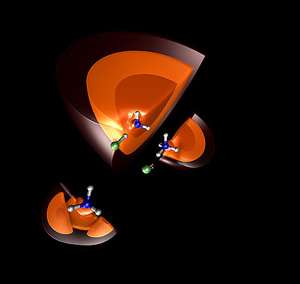
Electrons -- bits of negative energy that shock you when you touch a door handle -- spur the chemical reaction between an acid and a base, according to new results in the journal Science. The findings may help researchers someday precisely control chemistry in systems ranging from biology to energy technology.
The team of experimental and theoretical chemists from three research institutions used two of the simplest acids and bases -- hydrogen chloride and ammonia -- to investigate how the two react to form the product ammonium chloride in the absence of help from their surroundings. The result revealed that supplying or removing an extra electron -- not one already residing in the molecules -- can make the reaction go from acid and base to neutral molecule or back again.
"The dream of chemists is to control chemical reactions," says coauthor Greg Schenter of the Pacific Northwest National Laboratory (PNNL) in Richland, Wash. Adds coauthor Maciej Gutowski, formerly of PNNL and now at the Heriot-Watt University in Edinburgh, UK, "We want the reaction to happen when we want it to happen, and to go along a certain chemical pathway."
"We may be able to use this to get hydrogen out of the solid state, like in hydrogen storage materials," says Schenter. If so, that might lead to economic, safe and practical hydrogen-fueled automobiles. The fundamental result could help illuminate biological reactions as well, such as when radiation damages DNA within cells, says coauthor Kit Bowen of Johns Hopkins University in Baltimore, Md.
"Its value in my mind is that this reaction is a simple prototype. There are some very complicated reactions that occur this way," Bowen says. "It also shows that environmental effects are very important in reactivity."
The reaction is so common in everyday life that students to grandmothers are aware of it in some way. Many people know not to mix window cleaner and toilet bowl cleaner: compounds in each like to react, sometimes giving off dangerous fumes and leaving ammonium chloride in their wake. But what many people don't know is that if you take just one molecule each of the troublemakers, ammonia and hydrogen chloride, the two just can't get their act together.
In water, the reaction between ammonia (NH3) and hydrogen chloride (HCl) is a textbook example of acid-base chemistry most of us learn in high school. By its chemical nature, the nitrogen in ammonia prefers to be attached to four hydrogens rather than the mere three it has, so it steals the hydrogen from hydrogen chloride.
The theft leaves chloride alone and negative. But the nitrogen molecule (now called ammonium) has gained a positive charge from the stolen hydrogen, and that attracts the chloride. The attraction is not as strong as the so-called covalent bond between the nitrogen and its fan base, but the ammonium and chloride form an ionic bond, one that forms when opposites attract. To a chemist, this looks like NH4+Cl-.
But that's in a crowd -- not so in private. Previous research has shown that when one ammonia molecule exists in isolation with one hydrogen chloride molecule, nothing happens. All the necessary, classical components are there: positive hydrogens (also called protons) and negative electrons, but still, nothing happens. Researchers have long suspected additional electrons floating around in the high-volume environment could somehow help the ammonia and hydrogen chloride molecules to react. If so, an ammonium chloride in nature would really look like [NH4+Cl-]-.
"Extra electrons are everywhere," says computational chemist Schenter. "When you rub a balloon in your hair, you knock electrons off your hair and the balloon's surface and you get static electricity. You can't get away from them."
To test the idea, the experimentalists, led by physical chemist Bowen, had to do the reaction in reverse. First, they created a molecule of ammonium chloride adorned with an extra electron -- [NH4+Cl-]-. Using a beam of light, they then measured how easily different colors of light knocked off that electron. Losing the electron leaves behind an offkilter NH4+Cl-, which immediately rearranges into a cozy pair, NH3 and HCl.
With computer programs developed to understand the nature of chemical bonding and structure at the DOE's Environmental Molecular Sciences Laboratory on the PNNL campus, the theory and modeling team took that data and used it to gauge how closely the chloride's hydrogen was sidling up to the ammonia's nitrogen when the extra electron is around. The resulting picture showed how losing the surplus electron can cause ammonia and hydrogen chloride to transform into ammonium chloride.
"It's like a switch," says Schenter. "In the presence of electrons, it behaves one way. Without electrons, it behaves another way."
The researchers solved another riddle as well. Chemists have long wondered about that interaction between that cozy pair, one molecule of ammonia and one molecule of hydrogen chloride. The bond could be either ionic in nature or more like a so-called hydrogen bond, weaker than both ionic and covalent bonds but with characteristics of each. Comparing the data in the absence and presence of electrons, the theoretical team determined the types of arrangements the nitrogen, hydrogens and chloride could be in. From these, they concluded the molecules formed a hydrogen bond.
Understanding the reaction brings hope that chemistry will have a clean future. "If you can control the reaction, you can operate in a safe, environmentally friendly way," Gutowski says.
Source: Pacific Northwest National Laboratory


