Astronomers discover scaled-down Jupiter and Saturn in a faraway solar system like our own
February 14, 2008 Astronomers discover scaled-down Jupiter and Saturn in a faraway solar system like our own

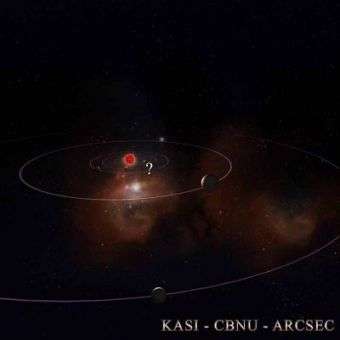
This artist's rendering of a distant solar system shows the location of two newly discovered planets -- one resembling Jupiter (middle right) and one resembling Saturn (bottom). The question mark indicates where an inner system of planets would be located -- if the solar system contained terrestrial planets similar to Earth. Ohio State University astronomers led an international collaboration that published the discovery in the Feb. 15 issue of the journal Science. Image courtesy of Cheongho Han and colleagues at the Korea Astronomy and Space Science Institute

An international team of astronomers has discovered two planets that resemble smaller versions of Jupiter and Saturn in a solar system nearly 5,000 light years away. The find suggests that our galaxy hosts many planetary systems like our own, said Scott Gaudi, assistant professor of astronomy at Ohio State University.

He and his colleagues reported their results in the February 15 issue of the journal Science.

The two planets were revealed when the star they orbit crossed in front of a more distant star as seen from Earth. For a two-week period from late March through early April of 2006, the nearer star magnified the light shining from the farther star.

The phenomenon is called gravitational microlensing, and this was a particularly dramatic example: the light from the more distant star was magnified 500 times.

The Optical Gravitational Lensing Experiment (OGLE) first detected the event, dubbed OGLE-2006-BLG-109, on March 28, 2006. The Microlensing Follow Up Network (MicroFUN), led by Andrew Gould, professor of astronomy at Ohio State, then joined with OGLE to organize astronomers worldwide to gather observations of it. Andrzej Udalski, professor of astronomy at Warsaw University Observatory, is the leader of OGLE.

Gaudi took the lead in analyzing the data as they came in. As he studied the light signal, he saw a distortion that he thought was caused by a Saturn-mass planet. Then, less than a day later, came an additional distortion he wasn't expecting: a "blip" in the signal that appeared to be caused by a second, larger planet orbiting the same star.

Over the next few months, Gaudi demonstrated that this two-planet interpretation was correct. Then David Bennett, a research associate professor of astrophysics and cosmology at the University of Notre Dame, refined Gaudi's preliminary model using sophisticated software, and revealed additional details about the system.

This is the third time a Jupiter-mass planet was found by microlensing, Gaudi explained. In the previous two cases, additional planets would have been very difficult to detect, had they been there.

"This is the first time we had a high-enough magnification event where we had significant sensitivity to a second planet -- and we found one." Gaudi said. "You could call it luck, but I think it might just mean that these systems are common throughout our galaxy."

Astronomers have found two planets at once before, “but using other techniques that don’t pick up on solar systems like ours,” he said.

The newly-discovered planets appear to be gaseous planets like Jupiter and Saturn -- only about 80 percent as big -- and they orbit a star about half the size of the sun. The star is dim and cold compared to ours, issuing only five percent as much light.

Still, the new solar system appears to be a smaller analog of our own. The larger planet is about as massive compared to its star as Jupiter is to ours. The smaller planet shares a similar mass ratio with Saturn.

Also, the smaller planet is roughly twice as far from its star as the larger one, just as Saturn is roughly twice as far away from the sun as Jupiter. Although the star is much dimmer than our sun, temperatures at both planets are likely to be similar to that of Jupiter and Saturn, because they are closer to their star.

“The temperatures are important because these dictate the amount of material that is available for planet formation,” Gaudi said. “Most theorists think that the biggest planet in our solar system formed at Jupiter's location because that is the closest to the sun that ice can form. Saturn is the next biggest because it is in the next location further away, where there is less primordial material available to form planets.”

“Theorists have wondered whether gas giants in other solar systems would form in the same way as ours did. This system seems to answer in the affirmative.”

The fact that astronomers found the planets during the first event that allowed such a detection suggests that these scaled-down versions of our solar system are very common, he added.

Previously, astronomers had found four planets using microlensing; two of those were found by the Ohio State University-based MicroFUN group. The latest two planets make six, and he expects that number to double over the next year as other teams publish new findings.

"We're just getting better at what we do," Gaudi said. "We've hit our stride with this technique."

He has also calculated that the next generation of microlensing experiments -- using telescopes on the ground and in space -- will likely be able to detect analogs to all of our solar system’s planets, except for the tiniest one, Mercury.

The current discovery relied on 11 different ground-based telescopes in countries around the world, including New Zealand, Tasmania, Israel, Chile, the Canary Islands, and the United States.

Both professional and amateur skywatchers joined in. People from three other microlensing collaborations -- the Microlensing Observations in Astrophysics (MOA) Collaboration, the Probing Lensing Anomalies NETwork (PLANET), and the RoboNet Collaboration -- all contributed observations and are co-authors of the study with MicroFUN and OGLE.

Gaudi described this microlensing event as the most complicated one ever studied. The astronomers carefully modeled their data on computers, and explored all possible explanations for the light signal. A year and a half later, they were confident that they’d found two planets. In part, their confidence came from additional observations from the W.M. Keck Observatory in Hawaii, which they used to calculate the mass of the star.

Source: Ohio State University


print this article email this article download pdf blog this article bookmark this article     Stumble it Digg this share on Facebook retweet share on Reddit add to delicious
Rate this story - 4.5 /5 (49 votes)

Rank Filter

Move the slider to adjust rank threshold, so that you can hide some of the comments.


Display comments: newest first

  • EarthScientist - Feb 14, 2008
    • Rank: 1 / 5 (7)
    There are 54 galaxies in our universe and we call each one a flower,our sun is also the sun for system 26 and 7. We are system 28 and so all of the planets you folks are observing are tone planets that create the gases and grid field cymatics from their mass and speed.Mars as you know has a 24 hour day and was our other habitable planet on our flower.So cmon guys ,get with the science of the grid. It surely will help you with your process.
  • Soylent - Feb 15, 2008
    • Rank: 5 / 5 (6)
    EarthScientist, please seek professional help.
  • Algaholic - Feb 15, 2008
    • Rank: not rated yet
    I have to agree with you Soylent.
  • TexasMeteorites - Feb 15, 2008
    • Rank: 1 / 5 (1)
    I was trying to figure out what part of this story was actually news. The notion that we can see distant planets and galaxies through the telescope is nothing new.

    Cordially,
    S. Ray DeRusse

    www.bccmeteorites.com
  • Ashibayai - Feb 15, 2008
    • Rank: not rated yet
    Actually it is. There are relatively few extrasolar planets that we know about and far fewer that we have found through this gravitational lensing technique. Most of them haven't even been observed, but rather inferred from the motion of stars.
  • TexasMeteorites - Feb 17, 2008
    • Rank: 3 / 5 (3)
    Employing a series of common sense sets and subsets of visual data to explain and interpret a phenomenon is nothing new in any scientific endeavor. This article is like saying Christopher Columbus discovered America. Really? There are many observable extra-solar planets just because they have not been tagged and labeled does not mean they don't exist.

    " Previously, astronomers had found four planets using microlensing; two of those were found by the Ohio State University-based MicroFUN group. The latest two planets make six, and he expects that number to double over the next year as other teams publish new findings."

    Cordially,
    S. Ray DeRusse

    http://www.bccmet...ary.html
  • srikkanth_kn - Feb 25, 2008
    • Rank: not rated yet
    We have been hearing many of such discoveries. Having "discovered", we donot hear anything more about it like the planets approximate atmospheric composition and etc.

February 14, 2008 all stories

Comments: 7

4.5 /5 (49 votes)
  • Stumble this up

  • Digg this

  • share this

  • hide
  • Related Stories


  • hide
  • Relevant PhysicsForums posts

  • Question about 2-body gravity
    created Nov 24, 2009
  • life on Mars
    created Nov 24, 2009
  • Semi-major axis from cartesian co-ordinates
    created Nov 23, 2009
  • Primary Mirror grinding
    created Nov 23, 2009
  • dark energy can escape black holes.
    created Nov 23, 2009
  • Are there green, purple and pink stars?
    created Nov 22, 2009
  • More from Physics Forums - General Astronomy

Other News

Monster Waves on the Sun are Real

Monster Waves on the Sun are Real (w/ Video)

Space & Earth / Astronomy

created 16 hours ago | popularity 4.8 / 5 (13) | comments 1

Sometimes you really can believe your eyes. That's what NASA's STEREO (Solar Terrestrial Relations Observatory) spacecraft are telling researchers about a controversial phenomenon on the sun known as the "solar ...


Russia: no space for space tourists (AP)

Russia: no space for space tourists

Space & Earth / Space Exploration

created 3 hours ago | popularity 2.5 / 5 (2) | comments 2

(AP) -- A top Russian space official says there is no space for tourists wishing to fly to the International Space Station.


Climate experts debate strategies for reducing atmospheric carbon and future warming

Climate experts debate strategies for reducing atmospheric carbon and future warming

Space & Earth / Environment

created 16 hours ago | popularity 2.6 / 5 (7) | comments 10

(PhysOrg.com) -- Reducing carbon dioxide to safe levels may require extracting carbon from the air, says Cornell climate researcher.


Cosmic 'dig' reveals vestiges of the Milky Way's building blocks

Cosmic 'Dig' Reveals Vestiges of the Milky Way's Building Blocks

Space & Earth / Astronomy

created 20 hours ago | popularity 4.9 / 5 (15) | comments 1

(PhysOrg.com) -- Peering through the thick dust clouds of our galaxy's "bulge" (the myriads of stars surrounding its center), a team of astronomers has unveiled an unusual mix of stars in the stellar grouping ...


Cutting greenhouse pollutants could directly save millions of lives worldwide

Space & Earth / Environment

created 22 hours ago | popularity 2.2 / 5 (10) | comments 6

Tackling climate change by reducing carbon dioxide and other greenhouse emissions will have major direct health benefits in addition to reducing the risk of climate change, especially in low-income countries, according to ...