Protein maintains cross talk between cells that control hair growth
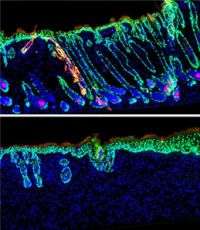
Genes, it turns out, are only as active as the signals that turn them on and off. Now scientists from Rockefeller University and the Howard Hughes Institute have identified the signaling molecule that ratchets up and clamps down the activity of key genes in dermal papilla, a type of skin cell whose unique collection of proteins ultimately instruct epithelial stem cells to make hair.
The research, which will be published in the February 15 issue of Genes & Development, highlights the cross talk between these two cell types and how this signaling molecule, a protein called BMP, is crucial for this exchange.
Epithelial stem cells nest in the upper portion of the adult hair follicle, and dermal papilla reside nearby in the mesenchymal layer below them. It is thought that the communication signals between the two cell types instruct the stem cells to form hair follicles during embryogenesis, and then, when these follicles have matured, regulate their cycles of hair growth and regeneration. "Scientists don't know how dermal papilla cells are programmed to provide the instructive signals to stem cells, but now we know that BMP signals play a crucial role," says Michael Rendl, who conducted this work while he was a postdoc in Elaine Fuchs's Laboratory of Mammalian Cell Biology and Development.
For several years, it has been known that BMP signaling must be reduced in order to activate follicle stem cells. "Michael has now uncovered a new twist to the story," says Fuchs, who is Rebecca C. Lancefield Professor at Rockefeller and an investigator at the Howard Hughes Medical Institute, "namely that dermal papilla cells appear to receive BMP signals from their surrounding microenvironment and this signaling is required for these two cell types to maintain cross talk."
Fuchs conducted the study with Rendl, who found that BMP6, a member of the BMP family of proteins, orchestrates dermal papilla's signature genes to turn on and off, thereby giving these skin cells their unique collection of proteins and features.
Fuchs's team developed a clever strategy to delete several genes in vitro, ones that encode for the receptor onto which several BMPs bind. They then grafted these genetically engineered dermal papilla cells onto the backs of bald mice to see if these mice would grow hair.
Well, the mice didn't. When dermal papilla cells lacked this receptor, their signature proteins were not expressed and the key signaling that occurs between epithelial stem cells and dermal papilla was impaired. Without this exchange, the hair follicles did not grow or make hair.
Nearly all of the signature proteins that Rendl and Fuchs tested in dermal papilla cells decreased when they deleted the BMP receptor. The exception: BMP6 itself. This increase in BMP6 expression levels suggests that BMP6 is necessary for both locking in dermal papilla's molecular identity as well as maintaining the crosstalk that allows stem cells to receive hair-inducing signals, but it itself is not the signal that stem cells await. This finding also provides clues to the type of signals that follicle stem cells may send to dermal papilla.
What's more, BMP6 specifically maintains the molecular identity of dermal papilla cells. When Rendl and Fuchs induced the BMP pathway in other cell types that respond to BMP signaling, they found that these cells continue to produce the normal amount of their signature proteins. "This was really interesting," says Rendl. "It is likely the case that different signaling pathways, or a combination of them, regulate different sets of genes to give each cell type in the hair follicle its characteristic properties."
Fuchs speculates that "this complex circuitry in BMP signaling may set the foundations for a BMP regulatory clock that drives the hair cycle. If so, we may be one step closer to unlocking nature's secrets to hair growth."
Source: Rockefeller University


