Michigan laser beam believed to set record for intensity
February 15, 2008
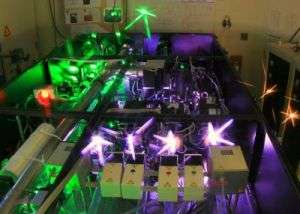
The new amplifier of the HERCULES laser fires. The laser is now capable of producing a beam so intense scientists believe it sets a world record. Credit: Anatoly Maksimchuk, associate research scientist in the Department of Electrical Engineering and Computer Science
If you could hold a giant magnifying glass in space and focus all the sunlight shining toward Earth onto one grain of sand, that concentrated ray would approach the intensity of a new laser beam made in a University of Michigan laboratory.
"That's the instantaneous intensity we can produce," said Karl Krushelnick, a physics and engineering professor. "I don't know of another place in the universe that would have this intensity of light. We believe this is a record."
The pulsed laser beam lasts just 30 femtoseconds. A femtosecond is a millionth of a billionth of a second.
Such intense beams could help scientists develop better proton and electron beams for radiation treatment of cancer, among other applications.
The record-setting beam measures 20 billion trillion watts per square centimeter. It contains 300 terawatts of power. That's 300 times the capacity of the entire U.S. electricity grid. The laser beam's power is concentrated to a 1.3-micron speck about 100th the diameter of a human hair. A human hair is about 100 microns wide.
This intensity is about two orders of magnitude higher than any other laser in the world can produce, said Victor Yanovsky, a research scientist in the U-M Department of Electrical Engineering and Computer Science who built the ultra-high power system over the past six years.
The laser can produce this intense beam once every 10 seconds, whereas other powerful lasers can take an hour to recharge.
"We can get such high power by putting a moderate amount of energy into a very, very short time period," Yanovsky said. "We're storing energy and releasing it in a microscopic fraction of a second."
To achieve this beam, the research team added another amplifier to the HERCULES laser system, which previously operated at 50 terawatts.
HERCULES is a titanium-sapphire laser that takes up several rooms at U-M's Center for Ultrafast Optical Science. Light fed into it bounces like a pinball off a series of mirrors and other optical elements. It gets stretched, energized, squeezed and focused along the way.
HERCULES uses the technique of chirped pulse amplification developed by U-M engineering professor emeritus Gerard Mourou in the 1980s. Chirped pulse amplification relies on grooved surfaces called diffraction gratings to stretch a very short duration laser pulse so that it lasts 50,000 times longer. This stretched pulse can then be amplified to much higher energy without damaging the optics in its path. After the beam is amplified to a higher energy by passing through titanium-sapphire crystals, an optical compressor reverses the stretching, squeezing the laser pulse until it's close to its original duration. The beam is then focused to ultra-high intensity.
In addition to medical uses, intense laser beams like these could help researchers explore new frontiers in science. At even more extreme intensities, laser beams could potentially "boil the vacuum," which scientists theorize would generate matter by merely focusing light into empty space. Some scientists also see applications in inertial confinement fusion research, coaxing low-mass atoms to join together into heavier ones and release energy in the process.
A paper on this research, "Ultra-high intensity 300-TW laser at 0.1 Hz repetition rate," is published online in the journal Optics Express. The full text is available at http://www.opticsi … e-16-3-2109. Yanovsky and Krushelnick are authors of the paper.
Source: University of Michigan
-
Infrared detector unmasks cocaine addicts
Jan 11, 2012 |
4.5 / 5 (2) |
4
-
The next big step toward atom-specific dynamical chemistry
Jan 06, 2012 |
5 / 5 (8) |
0
-
'Reversing the problem' clarifies molecular structure
Dec 23, 2011 |
4 / 5 (3) |
0
-
New spectroscopy technique enables investigation of two-dimensional electron states
Dec 22, 2011 |
5 / 5 (1) |
1
-
CNST collaboration demonstrates nanoscale focused ion beam employing laser-cooled lithium atoms
Dec 15, 2011 |
not rated yet |
0
-
Engineers build first sub-10-nm carbon nanotube transistor
Feb 01, 2012 |
5 / 5 (21) |
19
-
Something old, something new: Evolution and the structural divergence of duplicate genes
Jan 31, 2012 |
4.6 / 5 (7) |
1
-
The hidden nanoworld of ice crystals: Revealing the dynamic behavior of quasi-liquid layers
Jan 30, 2012 |
5 / 5 (2) |
1
-
Stock market network reveals investor clustering
Jan 27, 2012 |
4.1 / 5 (21) |
8
-
Of microchemistry and molecules: Electronic microfluidic device synthesizes biocompatible probes
Jan 26, 2012 |
not rated yet |
0
-
Are space and time things?
4 hours ago
-
Lock Magnet
8 hours ago
-
Neutrino interaction/detection?
12 hours ago
-
If an atom was scaled up to the size of a sports oval with a diameter of 150m...?
13 hours ago
-
Why no noise is added when we hear someone's voice from the other side of a wall?
16 hours ago
-
Force components between two bodies
21 hours ago
- More from Physics Forums - General Physics
More news stories
Renowned physicist invents microscope that can peer at living brain cells
(PhysOrg.com) -- Ever since scientists began studying the brain, theyve wanted to get a better look at what was going on. Researchers have poked and prodded and looked at dead cells under electron microscopes, ...
New kind of high-temperature photonic crystal could someday power everything from smartphones to spacecraft
A team of MIT researchers has developed a way of making a high-temperature version of a kind of materials called photonic crystals, using metals such as tungsten or tantalum. The new materials which ...
16 hours ago |
4.9 / 5 (12) |
4
|
Searching for a solid that flows like a liquid
(PhysOrg.com) -- A series of neutron scattering experiments at Oak Ridge National Laboratory and other research centers is exploring the key question about a long-sought quantum state of matter called supersolidity: ...
13 hours ago |
3 / 5 (1) |
7
|
Optics get magnetic powers
For decades, scientists have studied a class of materials called multiferroics in which static electric and magnetic structures are coupled to each other. This allows capabilities such as controlling ...
13 hours ago |
5 / 5 (1) |
0
Manipulating the texture of magnetism
Knowing how to control the combined magnetic properties of interacting electrons will provide the basis to develop an important tool for advancing spintronics: a technology that aims to harness these properties ...
14 hours ago |
5 / 5 (2) |
0
Amazon fungi found that eat polyurethane, even without oxygen
(PhysOrg.com) -- Until now polyurethane has been considered non-biodegradable, but a group of students from Yale University in the US has found fungi that will not only eat and digest it, they will do so even in the absence ...
Scientists chart high-precision map of Milky Way's magnetic fields
(PhysOrg.com) -- Scientists at the Naval Research Laboratory (NRL) are part of an international team that has pooled their radio observations into a database, producing the highest precision map to date of ...
Whole exome sequencing identifies cause of metabolic disease
Sequencing a patient's entire genome to discover the source of his or her disease is not routine yet. But geneticists are getting close.
Hearing metaphors activates brain regions involved in sensory experience
When a friend tells you she had a rough day, do you feel sandpaper under your fingers? The brain may be replaying sensory experiences to help understand common metaphors, new research suggests.
Discovery of extremely long-lived proteins may provide insight into cell aging
One of the big mysteries in biology is why cells age. Now scientists at the Salk Institute for Biological Studies report that they have discovered a weakness in a component of brain cells that may explain ...
Hackers intercept FBI, Scotland Yard call (Update)
(AP) -- Trading jokes and swapping leads, investigators from the FBI and Scotland Yard spent the conference call strategizing about how to bring down the hacking collective known as Anonymous, responsible ...
Feb 15, 2008
Rank: 5 / 5 (3)
Feb 15, 2008
Rank: 5 / 5 (2)
30 fs * 300 TW = 9 Joules per shot.
Feb 16, 2008
Rank: 5 / 5 (2)
Feb 17, 2008
Rank: 3 / 5 (4)
Yeah the usual BS for the public, who might wonders, what good that does. It may cure cancer. Or may not!
Do physicist have to lie now, to get funding for their toys ? Apparently so.
Feb 17, 2008
Rank: 5 / 5 (25)
Feb 25, 2008
Rank: not rated yet
Yeah but its not really a lie its just a very improbable statement i dont like it either.
The real problem is public ignorance.
I think we might reach the limit of democracy soon, since with the pace technology develops and with the impact it has on our lives a general uneducated public (or ignorant politicians) are not longer in position to make any informed decisions.
I hope humanity can develop a governing body populated by scientists representing various disciples and acting in our best interests.