Mars Rovers Sharpen Questions About Livable Conditions
February 15, 2008 Mars Rovers Sharpen Questions About Livable Conditions

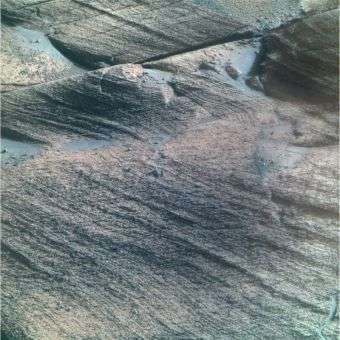
This view from NASA's Mars Exploration Rover Opportunity shows bedrock within a stratigraphic layer informally named "Lyell," which is the lowermost of three layers the rover has examined at a bright band around the inside of Victoria Crater. Image credit: NASA/JPL-Caltech/Cornell University

Like salt used as a preservative, high concentrations of dissolved minerals in the wet, early-Mars environment known from discoveries by NASA's Opportunity rover may have thwarted any microbes from developing or surviving.

"Not all water is fit to drink," said Andrew Knoll, a member of the rover science team who is a biologist at Harvard University, Cambridge, Mass.

Opportunity and its twin, Spirit, began their fifth year on Mars last month, far surpassing their prime missions of three months. Today, at a meeting of the American Association for the Advancement of Science in Boston, scientists and engineers discussed new observations by the rovers, recent analysis of some earlier discoveries, and perspectives on which lessons from these rovers' successes apply to upcoming missions to Mars.

"The engineering efforts that have enabled the rovers' longevity have tremendously magnified the science return," said Steve Squyres of Cornell University, Ithaca, N.Y., principal investigator for the rovers' science payload. "All of Spirit's most important findings, such as evidence for hot springs or steam vents, came after the prime mission."

Opportunity spent recent months examining a bright band of rocks around the inner wall of a crater. Scientists previously hypothesized this material might preserve a record of the ground surface from just before the impact that excavated the crater. Inspection suggests that, instead, it was at the top of an underground water table, Squyres reported.

Experiments with simulated Martian conditions and computer modeling are helping researchers refine earlier assessments of whether the long-ago conditions in the Meridiani area studied by Opportunity would have been hospitable to microbes. Chances look slimmer. "At first, we focused on acidity, because the environment would have been very acidic," Knoll said. "Now, we also appreciate the high salinity of the water when it left behind the minerals Opportunity found. This tightens the noose on the possibility of life."

Conditions may have been more hospitable earlier, with water less briny, but later conditions at Meridiani and elsewhere on the surface of Mars appear to have been less hospitable, Knoll said. "Life at the Martian surface would have been very challenging for the last 4 billion years. The best hopes for a story of life on Mars are at environments we haven't studied yet -- older ones, subsurface ones," he said.

NASA's current rovers and orbiters at Mars pursue the agency's "follow the water" theme for Mars exploration. They decipher the roles and fate of water on a planet whose most striking difference from Earth is a scarcity of water. "Our next missions, Phoenix and Mars Science Laboratory, mark a transition from water to habitability -- assessing whether sites where there's been water have had conditions suited to life," said Charles Elachi, director of NASA's Jet Propulsion Laboratory, Pasadena, Calif. "Where conditions were habitable, later missions may look for evidence of life."

Elachi cited the achievements of Spirit and Opportunity. "They have worked 16 times longer than planned, driven 20 times farther than planned, and, most important, found diverse geological records of the effects of water in ancient Martian environments," he said. "We must not let these successes lull us into thinking this type of exploration is easy. Fifty years into the Space Age, we are still in the golden age of robotic exploration of our solar system, when each mission is unprecedented in some way as we push the limits of what is possible. Each mission presents new challenges."

The Phoenix lander, on course to reach Mars on May 25, will assess habitability of a shallow subsurface environment of icy soil farther north than any earlier mission has landed. It revives technology from missions launched before Spirit and Opportunity. The following mission, the Mars Science Laboratory rover, will incorporate many lessons from the current rovers, said that project's manager, Richard Cook of JPL. "The next rover will be much bigger to carry the instruments necessary for meeting its goals, but it would be laughable to consider doing Mars Science Laboratory without the experience gained from doing the Mars Exploration Rovers," he said.

The Mars Science Laboratory rover will weigh about four times as much as Spirit or Opportunity. "There's no way we could use an airbag landing," said JPL's Rob Manning, chief engineer for the future rover. Instead, a rocket-powered hovering stage will lower it to the surface on a tether. Lessons from Spirit and Opportunity will come into play when it starts driving, though. "With the current rovers, we've learned we can trust the autonomous navigation technology to a level we never expected, so now we can include that as a capability in our mission design for Mars Science Laboratory," Manning said.

Source: NASA


print this article email this article download pdf blog this article bookmark this article     Stumble it Digg this share on Facebook retweet share on Reddit add to delicious
Rate this story - 4.8 /5 (32 votes)

Rank Filter

Move the slider to adjust rank threshold, so that you can hide some of the comments.


Display comments: newest first

  • weewilly - Feb 16, 2008
    • Rank: 2 / 5 (1)
    Truly amazing science. What will happen there in the future is being bought and paid for by the robots we send now. Very interesting discoveries but not finding any microbes so far by reason of the acidity does not take into the fact that we in relatively recent times found new microbes that do indeed live in extremely harsh enviroments of heat and acidic surroundings. So why would we preclude that because of the high mineral deposits found on the surface of Mars, there would be none??? Perhaps it might look dismal but I would not say no to microbes being there. I guess we will find out someday when someone there gets a cut finger. Then what????
  • SDMike - Feb 16, 2008
    • Rank: 1 / 5 (2)
    For all those scientists that believe life is the result of random events and therefore must occur everywhere, it is interesting to see them back peddling and explaining away their previous certainty. According to their logic, life should have evolved on Mars. If the conditions were different then life should have evolved differently to suit those conditions. Their inconsistency is amusing.
  • MarkG - Feb 16, 2008
    • Rank: 4 / 5 (1)
    Andrew Knoll seems unaware of extremophiles.
    All to often the specialists can't see outside "their" box.

February 15, 2008 all stories

Comments: 3

4.8 /5 (32 votes)
  • Stumble this up

  • Digg this

  • share this

  • hide
  • Related Stories

  • A Mars Rover Named 'Curiosity'
    created Oct 30, 2009 | popularity not rated yet | comments 0
  • NASA is 'go' for crucial rocket test
    created Oct 25, 2009 | popularity not rated yet | comments 0
  • Scientists work to free Mars rover Spirit
    created Oct 13, 2009 | popularity not rated yet | comments 0
  • Seeking Life's Shadow
    created Oct 01, 2009 | popularity not rated yet | comments 0
  • New robot travels across the seafloor to monitor the impact of climate change on deep-sea ecosystems
    created Sep 14, 2009 | popularity not rated yet | comments 0


  • hide
  • Relevant PhysicsForums posts

  • Supernova's Gamma Rays and Comets
    created 15 hours ago
  • Our Moon
    created 18 hours ago
  • Question about a Carl Zeiss lens
    created Nov 05, 2009
  • Origin of planets
    created Nov 05, 2009
  • Q?
    created Nov 02, 2009
  • Mercury not travelling in a straight line?
    created Nov 02, 2009
  • More from Physics Forums - General Astronomy

Other News

'Dropouts' pinpoint earliest galaxies

'Dropouts' pinpoint earliest galaxies

Space & Earth / Astronomy

created 9 hours ago | popularity 3.8 / 5 (6) | comments 3

Astronomers, conducting the broadest survey to date of galaxies from about 800 million years after the Big Bang, have found 22 early galaxies and confirmed the age of one by its characteristic hydrogen signature ...


Kepler

Kepler Mission Update

Space & Earth / Space Exploration

created 11 hours ago | popularity 4.8 / 5 (4) | comments 0

(PhysOrg.com) -- Kepler completed another science data download over October 18-19. In this download, a month's worth of science data was transmitted through the NASA Deep Space Network and into the Science ...


Station Prepares For New Spacecraft, Monitors Debris

Station Prepares For New Spacecraft, Monitors Debris

Space & Earth / Space Exploration

created 8 hours ago | popularity 5 / 5 (1) | comments 2

The station crew prepared Friday for the arrival of the Russian Mini-Research Module 2 (MRM2) which is scheduled for launch from the Baikonur Cosmodrome, Kazakhstan on Nov. 10. The MRM2 will arrive at the ...


The politics of climate fixes

The politics of climate fixes

Space & Earth / Environment

created 10 hours ago | popularity 1.6 / 5 (7) | comments 6

In the middle of a day filled with a stream of information-packed PowerPoint displays and alarming projections of what the future holds for our planet and our civilization, Judith Layzer’s talk was something ...


Mars: Chaotic terrain between Kasei Valles and Sacra Fossae

Mars: Chaotic terrain between Kasei Valles and Sacra Fossae

Space & Earth / Space Exploration

created 13 hours ago | popularity 4.6 / 5 (5) | comments 0

(PhysOrg.com) -- Mars Express flew over the boundary between Kasei Valles and Sacra Fossae and imaged the region, acquiring spectacular views of the chaotic terrain in the area.