Past greenhouse warming events provide clues to what the future may hold
If carbon dioxide emissions from the burning of fossil fuels continue on a "business-as-usual" trajectory, humans will have added about 5 trillion metric tons of carbon to the atmosphere by the year 2400. A similarly massive release of carbon accompanied an extreme period of global warming 55 million years ago known as the Paleocene-Eocene Thermal Maximum (PETM).
Scientists studying the PETM are piecing together an increasingly detailed picture of its causes and consequences. Their findings describe what may be the best analog in the geologic record for the global changes likely to result from continued carbon dioxide emissions from human activities, according to James Zachos, professor of Earth and planetary sciences at the University of California, Santa Cruz.
"All the evidence points to a massive release of carbon at the PETM, and if you compare it with the projections for anthropogenic carbon emissions, it's roughly the same amount of carbon," Zachos said. "The difference is the rate at which it was released--we're on track to do in a few hundred years what may have taken a few thousand years back then."
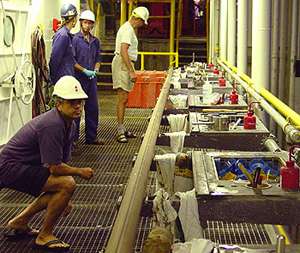
Zachos and his collaborators have been studying marine sediments deposited on the deep ocean floor during the PETM and recovered in sediment cores by the Integrated Ocean Drilling Program. He will discuss their findings, which reveal drastic changes in ocean chemistry during the PETM, in a presentation at the annual meeting of the Association for the Advancement of Science (AAAS) in Boston on Friday, February 15. His talk is part of a symposium entitled "Ocean Acidification and Carbon-Climate Connections: Lessons from the Geologic Past."
The ocean has the capacity to absorb huge amounts of carbon dioxide from the atmosphere. But as carbon dioxide dissolves in the ocean, it makes the water more acidic. That, in turn, could make life more difficult for corals and other marine organisms that build shells and skeletons out of calcium carbonate.
Technically, the "acidification" is a lowering of the pH of ocean water, moving it closer to the acidic range of the pH scale, although it remains slightly alkaline. Lowering the pH affects the chemical equilibrium of the ocean with respect to calcium carbonate, reducing the concentration of carbonate ions and making it harder for organisms to build and maintain structures of calcium carbonate. Corals and some other marine organisms use a form of calcium carbonate called aragonite, which dissolves first, while many others build shells of a more resistant form called calcite.
"As the carbonate concentration starts to decrease, it becomes harder for some organisms to build their shells. They have to use more energy, and eventually it's impossible--in laboratory experiments, they precipitate some shell during the day, and overnight it dissolves," Zachos said. "If you lower the carbonate concentration enough, corals and eventually even calcite shells start to dissolve."
The effect of ocean acidification on the chemistry of calcium carbonate is reflected in the sediment cores from the PETM. Marine sediments are typically rich in calcium carbonate from the shells of marine organisms that sink to the seafloor after they die. Sediments deposited at the start of the PETM, however, show an abrupt transition from carbonate-rich ooze to a dark-red clay layer in which the carbonate shells are completely gone (see earlier press release).
Ocean acidification starts at the surface, where carbon dioxide is absorbed from the atmosphere, and spreads to the deep sea as surface waters mix with deeper layers. The calcium carbonate in marine sediments on the seafloor provides a buffer, neutralizing the increased acidity as the shells dissolve and enabling the ocean to absorb more carbon dioxide. But the mixing time required to bring acidified surface waters into the deep sea is long--500 to 1,000 years, according to Zachos.
"We are adding all this carbon dioxide in less than one mixing cycle. That's important for how the ocean buffers itself, and it means the carbonate concentration in surface waters will get low enough to affect corals and other organisms, assuming emissions continue on the current trajectory," he said.
In a recent article in Nature (January 17, 2008), Zachos and coauthors Gerald Dickens of Rice University and Richard Zeebe of the University of Hawaii provided an overview of the PETM and other episodes of greenhouse warming in the past 65 million years. These "natural experiments" can help scientists understand the complex interactions that link the carbon cycle and the climate.
Christina Ravelo, a professor of ocean sciences at UCSC and coorganizer of the symposium at which Zachos will speak, said climate records preserved in seafloor sediments provide a valuable test for the climate models scientists use to predict the future consequences of greenhouse gas emissions.
"There are no exact analogs in the past for what is happening now, but we can use past climates to test the models and improve them," Ravelo said. "The ocean drilling program is the only way to get really good records of these past warm periods."
Current climate models tend to have difficulty replicating the features of warm periods in the past, such as the PETM, she said. "Even though the models do a great job of simulating the climate over the past 150 years, the future probably holds many climatic surprises. As you run the models farther into the future, the uncertainties become greater."
A particular concern over the long run is the potential for positive feedback that could amplify the initial warming caused by carbon dioxide emissions. For example, one possible cause of the PETM is the decomposition of methane deposits on the seafloor, which could have been triggered by an initial warming. Methane hydrates are frozen deposits found in the deep ocean near continental margins. Methane released from the deposits would react with oxygen to form carbon dioxide. Both compounds are potent greenhouse gases.
"We have some new evidence that there was a lag between the initial warming and the main carbon excursion of the PETM," said Zachos, who is a coauthor of a paper describing these findings in the December 20/27, 2007, issue of Nature. "It's consistent with the notion of a positive feedback, with an initial warming causing the hydrates to decompose," he said.
Although this raises the possibility that the current global warming trend might trigger a similar release of methane from the ocean floor, that would not happen any time soon. It would take several centuries for the warming to reach the deeper parts of the ocean where the methane hydrate deposits are, Zachos said.
"By slowing the rate of carbon emissions and warming, we may be able to avoid triggering a strong, uncontrolled positive feedback," he said.
Source: University of California, Santa Cruz


