Brain waves pattern themselves after rhythms of nature
February 15th, 2008 Brain waves pattern themselves after rhythms of nature

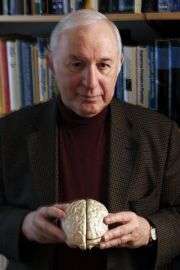
Jack Cowan works primarily to understand the workings of the brain. He uses mathematical theory to understand how neural circuits generate stable patterns of activity. Photo by Dan Dry

The same rules of physics that govern molecules as they condense from gas to liquid, or freeze from liquid to solid, also apply to the activity patterns of neurons in the human brain. University of Chicago mathematician Jack Cowan will offer this and related insights on the physics of brain activity this week in Boston during the annual meeting of the American Association for the Advancement of Science.

“Structures built from a very large number of units can exhibit sharp transitions from one state to another state, which physicists call phase transitions,” said Cowan, a Professor in Mathematics and Neurology at Chicago. “Strange and interesting things happen in the neighborhood of a phase transition.”

When liquids undergo phase transitions, they evaporate into gas or freeze into ice. When the brain undergoes a phase transition, it moves from random to patterned activity. “The brain at rest produces random activity,” Cowan said, or what physicists call “Brownian motion.”

Although the bulk of his work involves deriving equations, Cowan’s findings mesh well with laboratory data generated on the cerebral cortex and electroencephalograms. His latest findings show that the same mathematical tools physicists use to describe the behavior of subatomic particles and the dynamics of liquids and solids can now be applied to understanding how the brain generates its various rhythms.

These include the delta waves generated during sleep, the alpha waves of the visual brain, and the gamma waves, discovered during the last decade, which seem related to information processing. “The resting state of brain activity seems to have a statistical structure that’s characteristic of a certain kind of phase transition,” Cowan said. “The brain likes to sit there because that’s the place where information processing is optimized.”

Cowan organized a session for AAAS on Mathematics and the Brain, which will take place from 8:30 to 10 a.m. EST Saturday, Feb. 16. He also will participate in a news briefing on the topic at 3 p.m. EST Friday, Feb. 15. Joining him at both events will be mathematician Nancy Kopell of Boston University and computational neuroscientist Tomaso Poggio of the Massachusetts Institute of Technology.

At this stage of his research, Cowan said it would be premature and speculative for him to try to relate how phase transitions in the brain might relate to neurological conditions or states of human consciousness. “That’s for the future,” he said.

Another component of his latest research is the close relationship between spontaneous pattern formation in brain circuits and in chemical reaction networks. In this research, he shows how mathematics can help explain visual hallucinations and how the visual cortex obtained its stripes, which are visible to the naked eye when removed from cadavers.

“This line of research on pattern formation can be traced back to Alan Turing, who also founded the modern science of computation,” said Terrence Sejnowski of the Salk Institute for Biological Studies in La Jolla, Calif., who is a leading specialist in computational neurobiology.

Cowan’s quest to understand the brain’s workings using numerical methods spans more than four decades. Along the way he has collaborated with a series of Ph.D. students and colleagues in physics, mathematics, biology and neuroscience.

In 1972, he and postdoctoral fellow Hugh Wilson, now of Canada’s York University, formulated a set of equations that could describe the dynamics of neural networks. Now called “Wilson-Cowan equations,” they became a mainstay of neural network research. “But I always knew that those equations were inadequate, so I kept thinking about them,” Cowan said.

Then in 1985, he ran across an article in a Japanese journal that described a statistical physics approach to chemical reaction networks. “It took me years to understand how to use these tools for biological networks,” he said. “It so happens that there is an analogy between the behavior of chemical reaction networks and neural networks.”

His research career began in 1962, when as a graduate student in electrical engineering, he worked with the founders of neural network theory. These included Norbert Wiener, who died in 1964, before they could work jointly on the problem that Cowan continues to address.

Source: University of Chicago


print this article email this article download pdf blog this article bookmark this article     Digg this Stumble it share on Facebook share on Reddit add to delicious save to Yahoo! bookmarks
4.2/5 after 35 votes

Rank Filter

Move the slider to adjust rank threshold, so that you can hide some of the comments.


Display comments: newest first

  • shyataroo - Feb 15, 2008
    • Rank: not rated yet
    this isn't at all surpising, in fact I thought that this was the truth this entire time.
  • am_Unition - Feb 15, 2008
    • Rank: not rated yet
    I would be extremely interested to hear how/if he thinks electromagnetic fields interact with the brain and body. Also, using known nuclear magnetic resonance frequencies for various molecular structures in biologoy and factoring in the Earth's variable magnetic field (over extremely long time spans) could uncover some interesting things about biological evolution, and perhaps even evolution of our consciousness. Consider that the Earth's magnetic field was 10% stronger 150 years ago. Certainly on the nano-scale this could influence biological dynamics and interactions, which could consequently influence the macro-scale entity.
  • EarthScientist - Feb 16, 2008
    • Rank: 1 / 5 (3)
    Oh my , this could be fun ,but alas, this old tasker who understands many of the processes of the dot and understands the processes of hyperdimension and the effects that are just parts of the science of creation.We work on frequency and are powered by the aether AND ANY MANIFESTATIONS THAT PEOPLE OBSERVE ARE JUST THE TIP OF THE ICEBERG.
  • Ragtime - Feb 16, 2008
    • Rank: not rated yet
    By my idea, the neural network in brain can really create a quantum waves of neural activity, which are interacting mutualy and they can form colliding virtual particles, which are composed of areas of increased neural electrochemical activity (so called the mentions).

    http://superstrun...wave.gif

    Another point is, as these particles are formed by charged ions in motion (sort of cold plasma), they can form the gravitodynamic waves, which can propagate at the distance and to induce the simmilar waves in the neighboring brains, tuned for the same structures. Such particles can form a material base of so called "soul", but the another phenomena as well, for example so called ball lightning or telepathy or telekinesis.

    This idea follows from Aether Wave Theory, which considers the vacuum as a foam, which gets more dense after introducing of energy in whatever form by the same way, like soap foam. And the blobs of dense foam are behaving like inertial particle. Note the Aharamov-Bohm effect for lab-tested example of such action.

February 15th, 2008 all stories
Other Sciences / Mathematics

Comments: 4
Rank: 4.2/5 after 35 votes

  • Stumble this up

  • Digg this

  • Share it:
  • share on Facebook
  • share on MySpace
  • share on Slashdot
  • rss-newsfeed
  • share on Google
  • share on Reddit
  • add to delicious
  • save to Yahoo! bookmarks
  • share on Windows Live
  • Add to Mixx!
Rating: 4.2/5 after 35 votes

  • Related Stories

  • Study identifies biomarker that safely monitors tumor response to new brain cancer treatment
    created Jul 01, 2009 | popularity not rated yet | comments 0
  • 'Neurologger' reads bird brains in flight
    created Jun 25, 2009 | popularity not rated yet | comments 0
  • Sleep helps build long-term memories
    created Jun 24, 2009 | popularity not rated yet | comments 0
  • Imaging the hypnotized brain: Neural mechanisms of suggested paralysis
    created Jun 24, 2009 | popularity not rated yet | comments 0
  • New mechanisms of action found for drugs used to treat anxiety disorders
    created Jun 23, 2009 | popularity not rated yet | comments 0

Tags


  • Physicists Demonstrate Quantum Memory with Matter Qubits
    Physicists Demonstrate Quantum Memory with Matter Qubits
    Physics / General Physics
    created Jul 03, 2009 | popularity 4.4 / 5 (17) | comments 1
  • 'Holey' Nanosheets for Wastewater Dye Removal
    Nanotechnology / Nanomaterials
    created Jul 01, 2009 | popularity 5 / 5 (5) | comments 1
  • Jellyfish Robot Swims Like its Biological Counterpart
    Jellyfish Robot Swims Like its Biological Counterpart
    Electronics / Robotics
    created Jun 26, 2009 | popularity 4.4 / 5 (8) | comments 1
  • Could Maxwell's Demon Exist in Nanoscale Systems?
    Could Maxwell's Demon Exist in Nanoscale Systems?
    Physics / General Physics
    created Jun 24, 2009 | popularity 4.4 / 5 (18) | comments 29
  • Living Safely with Robots, Beyond Asimov's Laws
    Living Safely with Robots, Beyond Asimov's Laws
    Electronics / Robotics
    created Jun 22, 2009 | popularity 4.6 / 5 (54) | comments 40
  • Other News

    Creation Museum president Ken A. Ham

    Paleontologists brought to tears, laughter by Creation Museum

    Other Sciences / Other

    created Jun 30, 2009 | popularity 4.1 / 5 (46) | comments 127

    For a group of paleontologists, a tour of the Creation Museum seemed like a great tongue-in-cheek way to cap off a serious conference.


    Mummified dinosaur skin yields up new secrets

    Mummified dinosaur skin yields up new secrets

    Other Sciences / Archaeology & Fossils

    created Jul 01, 2009 | popularity 4.7 / 5 (17) | comments 10

    (PhysOrg.com) -- Scientists from The University of Manchester have identified preserved organic molecules in the skin of a dinosaur that died around 66-million years ago.


    Liberal? Conservative? Stanford study says mental nudge can make voters flip-flop

    Liberal? Conservative? Stanford study says mental nudge can make voters flip-flop

    Other Sciences / Social Sciences

    created Jul 02, 2009 | popularity 3.8 / 5 (6) | comments 4

    (PhysOrg.com) -- No doubt you’ve worked hard for your success. But chances are you’ve also had some help and lucky breaks along the way.


    Probing Question: How do Ponzi Schemes work?

    Other Sciences / Economics

    created Jul 02, 2009 | popularity 5 / 5 (2) | comments 2

    Imagine the shock, the horror, and the sheer panic that would come with learning that the financial plan you’d sunk your life savings into was a sham, the financial experts you trusted were crooks, and all your money was ...


    New fossil primate suggests common Asian ancestor, challenges primates such as 'Ida'

    New fossil primate suggests common Asian ancestor, challenges primates such as 'Ida'

    Other Sciences / Archaeology & Fossils

    created Jul 01, 2009 | popularity 4.4 / 5 (11) | comments 0

    According to new research published online in the Proceedings of the Royal Society B (Biological Sciences) on July 1, 2009, a new fossil primate from Myanmar (previously known as Burma) suggests that the co ...