Many, perhaps most, nearby sun-like stars may form rocky planets
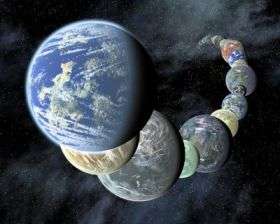
Astronomers have discovered that terrestrial planets might form around many, if not most, of the nearby sun-like stars in the disk of our galaxy. These new results suggest that worlds with potential for life might be more common than thought.
University of Arizona astronomer Michael Meyer led a Legacy Science Program with NASA's Spitzer Space Telescope to determine whether planetary systems like ours are common or rare in the Milky Way galaxy. Meyer and his colleagues found that at least 20 percent, and possibly as many as 60 percent, of stars similar to the sun are candidates for forming rocky planets.
Meyer is presenting the findings at the annual meeting of the American Association for the Advancement of Science tomorrow. The results appear in the Feb. 1, 2008, issue of Astrophysical Journal Letters.
Members of the research team include John Carpenter of the California Institute of Technology, Eric Mamajek of the Harvard-Smithsonian Center for Astrophysics and 11 other astronomers from the United States and Germany.
The astronomers surveyed six groups of stars with masses comparable to our sun using Spitzer, which includes an instrument built at UA's Steward Observatory by a team led by Professor George Rieke. The stars were grouped by age, ranging from three-to-10 million years, 10-to-30 million years, 30-to-100 million years, 100-to-300 million years, 300 million to one billion years and one-to-three billion years old.
"We wanted to study the evolution of the gas and dust around stars similar to the sun and compare the results with what we think the solar system looked like at earlier stages during its evolution," Meyer said. The sun is about 4.6 billion years old.
The Spitzer telescope detects dust at a range of infrared wavelengths. The hottest dust, at temperatures more than 2,000 degrees Fahrenheit, is detected at the shortest wavelengths, between 3.6 microns and 8 microns. Cool dust, about minus 380 degrees Fahrenheit, is detected at the longest wavelengths, between 70 microns and 160 microns. Warm dust, between minus 280 and 80 degrees Fahrenheit, can be traced at 24 micron wavelengths.
Because dust closer to the star is hotter than dust farther from the star, the warm dust likely traces material orbiting the star at distances comparable to distances between Earth and Jupiter around our star, the sun.
"We found that about 10 to 20 percent of the stars in each of the four youngest age groups shows 24 micron emission due to dust," Meyer said. "But we don't often see warm-dust around stars older than 300 million years. The frequency just drops off. That's comparable to the time scales thought to span the formation and dynamical evolution of our own solar system," he added. "Theoretical models and meteoritic data suggest that Earth formed over 10-to-50 million years from collisions between smaller bodies."
In a separate study, Thayne Currie and Scott Kenyon of the Smithsonian Astrophysical Observatory in Cambridge, Mass., and their team including Rieke and Zoltan Balog of the UA, also found evidence of dust from terrestrial planet formation around stars from 10-to-30 million years old. "Our evidence suggests that similar processes could be occurring around stars between 3 million and 300 million years old," Meyer said.
Kenyon and Ben Bromley of the University of Utah have developed planet formation models that provide a plausible scenario. Their models predict warm dust would be detected at 24 micron wavelengths during planet formation, as small rocky bodies collide and merge, creating larger rocky bodies, eventually assembling the asteroids, moons and planets.
Kenyon said, "Our work suggests that the warm dust Meyer and colleagues detect is a natural outcome of rocky planet formation. We predict a higher frequency of dust emission for the younger stars, just as Spitzer observes."
The numbers on how many stars form planets are ambiguous because there's more than one way to interpret the Spitzer data, Meyer said.
The warm-dust emission that Spitzer observed around 20 percent of the youngest cohort of stars could persist as the stars age. That is, the warm dust generated by collisions around three-to-10 million year old stars could carry over and show up as warm dust emission seen around stars in the 10-to-30 million year old range and so on. Interpreting the data this way, at least one out of five sun-like stars is potentially planet-forming, Meyer said.
There's another way to interpret the data."An optimistic scenario would suggest that the biggest, most massive disks would undergo the runaway collision process first and assemble their planets quickly. That's what we could be seeing in the youngest stars. Their disks live hard and die young, shining brightly early on, then fading," Meyer said. "However, smaller, less massive disks will light up later. Planet formation in this case is delayed because there are fewer particles to collide with each other," he said.
If this is correct and the most massive disks form their planets first and the wimpiest disks take 10 to 100 times longer, then as many as 62 percent of the surveyed stars have formed, or may be forming, planets. "The correct answer probably lies somewhere between the pessimistic case of less than 20 percent and optimistic case of more than 60 percent," Meyer said.
The next critical test for evidence that terrestrial planets could be common around stars like the sun will come next year with the launch of NASA's Kepler mission. Kepler will detect the tiny dips in the amount of light seen as planets pass in front of their stars.
The Giant Magellan Telescope, one in a new generation of extremely large ground-based telescopes, could also play a role in determining how many neighboring sun-like stars are forming rocky planets, Meyer said.
The Giant Magellan Telescope, known as the GMT, is slated for completion in 2016 in a site in northern Chile. It will use seven 8.4-meter primary mirrors arranged as a hexagon on a single mount. The telescope will have the resolution, or light-resolving power, equivalent to a telescope with a single 24.5-meter, or 80-foot diameter, primary mirror.
UA astronomer Phil Hinz, who has been pioneering adaptive optics systems to improve seeing with the new giant ground-based telescopes, said "Imaging and spectroscopically characterizing an Earth-like planet is an incredibly difficult task. But if Earth-like planets really are this common, we might just be able to take the first picture of another Earth with the GMT. It's an exciting prospect!"
Source: University of Arizona


